Main Points :
- Ethereum has evolved from a programmable blockchain into a global public infrastructure supporting finance, identity, and governance.
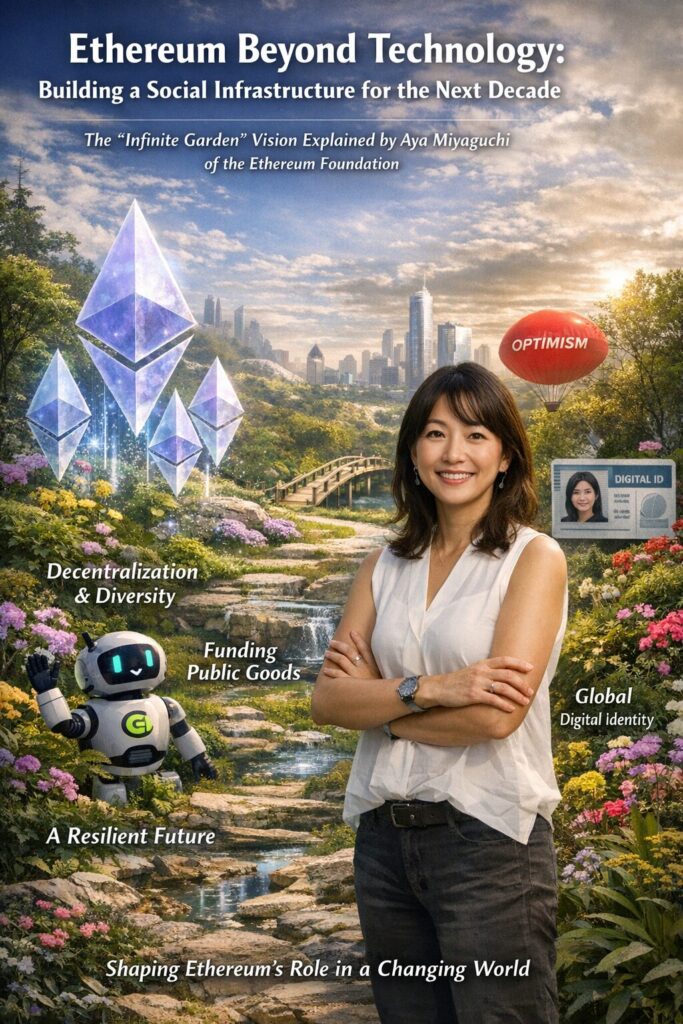
- Under **Ethereum Foundation President Aya Miyaguchi, Ethereum’s mission is no longer purely technical, but societal.
- The concept of the “Infinite Garden” explains Ethereum’s resilience through diversity, decentralization, and open participation.
- Funding mechanisms such as Gitcoin and Optimism demonstrate Ethereum’s unique public-goods economy.
- Real-world implementations—such as national digital identity systems—signal Ethereum’s shift toward long-term social deployment.
- The next decade will define Ethereum’s role as a defensive and constructive layer for an increasingly unstable world.
1. From a White Paper to a Global Infrastructure
In 2013, Vitalik Buterin published a white paper that challenged the limitations of Bitcoin. While Bitcoin excelled as a monetary system, it lacked flexibility as a platform for applications. Ethereum was conceived as a solution: a decentralized, programmable infrastructure where anyone could build.
When Ethereum’s mainnet launched in July 2015, few anticipated that it would become the backbone for decentralized finance (DeFi), stablecoins exceeding $150 billion in circulation globally, non-fungible tokens (NFTs), decentralized autonomous organizations (DAOs), and on-chain research ecosystems.
Importantly, Ethereum’s growth was not driven by a rigid master plan. Instead, it evolved organically through the participation of developers, researchers, communities, and institutions worldwide. This unpredictability, Miyaguchi argues, is not a weakness—it is Ethereum’s defining strength.
Ethereum resembles the internet’s TCP/IP: a protocol layer whose true societal impact emerges only after decades of experimentation.
2. Ethereum at 10 Years: Achievements and Structural Challenges
After a decade of operation, Ethereum has established itself as the dominant blockchain ecosystem by developer activity and total value settled. Yet Miyaguchi emphasizes that social penetration remains incomplete.
Scalability, usability, privacy, and governance are still evolving. While Layer-2 solutions have dramatically reduced transaction costs—often to less than $0.05 per transaction—the user experience remains complex for non-technical audiences.
Ethereum today sits at an inflection point: technically mature, economically significant, but still early in its role as a social foundation.
3. From a Tech Project to a Social Foundation
In 2025, the Ethereum Foundation underwent a significant organizational transformation. Miyaguchi transitioned from Executive Director to President—a role better described as a long-term steward of Ethereum’s vision.
The Foundation’s structure now separates:
- Vision and philosophy (Board, including Miyaguchi and Buterin)
- Execution and operations (Executive Directors)
This shift reflects Ethereum’s expanded scope. Decentralization cannot be achieved through blockchain technology alone. It requires coordination with adjacent fields such as:
- Open-source artificial intelligence
- Privacy-preserving cryptography
- Public digital infrastructure
- Governance and policy design
Ethereum is no longer just “a blockchain.” It is becoming a coordination layer for decentralized society.
4. The “Infinite Garden” Philosophy
Miyaguchi describes Ethereum as an “Infinite Garden.”
Unlike centralized platforms that deliver finished products, Ethereum offers an open environment where growth is unpredictable and collective. Multiple clients, independent teams, and competing ideas coexist—much like species in a natural ecosystem.
This diversity ensures resilience. No single failure can collapse the system. Innovation emerges not from control, but from openness.
The Two Core Goals
Together with Vitalik Buterin, Miyaguchi articulated two priorities:
- Increase meaningful users
Not just more wallets—but users who benefit from Ethereum’s core values: openness, privacy, and censorship resistance. - Strengthen ecosystem resilience
Sustainability through decentralization of funding, governance, and infrastructure support.
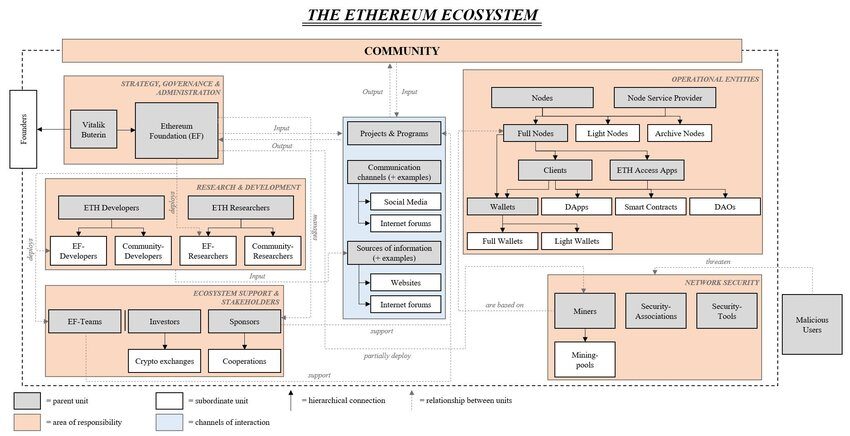
Ethereum “Infinite Garden” Ecosystem Map
5. Reinventing Public-Goods Funding on Ethereum
Ethereum’s public infrastructure is supported by diverse funding models beyond the Ethereum Foundation itself.
Programs such as Gitcoin quadratic funding rounds and Optimism’s Retroactive Public Goods Funding (RPGF) allocate tens of millions of dollars annually to open-source developers, research teams, and social infrastructure.
No single model dominates. Instead, experimentation continues—another hallmark of the Infinite Garden.
This pluralism is unique among blockchains and has enabled Ethereum to remain adaptable over ten years.
6. CROPS: The Values That Must Not Be Compromised
In 2025, Miyaguchi introduced the acronym CROPS:
- Censorship Resistance
- Research & Open Source
- Openness
- Privacy
- Security
As Ethereum adoption grows, commercial pressures increase. CROPS serves as a reminder that sacrificing core values for short-term growth undermines Ethereum’s purpose.
7. Real-World Deployment: National Digital Identity
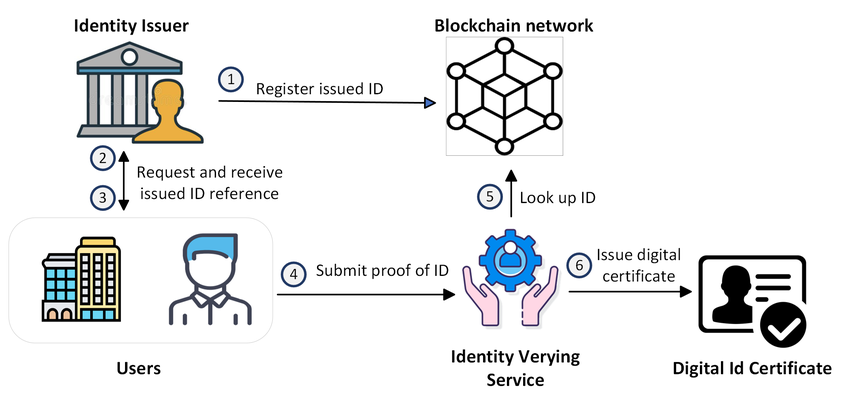
Ethereum’s transition from experimentation to societal deployment is exemplified by its use in national digital identity systems, including projects in Bhutan.
These systems:
- Do not rely on centralized government servers
- Enhance privacy and cryptographic security
- Operate as long-term public infrastructure
Such implementations demonstrate Ethereum’s viability beyond finance—into governance, identity, and public trust systems.
Blockchain-Based Digital Identity Architecture
8. Beyond Finance: A Broader Regulatory Dialogue
Miyaguchi cautions against framing blockchain solely through financial regulation. While AML and financial oversight are important, excessive focus on finance ignores blockchain’s broader societal roles.
A privacy-less society creates new risks. Governance must operate at a higher conceptual layer—balancing security, privacy, and decentralization.
Ethereum’s challenge is to communicate this nuance to regulators worldwide.
9. Why Privacy and Security Matter More Than Ever
In an increasingly unstable global environment, blockchain offers both preventive and defensive capabilities:
- Transparent systems reduce corruption
- Decentralized governance limits power concentration
- Cryptography protects individual autonomy
Ethereum’s emphasis on privacy and security is not ideological—it is pragmatic.
10. Japan’s Role in the Next Decade
Japan’s culture of trust, craftsmanship, and long-term thinking aligns naturally with Ethereum’s resilience-focused philosophy. Events like ETHTokyo demonstrate this alignment.
Miyaguchi emphasizes the importance of:
- Nurturing cryptographic talent
- Maintaining regulatory flexibility
- Encouraging young people to explore non-financial Web3 domains
Conclusion: Ethereum as a Long-Term Social Substrate
Ethereum’s next decade will not be defined by price charts alone. Its success will be measured by how deeply it integrates into society—as infrastructure that supports fairness, resilience, and freedom.
The Infinite Garden remains unfinished. And that, Miyaguchi suggests, is precisely the point.