Main Points :
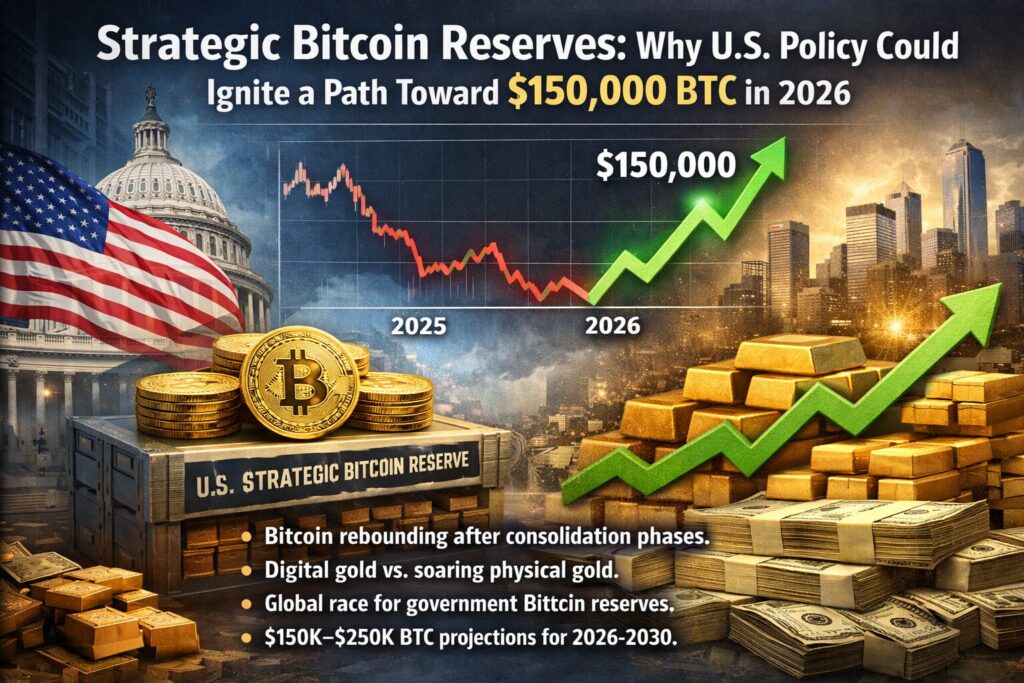
- Market analysts argue that a U.S. Strategic Bitcoin Reserve could act as a structural price floor and a powerful catalyst for Bitcoin’s next major rally.
- Despite a 7% year-to-date decline in 2025, historical patterns suggest Bitcoin often rebounds strongly after consolidation years.
- Bitcoin’s role as “digital gold” is under scrutiny, especially as physical gold has surged more than 70% in the same period.
- Government-led accumulation of Bitcoin could trigger a global strategic reserve race, amplifying demand far beyond private-sector buying.
- Major financial institutions project $150,000–$250,000 BTC scenarios for 2026–2030, conditional on macro stability and policy follow-through.
1. The $150,000 Bitcoin Thesis Backed by a U.S. Strategic Reserve
In late December 2025, U.S.-based market analyst Dominic Basult drew renewed attention to Bitcoin’s long-term upside, projecting that BTC could reach $150,000 in 2026. His argument rests not on speculative hype, but on what he views as a fundamentally new market force: the strategic involvement of the U.S. government as a Bitcoin holder.
At present, Bitcoin trades in a range of approximately $86,000–$90,000, down nearly 30% from its October all-time high. While such a drawdown might appear alarming to short-term traders, Basult emphasizes that the broader structural foundations of the market remain intact. Liquidity, institutional infrastructure, and regulatory clarity—particularly in the United States—have all improved markedly compared with previous cycles.
Basult argues that Bitcoin’s 2025 correction resembles earlier consolidation phases that preceded strong multi-year rallies. From this perspective, the current market environment is not a breakdown, but a pause—one that could set the stage for a 75% appreciation into 2026.
Central to this outlook is the concept of U.S. strategic Bitcoin accumulation, a policy shift that introduces a sovereign buyer with long-term, non-speculative incentives.
2. U.S. Policy and the 2026 Bitcoin Price Outlook
2.1 Historical Patterns of Bitcoin Rebounds
Bitcoin’s historical price behavior provides context for why a sharp rebound is not an outlier scenario. Since 2012, Bitcoin has recorded multiple years with annual gains exceeding 100%. Even during periods considered weak by market standards, performance has often surprised to the upside.
For example:
- In 2015, widely viewed as a bearish year, Bitcoin still posted a 36% annual gain.
- After collapsing 74% in 2018, Bitcoin rebounded by 95% in 2019, driven by renewed institutional interest and macro uncertainty.
Basult notes that 2025’s 7% decline mirrors these historical “reset” years rather than the start of prolonged bear markets. In his view, 2026 could echo 2019—a year defined by recovery, narrative shifts, and expanding participation.
2.2 Bitcoin as a Store of Value: A Challenge to the “Digital Gold” Narrative

Despite bullish structural arguments, Bitcoin’s identity as a store of value is being actively questioned. The divergence between Bitcoin and gold performance in 2025 is striking: while BTC declined modestly, gold surged approximately 73%, reaching new all-time highs.
This divergence has reinforced the perception among some investors that Bitcoin remains a risk asset, rather than a safe haven. In times of geopolitical tension and monetary uncertainty, capital has flowed into physical gold rather than digital alternatives.
Basult cautions that unless Bitcoin reestablishes credibility as a long-term value preservation tool, it risks losing strategic capital to traditional assets. In his words, “If investors continue to treat Bitcoin purely as a high-beta trade, gold will remain the default hedge.”
For Bitcoin to justify valuations above $150,000, it must regain trust not only as a growth asset, but as monetary infrastructure for the digital age.
3. The Strategic Bitcoin Reserve and Its Market Impact
3.1 The U.S. Government’s Bitcoin Strategy
In March 2025, U.S. President Donald Trump signed an executive order establishing a Strategic Bitcoin Reserve. The reserve is initially funded by approximately 200,000 BTC seized through criminal and civil forfeiture proceedings.
Crucially, the order allows for future Bitcoin acquisitions under a “budget-neutral” framework. While early market reactions were mixed—some investors expressed disappointment that immediate open-market purchases were not announced—Basult highlights remarks by U.S. Treasury Secretary Scott Bessent, which left the door open to future accumulation.
If the U.S. Treasury were to begin systematic Bitcoin purchases, the implications would be profound. Unlike private investors, governments can operate on multi-decade horizons, dramatically altering supply-demand dynamics.
3.2 A Global Domino Effect: Strategic Reserves Beyond the U.S.
The U.S. move has already sparked international responses. In May 2025, Pakistan publicly announced that it was exploring the creation of a national Bitcoin reserve, citing the need to diversify sovereign assets in a rapidly digitizing global economy.
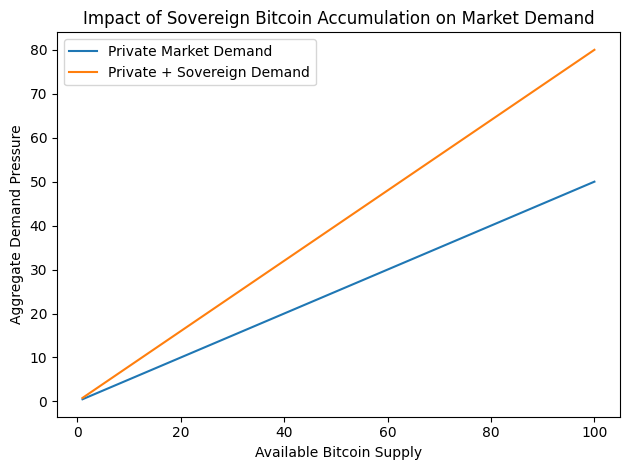
According to Basult, this is where the true leverage lies. A single government’s purchases are significant, but multiple sovereign buyers competing for a scarce asset could create a powerful feedback loop. Unlike corporate treasury strategies, sovereign accumulation has geopolitical and game-theoretical implications.
“Once one major power legitimizes Bitcoin as a strategic asset, others cannot afford to ignore it,” Basult argues.
4. Industry Support for Government Bitcoin Accumulation
Prominent figures within the cryptocurrency industry have voiced strong support for sovereign Bitcoin reserves.
In March 2025, Cameron Winklevoss, co-founder of Gemini, stated that national Bitcoin accumulation is no longer optional, but a matter of game theory and national security. He emphasized that early movers benefit from lower acquisition costs, while late adopters risk paying significantly higher prices.
Similarly, Brian Armstrong, CEO of Coinbase, has advocated for a Bitcoin-only national digital asset reserve, arguing that Bitcoin remains the most credible successor to gold due to its fixed supply and decentralized architecture.
These endorsements reinforce the narrative that Bitcoin is transitioning from a speculative instrument to strategic financial infrastructure.
5. Signals of a 2020-Style Bull Market
Several analysts have noted similarities between current market conditions and those of 2020, when Bitcoin entered a powerful bull cycle fueled by monetary expansion and institutional adoption.
Large holders continue to accumulate BTC during price weakness, while derivatives markets suggest declining volatility—an indicator often associated with maturing assets.
6. Institutional Forecasts for Bitcoin in 2026 and Beyond
Major financial institutions have also weighed in:
- JPMorgan Chase strategists suggested Bitcoin could reach $170,000 within 6–12 months, assuming volatility converges toward gold-like levels.
- Fundstrat co-founder Tom Lee maintains a long-term target of $250,000 by the end of 2026.
- Standard Chartered, while revising down earlier projections, still expects Bitcoin to reach $150,000 by 2026 and $500,000 by 2030.
Each forecast is conditional on sustained institutional flows, regulatory clarity, and macroeconomic stability.
Conclusion: Is $150,000 Bitcoin Realistic?
The case for $150,000 Bitcoin in 2026 is not built on speculation alone. It rests on a convergence of historical patterns, institutional adoption, and—most importantly—state-level participation.
However, Basult is clear that this outcome is not guaranteed. It requires:
- Expansion of U.S. strategic Bitcoin holdings,
- Policy alignment among other major economies,
- And a renewed perception of Bitcoin as a reliable store of value.
If these conditions are met, the next phase of Bitcoin’s evolution may be defined not by retail speculation, but by sovereign balance sheets. 📊 Figure Insertion Guide (for your production use)
[Insert Figure 1 here]
“Bitcoin vs Gold Performance (2024–2025, USD)”
→ Line chart comparing BTC price and gold price indexed to 100.
[Insert Figure 2 here]
“Potential Impact of Sovereign Bitcoin Accumulation”
→ Supply-demand diagram showing government buying pressure.