Main Points :
- Bitcoin’s traditional four-year cycle may be breaking down as institutional capital reshapes market structure.
- Spot Bitcoin ETFs, regulatory clarity, and large-scale tokenization are altering demand dynamics.
- Volatility is structurally declining as slow-moving institutional allocators replace momentum-driven retail traders.
- The market may shift from violent boom-bust cycles to a long-term, stair-step growth pattern.
- Bitcoin’s role is evolving from a speculative asset to a strategic hedge against fiat debasement.
Introduction: A Market at a Turning Point
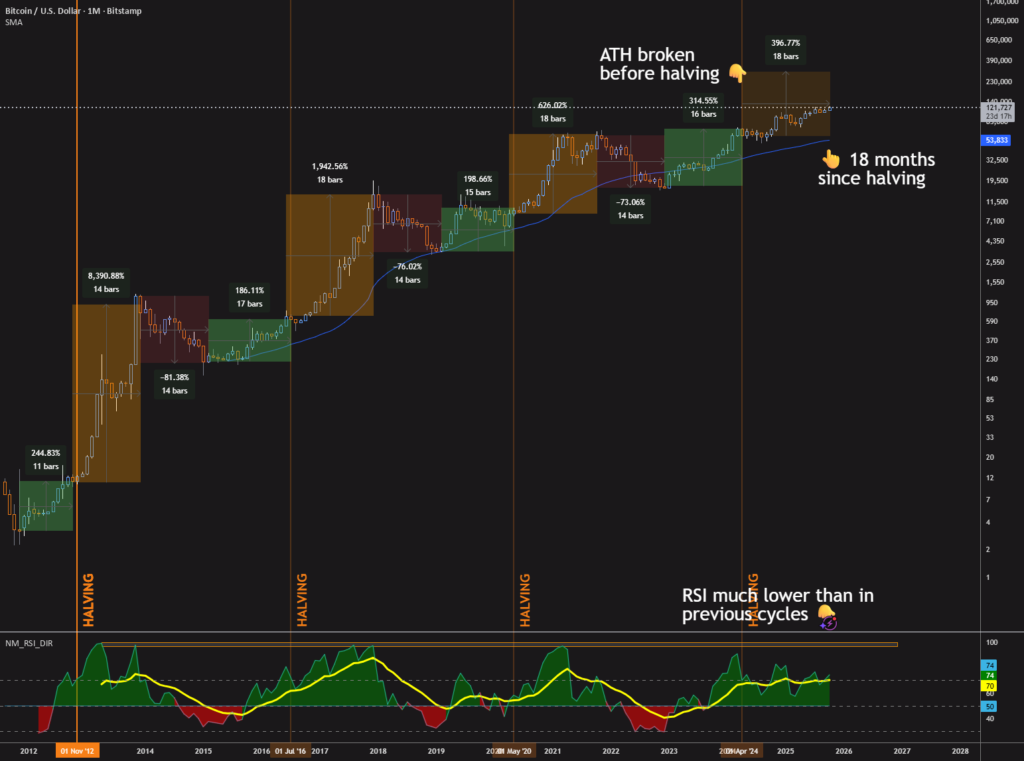
For more than a decade, Bitcoin has been widely understood through the lens of the “four-year cycle”—a pattern tied closely to Bitcoin’s halving events, speculative excess, and subsequent crashes. This framework has guided traders, miners, and investors alike, shaping expectations of euphoric rallies followed by brutal drawdowns.
However, as Bitcoin moves deeper into global financial infrastructure, a growing number of institutional voices argue that this cycle-based worldview is becoming obsolete. According to Bitwise, the launch of spot Bitcoin ETFs and accelerating regulatory clarity in the United States may have triggered a fundamental regime shift—one that could define Bitcoin’s trajectory for the next decade.
This article examines whether Bitcoin has truly entered a sustained structural bull market, how institutional investors are transforming volatility and time horizons, and why tokenization and on-chain finance could generate entirely new cycles beyond anything seen in 2017 or 2021.
The Claimed End of the Four-Year Cycle
In a recent interview on CNBC Television, Bitwise CIO Matt Hougan argued that Bitcoin’s historical four-year cycle has effectively ended. In his view, the launch of spot Bitcoin ETFs in January 2024 created an entirely new demand engine—one driven not by speculative retail flows, but by strategic, long-term institutional capital.
Hougan emphasizes that regulatory developments since early 2025 have further accelerated this shift. Bitcoin is no longer a legally ambiguous asset hovering between commodity and security status. Instead, it is increasingly embedded within regulated investment frameworks, complete with licensed custodians, compliance-grade reporting, and ETF wrappers familiar to pension funds, endowments, and wealth managers.
In parallel, the explosive growth of stablecoins and real-world asset (RWA) tokenization is overpowering the halving-driven dynamics that once defined Bitcoin’s rhythm. These forces, Hougan argues, are strong enough to support sustained upside through at least 2026 and beyond.
Behavioral Cycles Still Matter
Not everyone is ready to declare the four-year cycle dead.
Sebastian Bea, CIO of ReserveOne, agrees that the classic cycle no longer makes theoretical sense in a market dominated by institutional players. Yet he cautions that markets are ultimately driven by human behavior—and humans are often irrational.
Retail investors, algorithmic traders, and even professional allocators still anchor their expectations to historical narratives. This psychological inertia can continue to generate cyclical patterns, even when the original structural drivers have weakened.
From Bea’s perspective, declaring the absolute end of cycles may itself be premature. Instead, the market may be entering a hybrid regime where structural demand rises steadily, but episodic volatility still emerges from collective behavior.
Tokenization: A Catalyst for the Next Cycle
One of the most consequential developments discussed by Bea is the announcement by Depository Trust Corporation that it plans to tokenize assets representing approximately $99 trillion in value.
This figure dwarfs anything seen in prior crypto cycles. Unlike the speculative ICO booms of 2017 or DeFi summer in 2021, this wave of on-chain activity is rooted in traditional capital markets infrastructure. Importantly, the tokenization rollout is expected to begin in earnest around mid-2026.
Bea suggests that while Bitcoin’s old halving-driven cycle may fade, tokenization itself could introduce a new kind of cycle—one driven by institutional adoption timelines, regulatory approvals, and settlement efficiency gains rather than pure speculation.
“Bitcoin Market Drivers – From Halving Cycles to Institutional Infrastructure”
Declining Volatility and Diverging Time Horizons
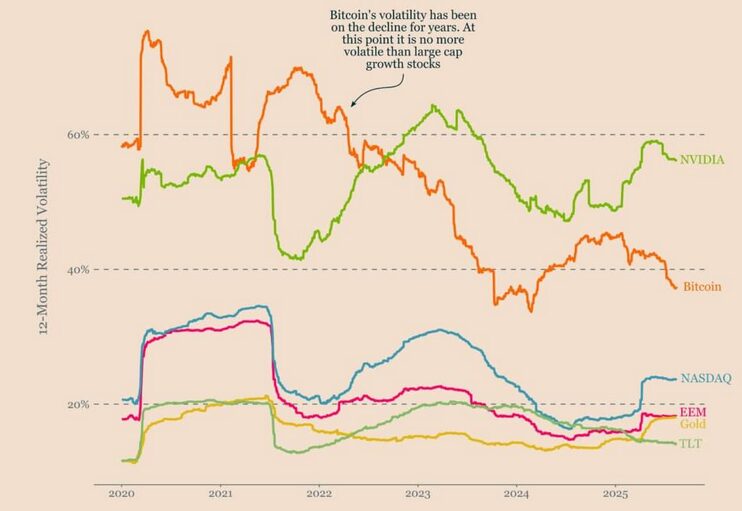
A defining feature of Bitcoin’s current phase is declining volatility—a trend that would have seemed unthinkable just a few years ago.
Bea explains this shift through the contrasting behaviors of retail and institutional investors. Retail traders tend to buy aggressively during price surges and sell during downturns, amplifying volatility. Institutional investors, by contrast, allocate capital based on strategic asset allocation models embedded in investment policy statements.
Once Bitcoin is approved within such frameworks, capital flows become slow, methodical, and persistent—smoothing price action over time.
Hougan notes that over the past year, Bitcoin’s realized volatility has fallen below that of NVIDIA, a benchmark often associated with high-growth equity risk. This inversion signals a profound transformation: Bitcoin is no longer behaving like a speculative tech proxy, but increasingly like a macro asset.
“Harvard Buys, Retail Sells”
One of Hougan’s most striking observations is encapsulated in a simple phrase: “Harvard buys, retail sells.”
Following Bitcoin’s new all-time high in 2025, prices retraced—but only by roughly 30%, far less than the 60–80% drawdowns typical of prior cycles. Hougan attributes this resilience to slow-moving institutional demand absorbing supply from fast-moving retail traders who exited early, fearing a repeat of past cycle collapses.
This dynamic creates what Hougan describes as a “stairs up, elevator down” pattern: gradual upward progress punctuated by sharp but shallow corrections. The coexistence of two investor classes operating on radically different time horizons explains much of Bitcoin’s current market behavior.
Why Institutions Move So Slowly
To understand why institutional influence takes time to materialize, Hougan highlights two concrete examples:
- Major wealth platforms—including Morgan Stanley, Merrill Lynch, Wells Fargo, and UBS—took nearly two years after ETF launch to approve Bitcoin products.
- The average institutional investor requires eight quarterly meetings before implementing a new strategic asset allocation.
These timelines mean that institutional adoption unfolds over years, not months. The impact on Bitcoin’s price is therefore cumulative and structural, rather than explosive and speculative.
“Retail vs Institutional Investment Time Horizons”
Regulation Changed Everything
Bea describes Bitcoin’s regulatory evolution as a shift from “night to day.” Five years ago, Bitcoin faced legal ambiguity, uncertain custody standards, and limited compliant investment vehicles. Today, SEC-approved ETFs, licensed custodians, and institutional-grade compliance tools have fundamentally altered its risk profile.
Hougan adds that institutional questions have evolved accordingly. Instead of asking what Bitcoin is, investors now ask how it fits—within portfolios, correlations, volatility regimes, and macroeconomic scenarios.
Bitcoin as a Hedge Against Fiat Debasement
Perhaps the most profound change is Bitcoin’s emerging role as a hedge against fiat currency debasement.
Five years ago, this concern was marginal among institutional investors. Today, it is central. Persistent inflation, rising sovereign debt, and currency dilution have pushed allocators to seek alternatives beyond traditional hedges like gold.
Hougan notes that institutions such as Harvard University holding both gold and Bitcoin reflect this shift. Bitcoin is increasingly viewed not merely as “digital gold,” but as a programmable, globally liquid hedge with asymmetric upside.
Conclusion: A New Bitcoin Era
Bitcoin may not be entering a straight line upward. Corrections, narratives, and behavioral cycles will persist. Yet the structural foundations of the market have undeniably changed.
The convergence of ETFs, regulatory clarity, institutional asset allocation, stablecoin growth, and large-scale tokenization suggests that Bitcoin’s future may be defined less by speculative cycles and more by sustained integration into global finance.
For investors seeking new crypto assets, long-term revenue opportunities, or practical blockchain applications, this shift represents not the end of volatility—but the beginning of maturity.