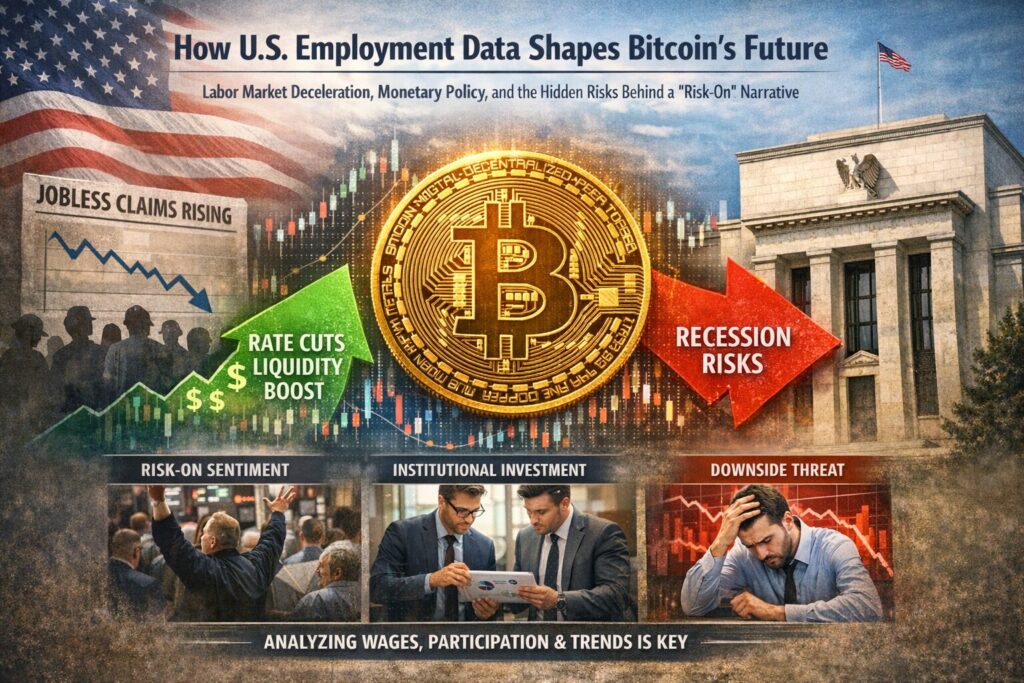
Main Points :
- U.S. employment data is the most influential leading indicator shaping Federal Reserve monetary policy.
- A slowing labor market can ease inflationary pressure, potentially triggering interest rate cuts and boosting Bitcoin.
- Bitcoin has become structurally dependent on global liquidity, behaving as a macro-sensitive risk asset.
- “Risk-on” sentiment driven by rate-cut expectations may attract both speculative and institutional capital.
- However, if labor market weakness signals recession rather than a soft landing, Bitcoin faces downside risk.
- Investors must analyze wage growth, labor participation, and trend consistency—not headline numbers alone.
1. The Labor Market as the Core Driver of Federal Reserve Policy
The reason U.S. employment statistics command such intense market attention lies in a fundamental reality: the Federal Reserve views the labor market as the most critical determinant of monetary policy. Employment data is not merely one indicator among many; it is arguably the most powerful forward-looking signal influencing interest rate decisions, liquidity conditions, and global capital flows.
The Federal Reserve operates under a dual mandate: price stability and maximum employment. When employment remains strong and wages continue rising, inflationary pressure intensifies. Conversely, when job growth slows and wage momentum weakens, inflation concerns begin to ease. This direct causal link elevates employment data into what can be described as the single most important macroeconomic leading indicator.
In the current environment, markets are acutely sensitive to any sign of labor market cooling. A slowdown in job creation suggests that wage inflation—one of the most persistent components of overall inflation—may finally be moderating. This creates room for the Federal Reserve to pause rate hikes or even consider rate cuts, fundamentally altering the liquidity landscape.
For Bitcoin, this relationship is critical. The cryptocurrency market no longer operates in isolation. It is deeply embedded in the global financial system and responds rapidly to shifts in monetary policy expectations. Employment data therefore acts as a trigger that can reshape Bitcoin’s price trajectory almost instantaneously.
2. Why Labor Market Deceleration Can Be a Tailwind for Bitcoin
The expetation that a slowing labor market could support Bitcoin is rooted in monetary mechanics. As employment growth weakens, inflationary pressures—particularly wage-driven inflation—tend to subside. This dynamic reduces the need for aggressive monetary tightening.
When markets anticipate the end of rate hikes or the beginning of rate cuts, global liquidity conditions improve. Capital becomes cheaper, risk tolerance rises, and investors begin reallocating funds into higher-risk assets. Bitcoin, classified firmly as a risk asset in modern portfolios, stands to benefit directly from this shift.
Historically, periods of expanding liquidity have coincided with strong performance in Bitcoin. Lower real interest rates reduce the opportunity cost of holding non-yielding assets, while increased money supply amplifies speculative demand. This creates an environment where Bitcoin can function as both a high-beta macro asset and a hedge against monetary debasement.
Importantly, this dynamic is no longer driven solely by retail speculation. Institutional investors now monitor macro indicators—including employment data—with the same rigor applied to equities and bonds. As a result, Bitcoin’s price increasingly reflects traditional macroeconomic narratives rather than purely crypto-native events.
3. The Rise of “Risk-On” Sentiment and Capital Inflows
Expectations of labor market deceleration often generate a powerful psychological shift across financial markets: the emergence of a “risk-on” environment. In such conditions, investors actively seek assets with higher return potential, reallocating capital away from cash and low-yield instruments.
Bitcoin benefits from this transition in several ways. First, improved liquidity enables leveraged trading and derivatives activity, increasing volume and volatility. Second, institutional capital—previously sidelined due to uncertainty—may re-enter the market once policy direction becomes clearer.
This is particularly relevant for funds, family offices, and treasury managers seeking asymmetric upside exposure. Bitcoin’s fixed supply narrative, combined with renewed liquidity, makes it an attractive candidate during early stages of monetary easing.
Title: Correlation Between U.S. Nonfarm Payroll Growth and Bitcoin Price (USD)
Description: A line chart comparing Bitcoin price movements with changes in U.S. employment growth rates over time.
Purpose: To visually demonstrate Bitcoin’s sensitivity to macro labor indicators.
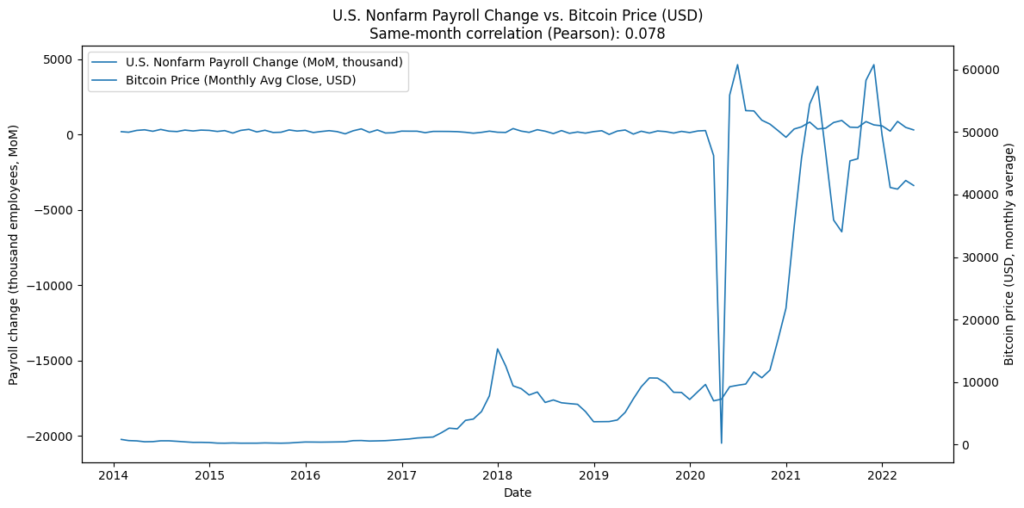
The presence of institutional inflows also reinforces Bitcoin’s legitimacy as a global financial asset. Its price action increasingly mirrors macro-driven assets, confirming its integration into broader capital markets.
4. Bitcoin as a Liquidity-Driven Macro Asset
One of the most important structural changes in Bitcoin’s market behavior is its increasing dependence on global liquidity. Unlike its early years—when price movements were driven by ideological adoption or technological milestones—Bitcoin today reacts sharply to central bank policy expectations.
This transformation reflects a broader shift in investor perception. Bitcoin is no longer viewed solely as a decentralized experiment; it is treated as a macro-sensitive asset class, responsive to interest rates, dollar strength, and liquidity cycles.
When liquidity expands, Bitcoin benefits disproportionately due to its limited supply and speculative appeal. When liquidity contracts, however, Bitcoin suffers alongside equities and other risk assets. Employment data, by shaping expectations of future liquidity, therefore plays a pivotal role in determining Bitcoin’s medium-term direction.
5. The Fine Line Between Soft Landing and Recession
While labor market deceleration can support Bitcoin, it also carries significant risk. The key question is whether slowing employment reflects a soft landing or the early stages of a full economic recession.
In a soft landing scenario, economic growth moderates without collapsing. Inflation cools, employment softens gradually, and the Federal Reserve can ease policy without triggering panic. This environment is ideal for Bitcoin, combining improved liquidity with stable risk sentiment.
However, if employment data deteriorates rapidly—marked by rising unemployment, falling labor participation, and contracting wages—markets may interpret this as a recessionary signal. In such cases, risk appetite evaporates, and capital flows into safe-haven assets instead.
Bitcoin’s performance during recessions remains complex. While long-term narratives emphasize its role as an alternative monetary system, short-term behavior shows strong correlation with equities during periods of acute stress. In a recession-driven sell-off, Bitcoin may experience sharp declines before recovering.
6. Reading Employment Data Beyond the Headline Numbers
Investors must resist the temptation to focus solely on headline employment figures. True insight lies in the details: wage growth trends, labor participation rates, sector-specific employment changes, and revisions to previous data.
A modest slowdown in job creation accompanied by stable wages may still support a soft landing narrative. Conversely, declining wages and shrinking participation rates may signal deeper structural weakness.
For Bitcoin investors, understanding these nuances is essential. Employment data should be analyzed not as a single event, but as part of a broader macro trend influencing liquidity and risk sentiment over time.
7. Conclusion: Employment Data as a Catalyst, Not a Guarantee
U.S. employment statistics have become one of the most powerful catalysts shaping Bitcoin’s short-term price movements. A slowing labor market can ease inflation fears, shift Federal Reserve policy expectations, and trigger a renewed “risk-on” environment favorable to Bitcoin.
However, this opportunity comes with risk. If labor market weakness signals recession rather than moderation, Bitcoin may face significant volatility and downside pressure.
For investors seeking new crypto assets, income opportunities, or practical blockchain exposure, the lesson is clear: Bitcoin’s future is increasingly tied to macroeconomic reality. Understanding employment data—and its implications for liquidity—has become a core competency for navigating the digital asset market.