

Key Points :
- Tom Lee argues that the structural foundation of crypto remains strong despite short-term volatility
- Bitcoin adoption is still in an early stage, with massive untapped global wealth
- Institutional capital, regulatory clarity, and ETF-driven access are reshaping the market
- Ethereum is evolving into core financial infrastructure rather than a speculative asset
- AI, tokenization, and on-chain finance are converging into a new growth cycle
- The next multi-year phase may favor builders, infrastructure, and real cash-flow crypto models
1. “The Foundation of Crypto Remains Strong”: Tom Lee’s View on the Current Market Environment
On December 15, 2025, Tom Lee, co-founder and Head of Research at Fundstrat Global Advisors, appeared on CNBC to discuss his long-term outlook on the cryptocurrency market. Despite recent volatility, deleveraging events, and lingering macro uncertainty, Lee delivered a clear and confident message: “The best year is yet to come.”
According to Lee, market participants often misinterpret consolidation phases as signs of weakness. In reality, these periods frequently mark transitions toward more sustainable growth. He emphasized that Bitcoin (BTC) and Ethereum (ETH) are not merely speculative instruments but assets supported by increasingly robust structural foundations.
Lee highlighted that crypto markets in 2025 experienced several stress events, including concerns over quantum computing threats, large-scale leverage unwinds around October 10, and short-term risk-off sentiment triggered by macro headlines. Yet, despite these shocks, core network activity, long-term holder behavior, and institutional engagement remained resilient.
In Lee’s assessment, this resilience is not accidental. It reflects a maturation process similar to what equity markets experienced during the early internet era—periods of hype followed by crashes, ultimately giving way to durable infrastructure and real economic value.
2. Bitcoin Adoption: Still in the Early Innings
One of the most striking data points cited by Tom Lee relates to Bitcoin ownership distribution.
Lee noted that only around 4 million Bitcoin wallets globally hold more than $10,000 worth of BTC. In contrast, there are approximately 900 million individual retirement accounts (IRAs), brokerage accounts, and investment accounts worldwide that hold assets exceeding $10,000.
This disparity suggests a massive adoption gap.
From a purely numerical standpoint, Lee estimates that Bitcoin’s potential addressable market could be over 200 times larger than its current penetration. This is not an argument for short-term price targets, but rather a structural observation about where Bitcoin sits in the global asset adoption curve.
Bitcoin, in Lee’s view, is still transitioning from:
- A niche, technically complex asset
- To a mainstream portfolio component comparable to gold, bonds, or equities
This transition is being accelerated by:
- Spot Bitcoin ETFs in major jurisdictions
- Custodial and non-custodial wallet UX improvements
- Regulatory normalization, particularly in the United States
Image File: Global Asset Ownership vs Bitcoin Wallet Distribution
Description: Bar chart comparing number of global investment accounts ($10,000+) vs BTC wallets holding $10,000+
3. Regulatory Tailwinds and Wall Street’s Structural Entry
Another pillar of Lee’s bullish thesis is the regulatory shift underway in the United States and other major financial centers.
Unlike earlier cycles, where regulatory uncertainty suppressed institutional participation, the current environment is characterized by:
- Defined pathways for ETFs and custodial products
- Increased clarity around asset classification
- Growing acceptance of crypto as a legitimate financial asset class
Lee emphasized that Wall Street is no longer debating whether crypto will exist, but rather how to integrate it profitably and compliantly.
Major banks, asset managers, and infrastructure providers are now investing in:
- Tokenized securities
- On-chain settlement systems
- Crypto-linked derivatives and structured products
This institutional engagement creates a fundamentally different demand profile compared to retail-driven cycles. Capital flows become:
- Slower but larger
- Less speculative and more allocation-driven
- More sensitive to compliance, custody, and risk frameworks
4. Bitcoin, AI, and the Debate Over “Expectation Reset”
During the interview, Lee also addressed concerns that both Bitcoin and artificial intelligence (AI) markets may be experiencing an “expectation reset.”
Some commentators argue that enthusiasm around AI and BTC has moved ahead of real-world utility. Lee does not dismiss this concern outright, but reframes it.
According to Lee, expectation resets are not failures—they are recalibrations. Historically, transformative technologies often experience:
- Over-exuberance
- Sharp corrections
- Infrastructure-driven consolidation
- Sustainable adoption
Bitcoin, like AI, is now entering phase three.
Rather than asking whether prices are “too high” or “too low,” Lee suggests investors should ask:
- Are networks becoming more useful?
- Are institutions committing capital and talent?
- Are real economic activities migrating on-chain?
In his view, the answer to all three questions remains “yes.”
5. Ethereum’s Evolution Into Financial Infrastructure
While Bitcoin is often framed as digital gold, Tom Lee devoted significant attention to Ethereum’s evolving role.
Ethereum, he argues, should be understood less as a “coin” and more as a decentralized financial operating system.
Key areas of Ethereum-centric investment include:
- Tokenized real-world assets (RWAs) such as bonds and funds
- Stablecoin settlement rails
- On-chain derivatives and lending protocols
- Enterprise and government-grade blockchain infrastructure
Ethereum’s value proposition increasingly lies in:
- Network security
- Developer ecosystem depth
- Regulatory compatibility relative to alternative chains
Lee noted that much of the capital flowing into Ethereum is infrastructure capital, not speculative trading capital. This mirrors early investment phases in cloud computing, where value accrued slowly but persistently.
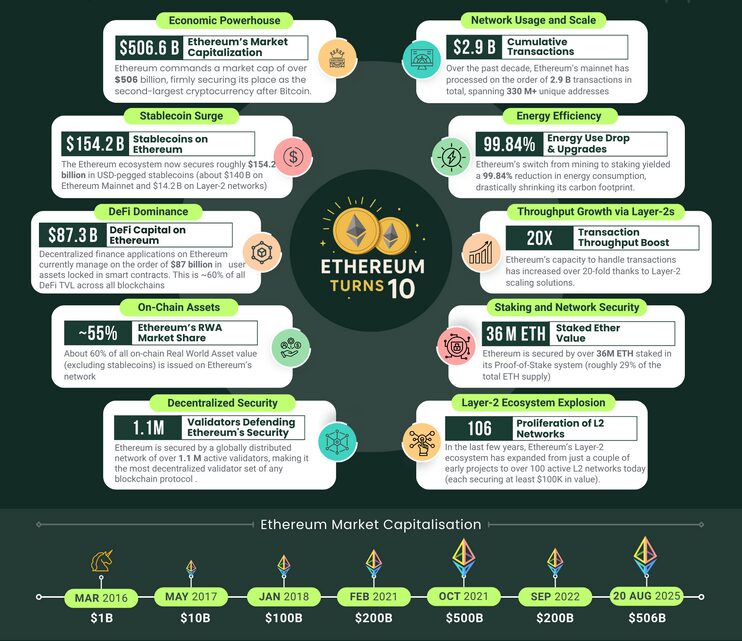
Image File: Ethereum Use Cases by Sector
Description: Pie chart showing DeFi, RWAs, stablecoins, NFTs, enterprise usage
6. Where the Next Growth Phase May Emerge
Tom Lee’s long-term optimism does not imply indiscriminate bullishness across all tokens.
Instead, he suggests that the next phase of growth may concentrate around:
- Infrastructure tokens with real usage
- Protocols generating sustainable fees
- Assets aligned with regulatory frameworks
- Platforms bridging traditional finance and on-chain systems
For investors and builders alike, this implies a shift in strategy:
- From short-term speculation
- To long-term participation in financial system redesign
This is particularly relevant for:
- Payment companies
- Remittance platforms
- EMI and VASP-regulated entities
- Tokenization and settlement providers
7. Conclusion: “The Best Year Is Yet to Come” — A Structural, Not Speculative, Thesis
Tom Lee’s message is ultimately not about predicting next month’s price movements. It is about recognizing where crypto stands in its historical arc.
Bitcoin remains under-owned relative to global wealth.
Ethereum is embedding itself into financial infrastructure.
Regulation is shifting from hostility to integration.
Institutional capital is entering methodically, not impulsively.
From this perspective, Lee’s statement that “the best year is yet to come” should be understood not as hype, but as a reflection of structural reality.
For those seeking new digital assets, new revenue models, and practical blockchain applications, the opportunity lies not in chasing narratives—but in understanding the foundations being laid today.


