Main Points :
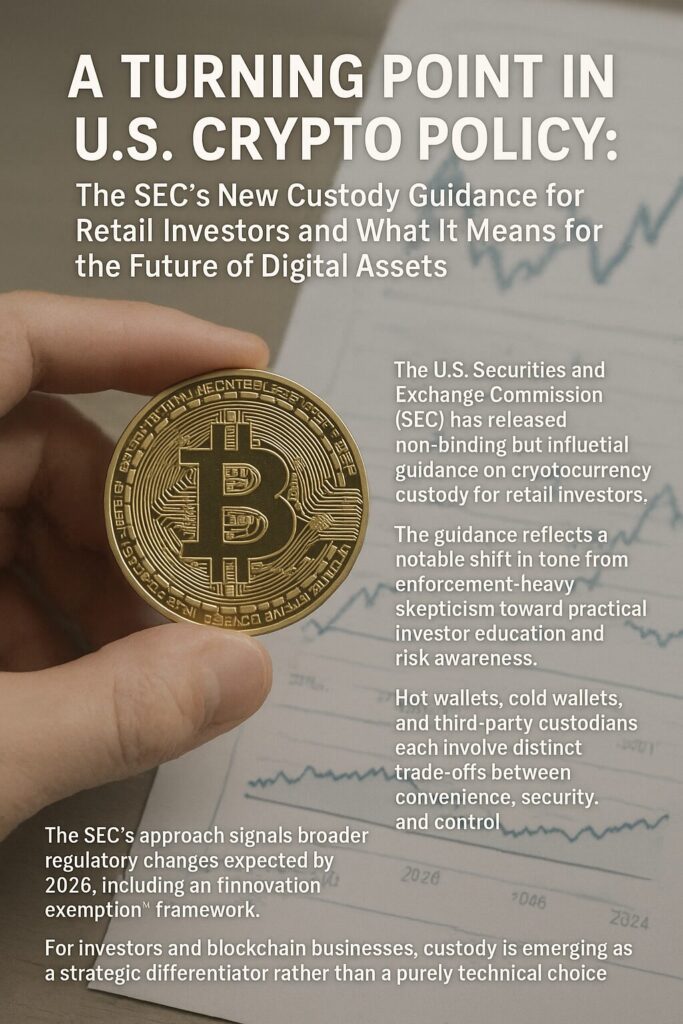
- The U.S. Securities and Exchange Commission (SEC) has released non-binding but influential guidance on cryptocurrency custody for retail investors.
- The guidance reflects a notable shift in tone from enforcement-heavy skepticism toward practical investor education and risk awareness.
- Hot wallets, cold wallets, and third-party custodians each involve distinct trade-offs between convenience, security, and control.
- The SEC’s approach signals broader regulatory changes expected by 2026, including an “innovation exemption” framework.
- For investors and blockchain businesses, custody is emerging as a strategic differentiator rather than a purely technical choice.
Introduction: Why Custody Matters More Than Ever
On December 12, 2025, the U.S. Securities and Exchange Commission (SEC) published new guidance aimed at helping retail investors understand how to safely store cryptocurrencies. While the document does not carry legal force, it represents one of the clearest and most accessible explanations the SEC has ever provided on digital asset custody.
For years, custody has been one of the most underestimated yet critical components of the crypto ecosystem. High-profile exchange collapses, wallet hacks, and frozen withdrawals have repeatedly demonstrated that ownership of digital assets is inseparable from control over private keys. In this context, the SEC’s guidance arrives at a moment when regulatory clarity, investor protection, and innovation must be carefully balanced.
Industry participants have interpreted this release as a potential turning point. Under the Biden administration, the SEC was widely viewed as hostile or at least skeptical toward crypto markets. Since the transition to the Trump administration, however, the Commission has begun signaling a more pragmatic stance—one that recognizes the permanence of digital assets and the need to regulate them through clearer frameworks rather than ambiguity.
Understanding Wallet Types: Hot Wallets and Cold Wallets
One of the core sections of the SEC’s guidance focuses on the distinction between hot wallets and cold wallets, a topic often misunderstood by new investors.
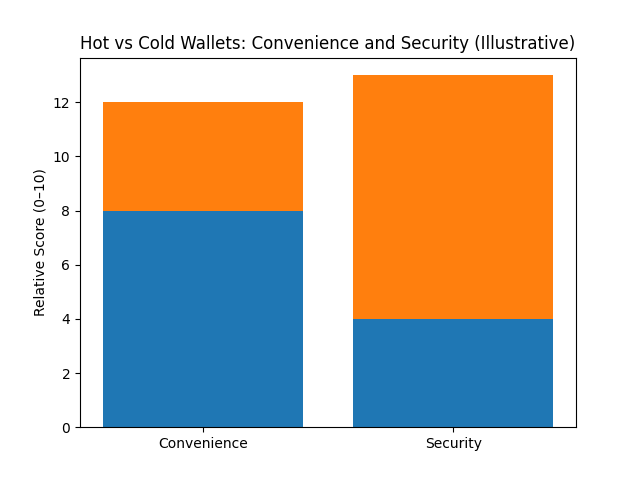
Hot wallets are wallets connected to the internet. They include mobile wallets, browser extensions, and web-based services. Their main advantage lies in convenience. Users can quickly send, receive, and interact with decentralized applications (dApps), making hot wallets ideal for frequent transactions and active participation in the blockchain ecosystem.
However, this convenience comes at a cost. Because hot wallets are online, they are more exposed to cyber threats such as malware, phishing attacks, and unauthorized access. Even when users follow best practices, the attack surface remains larger compared to offline storage.
Cold wallets, by contrast, are not connected to the internet. These typically take the form of hardware wallets or other physical devices. The SEC highlights that cold wallets significantly reduce exposure to online attacks, making them a preferred option for long-term storage of substantial holdings.
At the same time, cold wallets introduce their own risks. Physical loss, damage, or theft of the device can permanently cut off access to funds if recovery phrases are not properly secured. In other words, cold wallets shift risk from cyberspace to the physical world.
Hot vs Cold Wallets – Convenience and Security (Illustrative)
Self-Custody vs Third-Party Custody: A Fundamental Choice
Beyond wallet types, the SEC emphasizes a more fundamental decision every investor must make: whether to self-custody their crypto assets or entrust them to a third-party custodian.
In self-custody, the investor controls the private keys directly. This model aligns closely with the original ethos of cryptocurrencies—financial sovereignty and independence from intermediaries. However, it also places full responsibility on the user. Mistakes such as losing a recovery phrase, sending assets to the wrong address, or falling victim to scams are typically irreversible.
Third-party custody involves delegating key management to an exchange or specialized custody provider. This arrangement often simplifies the user experience, offering account recovery options, customer support, and integrated trading services. For many retail investors, this feels safer and more familiar, especially when compared to traditional financial institutions.
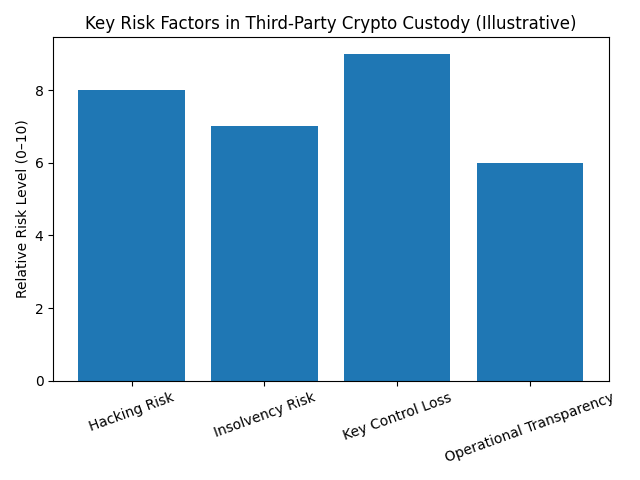
Yet the SEC explicitly warns that third-party custody introduces counterparty risk. If a custodian is hacked, mismanages assets, or becomes insolvent, users may lose access to their funds. The guidance reminds investors that in such scenarios, legal recovery is often uncertain and slow.
What to Look for in a Custodian
To help investors navigate these risks, the SEC outlines key factors to evaluate when choosing a custodial service provider.
First, investors should examine the custodian’s regulatory status and complaint history. A provider operating under recognized regulatory oversight and with a clean track record offers a stronger baseline of trust.
Second, supported assets matter. Not all custodians support all cryptocurrencies, and asset-specific risks can vary significantly depending on custody infrastructure.
Third, terms of service deserve close scrutiny. Investors should understand how assets are treated in bankruptcy, whether insurance coverage exists for theft or loss, and what legal protections apply.
Fourth, transparency around storage practices is critical. Investors should know where and how assets are stored, whether segregation is practiced, and what security standards are in place.
Fifth, the SEC stresses the importance of understanding whether custodians use customer assets for their own purposes, such as lending or collateralization. This practice can generate yield but also amplifies risk.
Finally, fee structures should be clearly disclosed and understood. Hidden or complex fees can materially affect long-term returns.
Key Risk Factors in Third-Party Crypto Custody (Illustrative)
A Broader Regulatory Shift Underway
The release of this guidance cannot be viewed in isolation. SEC Chair Paul Atkins recently suggested that 2026 could mark a significant breakthrough in U.S. crypto regulation. Among the initiatives under consideration is an “innovation exemption” framework, expected to launch by late January next year.
Under this framework, crypto companies would be allowed to test new business models under SEC supervision with temporary regulatory relief. This approach mirrors regulatory sandboxes used in fintech sectors worldwide and signals a willingness to foster innovation without abandoning oversight.
For blockchain entrepreneurs, this represents an opportunity to experiment with novel custody models, hybrid self-custody solutions, and compliance-by-design architectures. For investors, it promises clearer rules and better-aligned protections.
Implications for Investors and the Crypto Industry
For retail investors, the SEC’s guidance reinforces a crucial lesson: custody is not an afterthought. It is a central investment decision that affects security, liquidity, and long-term resilience.
For the crypto industry, the guidance suggests that regulators are increasingly willing to engage in practical education rather than relying solely on enforcement. This shift could encourage more institutional participation, higher-quality infrastructure, and renewed confidence among cautious investors.
From a broader perspective, custody sits at the intersection of technology, regulation, and trust. How assets are stored, who controls them, and under what rules will shape the next phase of digital finance.
Conclusion: Custody as Strategy, Not Just Storage
The SEC’s new custody guidance marks a subtle but meaningful change in U.S. crypto policy. By focusing on real-world risks and practical decision-making, the Commission acknowledges that cryptocurrencies are no longer a fringe experiment but a durable part of the financial system.
For investors seeking new digital assets, new income opportunities, or practical blockchain applications, understanding custody is now a strategic necessity. Whether through self-custody, third-party services, or emerging hybrid models, the future of crypto will belong to those who treat custody not as a technical detail, but as a foundation of financial autonomy and trust.