
Main Points :
- Bitcoin has shown a persistent pattern of sudden price drops around midnight JST (10:00 a.m. ET).
- Analysts suspect large high-frequency trading (HFT) firms—especially Jane Street—are strategically influencing liquidity.
- Jane Street is accumulating large positions in BlackRock’s Bitcoin ETF (IBIT), suggesting intentional accumulation rather than macro-driven weakness.
- This pattern reflects a broader shift: institutional liquidity strategies now dominate intraday Bitcoin movements.
- Once accumulation cycles finish, analysts expect Bitcoin to regain upward momentum.
- Recent market data supports this thesis, aligning with global liquidity flows, ETF inflows, and futures basis movements.
Introduction
Over the past several months—especially since early November—Bitcoin (BTC) has exhibited a strikingly consistent price pattern: a sharp drop occurring almost exactly at midnight Japan Standard Time, which corresponds to the U.S. stock market pre-open around 10:00 a.m. Eastern Time.
This recurring “midnight crash” has puzzled retail traders but increasingly appears to reflect the deliberate actions of sophisticated institutional players who possess the liquidity, speed, and regulatory access to manipulate short-term market structure without breaking any laws.
Among the firms singled out by analysts, Jane Street, one of the world’s largest high-frequency trading (HFT) firms, appears repeatedly as the most likely driver.
To understand why, we examine the mechanics behind the suspected strategy, the accumulation behavior observed in ETFs, and how this pattern aligns with broader institutional market trends.
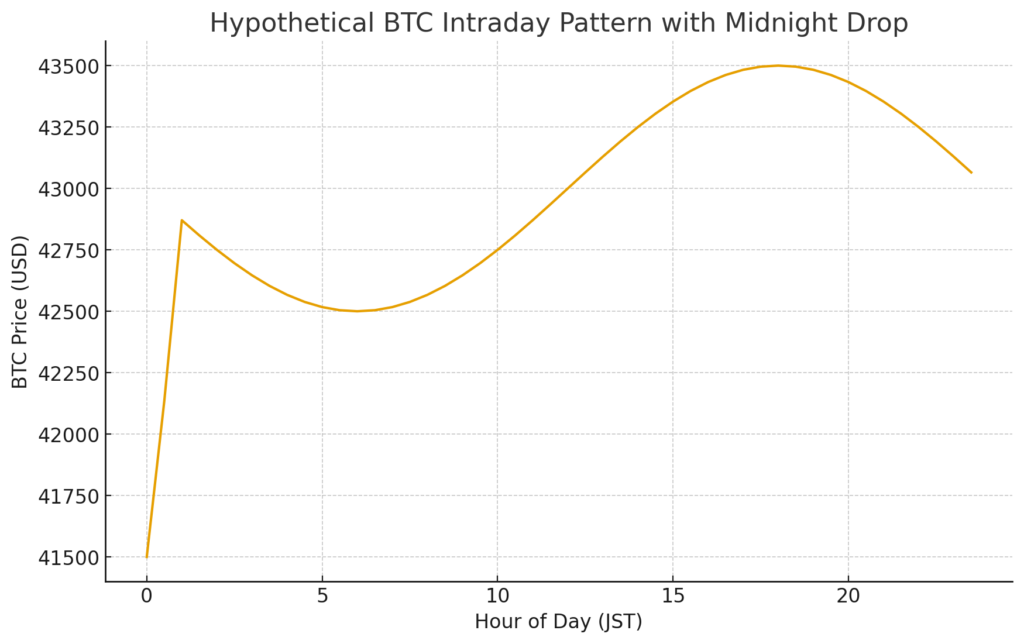
Section 1: The Midnight Crash Pattern — A New Market Rhythm
Since Q2 and Q3 of this year, traders around the world have noticed that Bitcoin tends to fall sharply at a very specific time: midnight in Japan, which corresponds to the moments leading into the U.S. equity market’s opening liquidity window.
This window is uniquely important because:
- Market makers rebalance their portfolios before U.S. equity trading begins
- Liquidity providers adjust correlated assets (like BTC futures vs Nasdaq futures)
- ETF authorized participants prepare for daily create/redeem operations
- Algorithmic funds recalibrate volatility models
Bitcoin—which trades 24/7—becomes a convenient asset to adjust intraday liquidity requirements.
The result?
A consistent downward shock that appears unrelated to macro news, retail behavior, or typical risk sentiment cycles.
Data from multiple exchanges shows an abnormally high concentration of:
- Market sell orders
- Short-term liquidation clusters
- Bid-side liquidity withdrawal
These combined effects produce sharp downward spikes that often recover within hours.
Section 2: Why Analysts Believe Jane Street Is Involved
Jane Street is not just another trading firm. It is:
- One of the world’s largest HFT firms
- A dominant authorized participant (AP) in ETFs
- A major proprietary trading operation with extremely deep liquidity reserves
- A specialist in statistical arbitrage and cross-asset liquidity strategies
In 2024–2025, Jane Street expanded aggressively into digital asset market-making, becoming a key liquidity provider for Bitcoin ETFs such as BlackRock’s IBIT.
Jane Street’s Suspected Method
Analysts outline the suspected arbitrage loop as follows:
- Sell BTC aggressively at the U.S. market open to push the price down.
- Trigger cascading liquidations and thin-out retail bids.
- Once price drops, buy back the same amount at lower levels.
- Deploy accumulated BTC for ETF arbitrage or longer-term positions.
This loop can produce millions of dollars in profit daily without violating the law, because it operates within the boundaries of market-making behavior, not manipulation.
The Key Evidence
The strongest circumstantial evidence is Jane Street’s massive accumulation of IBIT.
- Current IBIT holdings: approx. $2.5 billion
- Ranking in their portfolio: 5th largest position
- This scale implies strategic conviction—not short-term noise.
A firm quietly accumulating billions of dollars in Bitcoin-linked assets has strong incentives to periodically lower the price to optimize entry levels.
Section 3: IBIT Accumulation and What It Reveals
BlackRock’s Bitcoin ETF (IBIT) has become the dominant spot BTC ETF in the U.S., attracting global institutional inflows.
Jane Street acts as one of its main market makers and liquidity providers.
Why Accumulation Matters
Large, steady ETF inflows require market makers to source and hold physical BTC.
If a firm needs to acquire billions in Bitcoin:
- It wants low prices
- It benefits from periodic dips
- It has the infrastructure to engineer liquidity events
This aligns with the observed midnight crashes.
Not Macro-Driven
During these same periods:
- CPI releases showed stable inflation
- Risk assets like Nasdaq and gold were not in decline
- Dollar liquidity remained neutral
- Futures funding rates were relatively stable
Thus, the repeated BTC drops appear structurally engineered rather than economically triggered.
Section 4: Broader Market Trends Supporting the Hypothesis
Other independent market indicators support the idea of strategic accumulation rather than risk-off selling.
4.1 Futures Basis Compression
The BTC futures basis (annualized spread between spot and futures) has repeatedly tightened around the same midnight window.
A tightening basis usually means:
- Institutional arbitrageurs are active
- Market makers are hedging spot purchases
- Short-term volatility is being used to enter positions
4.2 ETF Inflows Remain Strong
IBIT, Fidelity’s FBTC, and Ark’s ARKB continue to experience consistent inflows even when BTC price falls.
This is a classic signal of:
- Institutional dip-buying
- Long-term capital allocation
- Hedged accumulation strategies
4.3 Liquidity Mapping Shows Predictable Vulnerabilities
On-chain and order book analysis show:
- 0:00 JST tends to have thinner liquidity
- Asian markets are closing
- European markets are inactive
- U.S. markets are preparing to open
This is the perfect moment for an HFT firm to move markets with minimal capital impact.
Section 5: How This Affects Retail Traders and New Crypto Investors
This pattern has major implications for:
Short-term traders
- Expect predictable volatility around midnight
- Avoid placing tight stop-losses near that time
- Use dips strategically rather than panicking
Long-term investors
- Midnight dips may signal strategic institutional accumulation
- These cycles often precede major bull runs
- ETF-based demand has historically driven sustainable price floors
Crypto entrepreneurs & builders
- Institutional participation validates BTC’s role as a macro asset
- Market microstructure is becoming more sophisticated
- Regulatory clarity continues to attract Wall Street capital
For readers seeking new revenue opportunities, alternative assets, or practical blockchain applications, this shift shows that Bitcoin has firmly entered the realm of institutional market mechanics.
This is not a retail-driven asset anymore.
Section 6: Outlook — What Happens After Accumulation Ends
Analysts broadly agree that once accumulation cycles finish:
- Downward pressure will ease
- Bitcoin will realign with its macro upward trend
- ETF demand will drive new all-time highs
Key supporting factors include:
- Increasing adoption of BTC as a reserve asset
- Growing ETF participation from global pension and insurance funds
- Reduction in exchange liquid supply
- Pre-halving + post-halving supply dynamics
- Rising stablecoin liquidity flows
In short:
The midnight crash pattern is likely a temporary side effect of strategic accumulation, not a long-term bearish signal.
Conclusion
Bitcoin’s repeated midnight crashes are not random. They reflect deeper structural behavior tied to institutional liquidity operations, most plausibly led by sophisticated players like Jane Street.
Evidence from ETF accumulation, futures basis movements, and liquidity cycles suggests that these dips represent a deliberate strategy to acquire BTC at favorable prices rather than signs of weakness.
For investors seeking the next strategic entry point, understanding these market mechanics is more important than ever.
As accumulation phases conclude, Bitcoin is expected to reassert its upward momentum—potentially more strongly than before—as institutional capital completes its positioning.