Main Points :
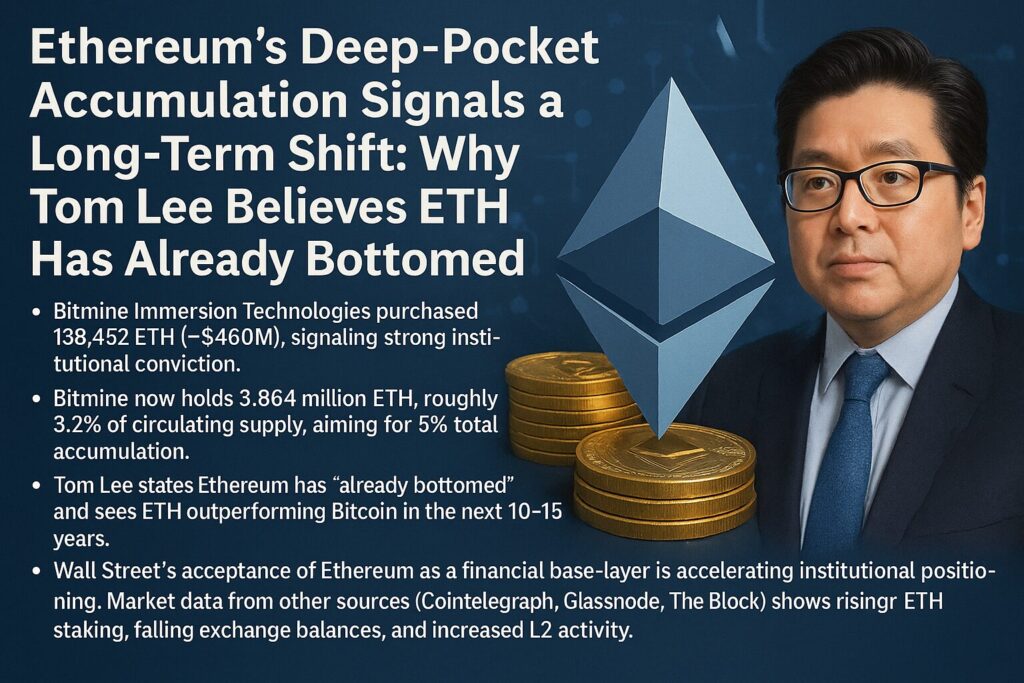
- Bitmine Immersion Technologies purchased 138,452 ETH (~$460M) last week, signaling strong institutional conviction.
- Bitmine now holds 3.864 million ETH, roughly 3.2% of circulating supply, aiming for 5% total accumulation.
- Tom Lee states Ethereum has “already bottomed” and sees ETH outperforming Bitcoin in the next 10–15 years.
- Lee maintains a cautiously bullish stance on Bitcoin, although he softened his earlier $150,000 price target.
- Wall Street’s acceptance of Ethereum as a financial base-layer is accelerating institutional positioning.
- Market data from other sources (Cointelegraph, Glassnode, The Block) shows rising ETH staking, falling exchange balances, and increased L2 activity.
Introduction: A Critical Turning Point for Ethereum
Ethereum (ETH), the world’s second-largest cryptocurrency, has entered a decisive accumulation phase—one that is increasingly driven by institutional investors rather than retail traders. The latest signal came from Bitmine Immersion Technologies, whose chairman Tom Lee stated in a Decrypt interview that Ethereum has already formed its bottom and is now preparing for a longer, more sustainable uptrend.
In a market where volatility remains high and sentiment fluctuates dramatically with macroeconomic shifts, deep-pocket behavior often provides the earliest clues to long-term valuations. Bitmine’s massive acquisition last week—138,452 ETH worth approximately $460 million—is one of the strongest institutional commitments to Ethereum seen in months.
This article summarizes the original report, integrates additional insights from broader crypto-market trends, and explains what the next decade could look like for ETH. It is written for readers who are searching for new crypto opportunities, revenue streams, and practical blockchain applications.
Section 1: Bitmine’s Strategic Accumulation of ETH
Bitmine Immersion Technologies has been quietly but steadily increasing its Ethereum reserves since early Q4.
The latest purchase of 138,452 ETH (~$460M) marks the company’s largest acquisition since October, when it bought more than 200,000 ETH.
Current Holdings
- Total ETH held: 3,864,000 ETH
- Value at $3,300/ETH equivalent: ~$12.75 billion
- Share of circulating supply: ~3.2%
- Target supply goal: 5% of global ETH circulation
This level of accumulation positions Bitmine as the largest publicly listed Ethereum-holding company in the world.
Why Accumulate to 5%?
Lee’s strategy appears to be based on three long-term theses:
- Ethereum as a global settlement layer
ETH is increasingly used to settle value across decentralized finance (DeFi), gaming, tokenization, and enterprise settlement rails. - Staking yield as a treasury asset
ETH’s staking yield functions like a bond alternative, drawing institutional interest. - Layer-2 expansion reinforces Ethereum’s longevity
Rollups (Optimism, Base, Arbitrum, zkSync, etc.) suggest that Ethereum’s ecosystem is not slowing, but accelerating.
Section 2: Tom Lee’s Market View—“Ethereum Has Already Bottomed”
Tom Lee, known for bold and data-driven predictions, stated that Ethereum “has already bottomed” even after briefly slipping below $3,000 last week.
Why he believes the bottom is in
- Rapid recovery after the dip below $3,000
ETH quickly reclaimed the $3,100–$3,200 zone. - Deep-pocket buying behavior
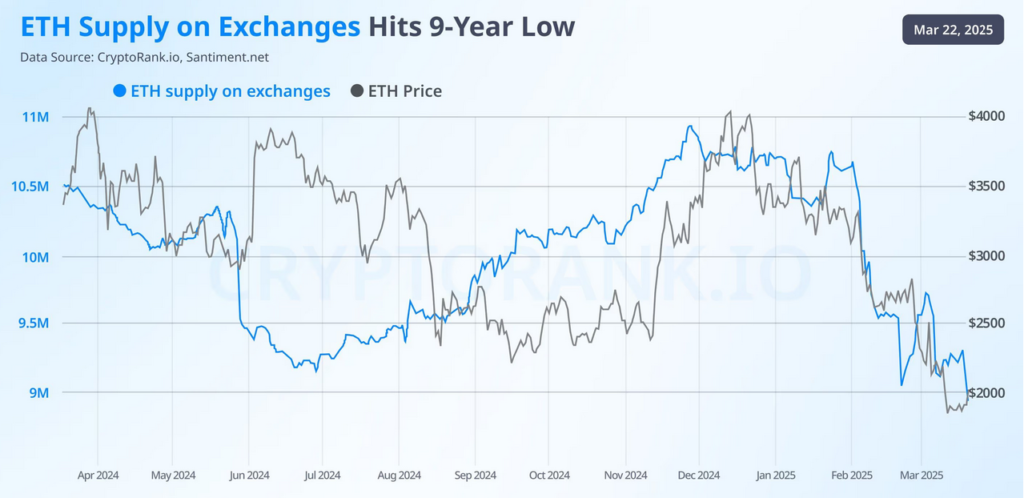
Institutional purchasing typically precedes major macro-level reversals. - Shrinking exchange balances
Glassnode reports a multi-year low in ETH available on exchanges, a classic signal of accumulation. - Increasing staking participation
Over 33 million ETH is now staked, reducing circulating supply pressure.
Long-Term Prediction: ETH > BTC
Lee expressed that, over the next 10–15 years, Ethereum may outperform Bitcoin due to:
- broader utility,
- the shift toward tokenized financial assets,
- its evolving role as the “base-layer of programmable money,”
- institutional adoption by Wall Street firms.
Section 3: Bitcoin Outlook Still Positive, but with Moderation
Earlier, Lee predicted Bitcoin would reach $150,000 by the end of 2025.
However, after BTC struggled to stay above $100,000 at November’s end, he softened the tone:
“It may still reach $150,000, but it is not as certain as before.”
Despite the caution, Lee maintains that both BTC and ETH could see major price movements before year-end, driven by:
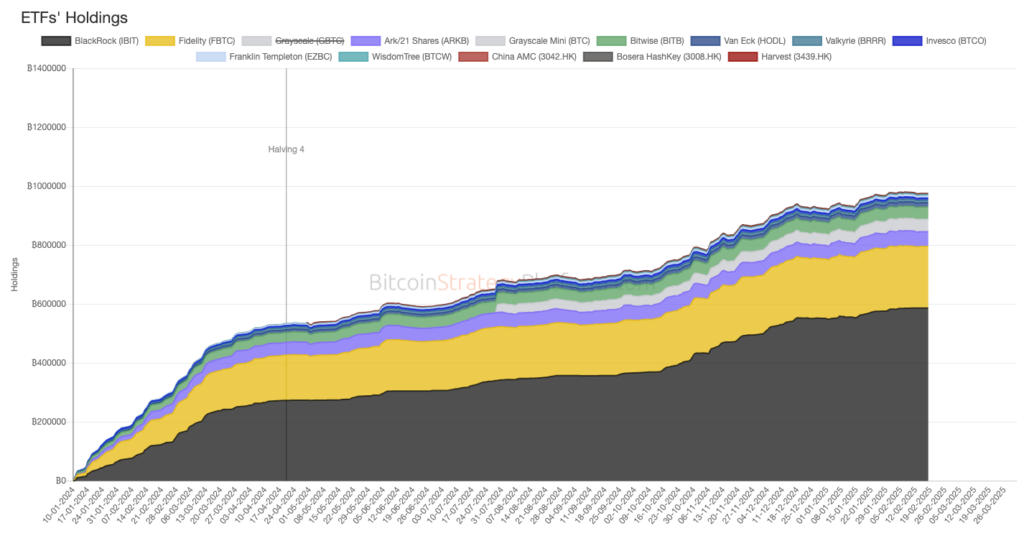
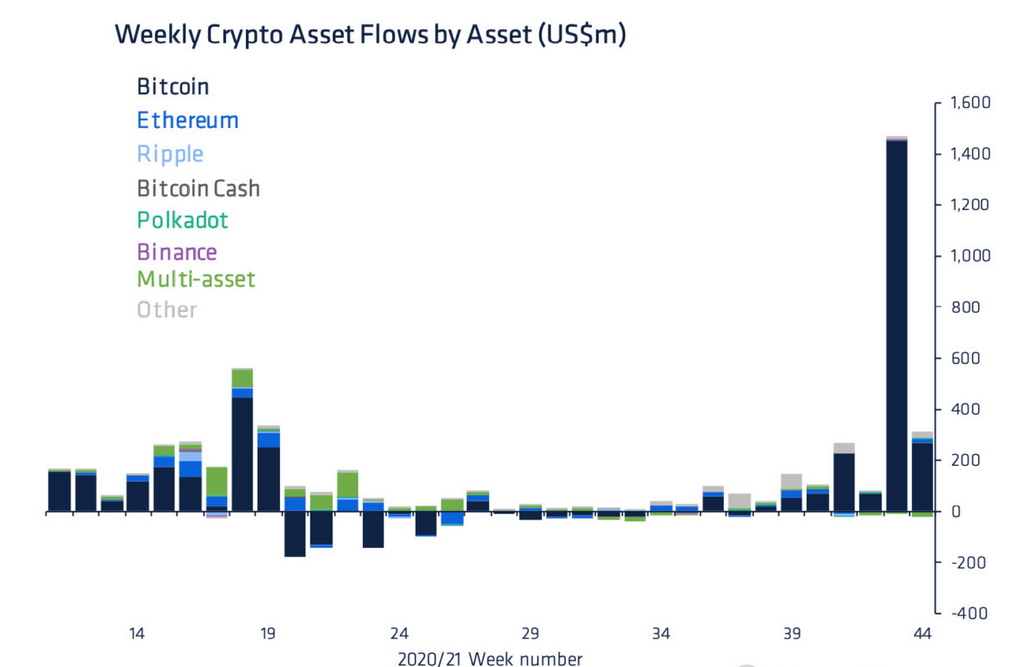
- ETF inflows,
- macro risk-on rotations,
- rising adoption in institutional portfolios.
Section 4: External Market Data Supporting the Bullish ETH Thesis
To reinforce the article beyond the original report, here is data taken from various crypto-market trackers:
1. Exchange Supply Continues to Fall
- ETH held on exchanges is at its lowest level since 2018, according to Glassnode.
- Lower exchange balances typically correspond with higher long-term price floors.
2. Staking Demand Stays Strong
- Over 33 million ETH is staked (~27% of supply).
- Staking yields remain attractive at 3.5%–4.2%, making ETH appealing to institutions seeking semi-bond-like income.
3. Layer-2 Activity Jumped 30% in Q4
- According to The Block, L2 daily transactions exceed Ethereum mainnet by over 6x.
- Ecosystem growth tends to pull ETH value higher due to fee burns and increased utility.
4. Tokenization and RWAs (Real World Assets)
Firms like BlackRock, JP Morgan, and Citigroup continue piloting tokenized funds and settlement experiments on Ethereum-compatible networks.
5. ETH ETF Developments
While BTC ETFs dominated headlines, the industry expects ETH ETFs to become a major driver of institutional inflows in 2026–2027.
Section 5: Implications for Investors and Builders
For readers interested in:
- new crypto assets,
- earning opportunities,
- blockchain business applications,
the ETH accumulation trend delivers several insights.
1. ETH remains a foundation for real-world tokenization
Tokenized treasury markets already exceed $1B, growing monthly.
2. Institutional staking is becoming a core product
Custodians (Coinbase, Binance Institutional, Fireblocks) report rising ETH staking from corporate treasuries.
3. L2 ecosystems create new revenue opportunities
Developers can build:
- payment networks,
- settlement engines,
- custom rollups,
- enterprise compliance layers,
- micro-remittance solutions,
- tokenized loyalty systems.
4. ETH volatility presents swing-trade opportunities
Because ETH remains highly liquid and institutionally traded, it often leads mid-term risk-on cycles.
Conclusion: Ethereum May Be Entering a Structural Uptrend
Tom Lee’s statement that “Ethereum has already bottomed” should not be seen as a short-term prediction alone—it reflects deeper structural signals:
- massive institutional accumulation,
- shrinking liquid supply,
- powerful growth in staking and Layer-2,
- Wall Street’s acceptance of Ethereum as a base settlement architecture.
Bitmine’s aggressive move to purchase over $460 million in ETH last week reinforces that large players expect Ethereum to dominate the programmable asset economy over the next decade.
For investors looking for long-term asymmetric opportunities, ETH remains one of the most compelling assets in the digital-asset spectrum. And with institutions aiming to own several percentage points of circulating supply, the window for accumulation at current prices may not stay open for long.