Main Points :
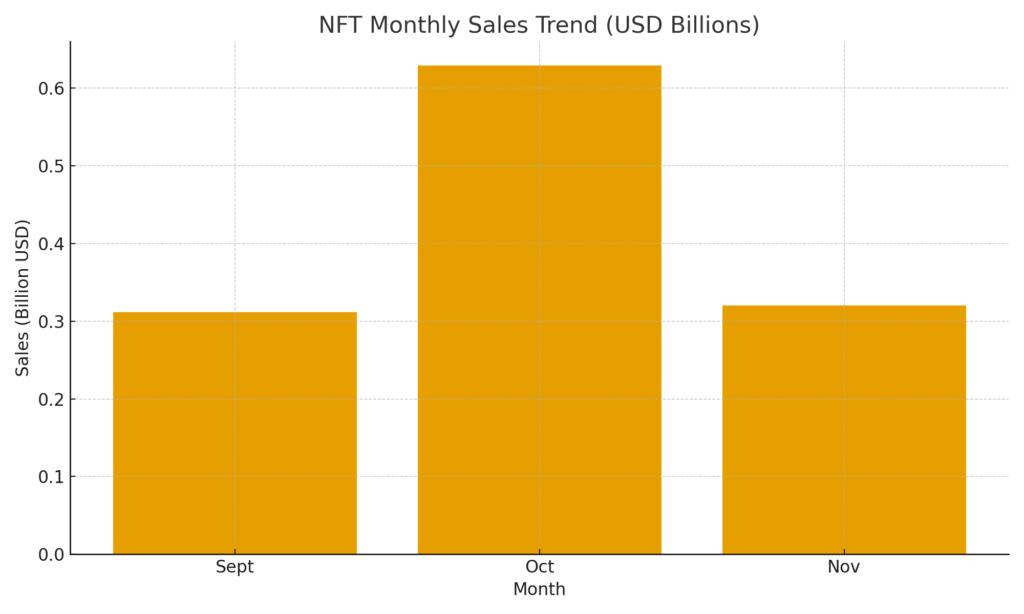
- NFT monthly sales fell to their lowest level in 2025, dropping nearly 50% from October to November.
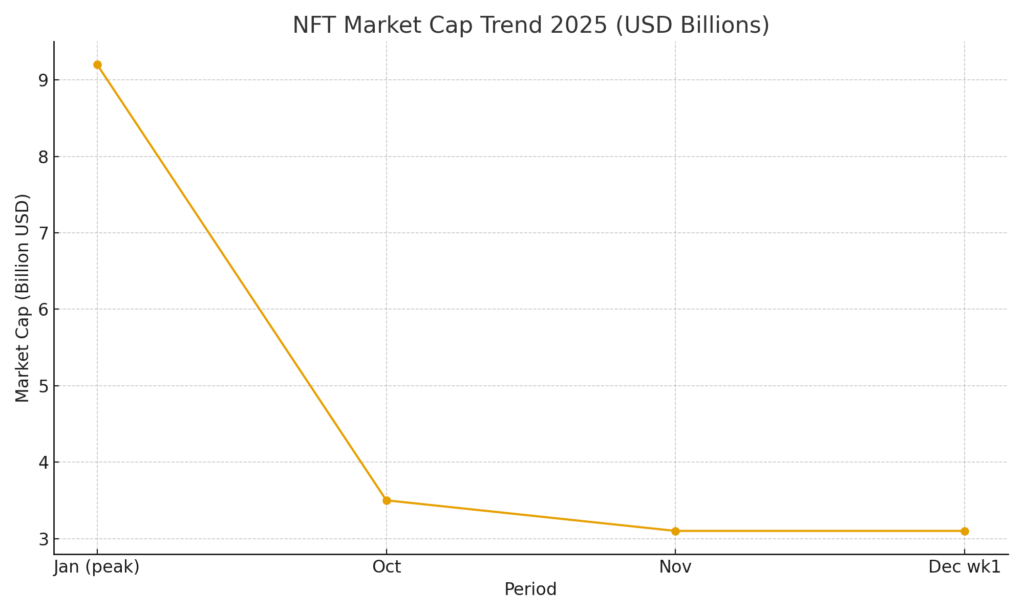
- The total NFT market capitalization has collapsed 66% from the January peak ($9.2B → $3.1B).
- Blue-chip NFTs—including CryptoPunks and BAYC—continue to slide, while only two major collections have shown growth.
- Market structure shifts suggest NFTs may be entering a new maturity phase tied to utility, gaming, and interoperability.
- Despite market decline, on-chain participation, Layer 2 adoption, and NFT-fi (liquidity protocols) are quietly expanding.
Graph 1: NFT Market Cap Trend (USD Billions)
Graph 2: NFT Monthly Sales Trend (USD Billions)
1. Introduction — A Critical Phase in the NFT Market’s Evolution
The NFT market has entered one of its sharpest downturns since the asset class emerged in mainstream culture between 2020 and 2021. New data from CryptoSlam and CoinGecko show that transaction volumes, prices, and market capitalization have fallen to their lowest point of 2025, signaling a prolonged cooling period often referred to as “NFT Winter.”
However, while surface-level indicators paint a dire picture, deeper structural shifts suggest not only a cleansing cycle but also the foundations for new opportunities—especially for readers seeking the next profitable digital asset, emerging sectors, and practical blockchain use-cases.
This report combines the originally referenced data with additional market insights from industry sources to analyze the decline, identify pockets of resilience, and evaluate what comes next.
2. NFT Sales Collapse to Yearly Lows — A November Breakdown
According to CryptoSlam, global NFT sales for November reached $320 million, a sharp contraction from October’s $629 million, marking nearly a 50% drop month-over-month.
This decline pushed the market back to levels not seen since September 2024, when monthly sales hit $312 million.
Even more concerning is the early performance for December. Between December 1–7, NFT sales totaled just $62 million, the lowest weekly total recorded in 2025.
The trend suggests weakening demand and fewer high-value transactions—both traditionally essential to maintaining liquidity within the NFT market.
What this means for investors is clear:
- Price discovery is ongoing, with floor prices still stabilizing.
- Market participants are repricing NFTs more conservatively.
- Liquidity is shifting toward memecoins, gaming tokens, and infrastructure plays.
3. Market Cap: From $9.2B to $3.1B — A 66% Collapse Since January
CoinGecko data shows that the total NFT market capitalization now sits at $3.1 billion, dropping 66% from the January peak of $9.2 billion.
This drop has occurred despite brief rebounds, such as the short-lived recovery in mid-November following a broad rally in memecoins.
Key Observations:
- The NFT market is outpaced by other crypto sectors (AI tokens, L2 tokens, RWA tokens).
- NFT lending and NFT liquidity platforms (NFT-Fi) remain active despite declining valuations.
- The majority of price depreciation is due to the collapse of high-value blue-chip collections, which act as market benchmarks.
The chart above (Graph 1) visually illustrates this dramatic decline.
4. Blue-Chip Collections Are Bleeding — Except Two Outliers
Most major NFT collections are experiencing consistent downward price pressure. CoinGecko’s 30-day data reveals:
Decliners
- CryptoPunks: −12%
- Bored Ape Yacht Club (BAYC): −8.5%
- Pudgy Penguins: −10.6%
- Chromie Squiggle: −5.6%
- Fidenza: −14.6%
- Moonbirds: −17.9%
- Mutant Ape Yacht Club (MAYC): −13.4%
- Hyper: −48% (largest decline among top collections)
The declines signal a reduced willingness for high-end collectors to deploy capital into legacy NFT brands.
Surprising Winners
Only two major collections posted gains over the past month:
- Infinex Patrons: +14.9%
- Autoglyphs: +20.9% (biggest gainer among top 10)
Their growth—during a collapsing market—suggests demand for scarce, historically relevant, or technically unique NFTs remains intact.
This bifurcation confirms a new thesis emerging in NFT research:
“Value is consolidating into assets that are either exceptionally scarce or tied to real ecosystem utility.”
5. Why the NFT Winter Is Deepening — Macro and Sector Drivers
Multiple structural factors have contributed to the worsening conditions:
(1) Liquidity Migration to Memecoins and L2 Tokens
Platforms like Solana, Base, and Avalanche have seen explosive activity driven by memecoins. Capital that once circulated through NFTs is now moving elsewhere.
(2) Over-saturation of NFT supply
Thousands of collections launched in 2022–2024 are now inactive, providing downward pressure on prices.
(3) Declining speculative demand
Consumers are more cautious amid rising global interest rates and risk-on assets.
(4) Failure of many NFT ecosystems to deliver long-term utility
Most collections remain art- or profile-picture-based with unclear roadmaps.
6. Emerging Opportunities: Where Investor Attention Is Moving
Despite the downturn, several NFT-related sectors are experiencing growth and may represent the “next wave” for profit-seeking users:
(1) Gaming NFTs
Titles leveraging tradable in-game assets are seeing renewed interest, especially on Solana and Immutable.
(2) NFT-Fi (NFT Lending, Fractionalization, Collateralization)
Platforms like Blur, Paraspace, and Arcade have brought liquidity to previously illiquid assets.
(3) Interoperable NFTs
Cross-chain identity NFTs and assets usable across multiple metaverses are gaining traction.
(4) On-chain generative art
Collections with provenance and historical relevance—such as Autoglyphs—are holding value better.
The market is shifting from hype-driven JPEGs to real utility and cross-chain functionality, aligning with the interests of serious investors.
7. The Path Ahead — Will NFTs Recover in 2025?
Analysts expect that NFT recovery will depend on three key variables:
(1) Bitcoin and Ethereum macro cycles
Historically, NFT bull cycles lag the main crypto market by 2–6 months.
(2) Utility expansion
Collections offering gaming integration, real-world benefits, or financial utility may outperform.
(3) Institutional adoption
Payment providers, gaming studios, and IP owners entering the NFT space (e.g., Disney, Nike) could reignite demand.
However, most experts agree:
The next NFT bull market will not resemble 2021. Utility, liquidity, and interoperability will matter far more than hype.
8. Conclusion — NFT Winter Is Painful, but Not the End
While the data shows a severe decline across nearly all major indicators—sales, market cap, and blue-chip valuations—the structural evolution beneath the surface paints a more nuanced picture.
The NFT market is not dying; it is transitioning.
Projects with real-world use, community depth, or technical innovation will survive and likely lead the next phase. Meanwhile, speculative PFP projects with no clear value proposition will continue to fade.
For investors seeking the next source of profit, the following sectors warrant close monitoring:
- Gaming NFTs
- NFT-Fi liquidity protocols
- Ultra-scarce generative art
- Interoperable, utility-based NFTs
- Layer 2 ecosystems with NFT-native applications
The current downturn may represent the most attractive accumulation period since 2020—provided investors focus on quality, utility, and long-term adoption trends.