

Main Points :
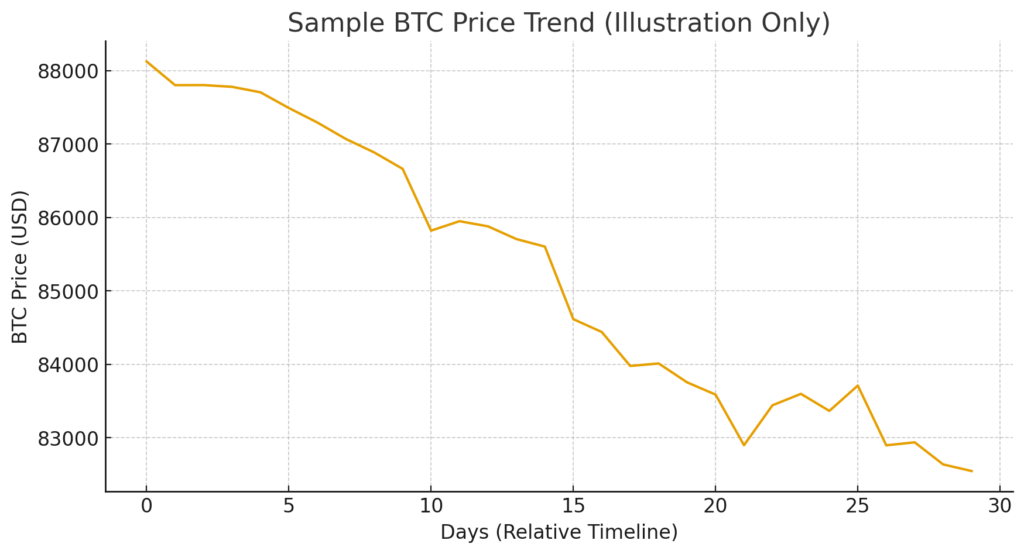
- Bitcoin briefly fell below $88,000 as volatility picked up ahead of a major U.S. macro decision.
- Traders expect further weakness before the FOMC meeting, where a 0.25% rate cut remains widely forecasted.
- Analysts warn that $86,000 is the last critical support for bullish continuation.
- CME futures indicate the formation of another price gap, which historically tends to be filled early in the week.
- Broader macro trends—including liquidity expansion, rate-cut expectations, and tightening vs. easing cycles—remain decisive for BTC’s medium-term direction.
1. Introduction: A Market on Edge Ahead of the FOMC
Bitcoin (BTC) has once again entered a zone of heightened uncertainty, slipping below $88,000 on Sunday as traders prepared for a crucial week dominated by macroeconomic developments in the United States. With the Federal Open Market Committee (FOMC) scheduled to announce its interest-rate decision, market participants are exhibiting caution, reflected in BTC’s sudden weekend pullback from above $89,000 to mid-$87,000 levels.
Although weekend trading volumes were muted, the abrupt two-hour candle drop of approximately $2,000 triggered concerns about whether BTC is positioned for a deeper correction—or preparing for a strong rebound in the days ahead.
2. Weekend Volatility: CME Futures Gap Reappears
One of the most discussed technical elements this week is the likelihood of a new CME futures gap, a recurring pattern in Bitcoin markets. Over the past six months, every CME gap has eventually been filled, according to trader Killa. Because CME futures do not trade on weekends, BTC’s weekend movements often create a gap between Friday’s closing price and Monday’s opening level.
Killa noted that Monday price action frequently defines the weekly trend, stating:
- If Bitcoin rises over the weekend, Monday tends to mark a high-of-week reversal.
- If Bitcoin declines over the weekend, Monday often becomes the week’s low.
Given that BTC fell during this most recent weekend, traders expect Monday volatility to intensify, possibly retesting lower support around $86,000–$87,000.
3. FOMC: The Dominant Macro Catalyst
The core driver of market sentiment this week is the upcoming FOMC decision, where the Federal Reserve is expected—though not guaranteed—to implement a 0.25% rate cut. According to CME’s FedWatch Tool, markets have largely priced this in.
Independent asset manager Peter Tarr summarized the situation:
“The rate-cut decision is the most significant event of the week. Liquidity, risk sentiment, and positioning all depend on it.”
The FOMC meeting also coincides with other macro events, including a delayed JOLTS employment report, further influencing liquidity expectations.
The crypto market historically reacts strongly to FOMC statements, sometimes reversing direction minutes after the announcement as traders attempt to interpret the Federal Reserve’s messaging around future monetary policy.
4. Analyst Expectations: Short-Term Weakness, Medium-Term Strength
Crypto analyst Michaël van de Poppe anticipates that BTC could dip toward $87,000—or even retest $86,000—before staging a recovery. He argues that macro liquidity conditions remain favorable for Bitcoin’s long-term trajectory:
- Quantitative tightening (QT) is slowing.
- Liquidity injections are rising in several global markets.
- A rate-cut cycle generally supports risk assets.
- BTC could reclaim $92,000 and aim for $100,000 within 1–2 weeks if key support levels hold.
Van de Poppe calls $86,000 the “final line of defense” for bulls. Breaking below it could shift momentum toward a deeper decline.
5. Macro Liquidity: Why BTC Remains Highly Sensitive
Bitcoin is now deeply intertwined with global liquidity cycles. Historically:
- Liquidity expansion → BTC rallies
- Liquidity contraction → BTC consolidates or declines
A 0.25% rate cut would mark a shift toward easing, but more important is the Fed’s tone:
- If the FOMC hints at multiple cuts in 2025, BTC may surge.
- If the FOMC signals caution or data-dependent positioning, BTC could remain range-bound.
- If QT reduction is formally announced, liquidity will improve further.
In all scenarios, BTC remains highly sensitive to macro conditions. Traders must assess not only price levels but broader economic signals.
6. Market Structure: Where Is BTC Heading Next?
Based on current technical and macro evidence:
Key Resistance Levels
- $89,500 – short-term intra-week ceiling
- $92,000 – breakout threshold
- $100,000 – psychological and technical round number target
Key Support Levels
- $87,000 – initial support from weekend dip
- $86,000 – critical support (“bullish defense line”)
- $82,000–$84,000 – deeper correction zone if support fails
Analysts widely agree that $92,000 must be reclaimed for the next rally phase. Conversely, a breakdown below $86,000 would introduce risk of acceleration to the downside.
7. Comparing With Broader Trends: BTC vs. Macro Assets
To put BTC’s FOMC sensitivity in perspective:
- The S&P 500 has been hovering near all-time highs.
- Bond yields remain volatile, reflecting uncertainty around inflation trajectories.
- Gold has stabilized but is not showing aggressive inflows.
This reinforces that Bitcoin continues to act as a macro risk asset, responding primarily to interest-rate expectations rather than acting merely as a hedge.
8. Implications for Altcoins and New Crypto Opportunities
Your target audience—investors searching for new crypto assets and income opportunities—should note that:
- Altcoins typically lag BTC during macro uncertainty.
- Once BTC stabilizes post-FOMC, capital often rotates into mid-cap and speculative assets.
- Sectors showing strong recent resilience include:
- DeFi protocols benefiting from rising yields
- Liquid staking derivatives (LSDs)
- AI-related crypto infrastructure
- Interoperability networks
If BTC rebounds strongly after FOMC, these sectors are likely to see renewed inflows.
9. Forward-Looking View: What Happens After the FOMC Decision?
If the Fed cuts 0.25%:
- Expect near-term BTC volatility, then potential upside toward $92,000–$100,000
- Risk assets likely stabilize and recover
- CME gaps may be filled early in the week
If the Fed holds rates unchanged:
- A temporary BTC drop toward $85,000–$86,000 becomes more likely
- Altcoins may remain muted
- Traders may wait for more clarity from Powell’s press conference
If the Fed signals accelerated easing:
- BTC could rally sharply, breaking $92,000 and triggering the next leg upward
10. Conclusion: Preparing for a High-Volatility Week
Bitcoin’s recent dip below $88,000 signals heightened tension ahead of a major macroeconomic decision. Technical factors—such as CME gaps and weekend reversals—add further complexity. Yet the most important forces driving BTC’s next major move remain macro-driven: interest rates, liquidity, and the Federal Reserve’s messaging.
For investors searching for new crypto assets, yield opportunities, and real-world blockchain applications, this FOMC week may mark a turning point. Whether BTC retests support or surges toward six-figure territory, the days ahead will define the market’s momentum into early 2026.