
Main Points :
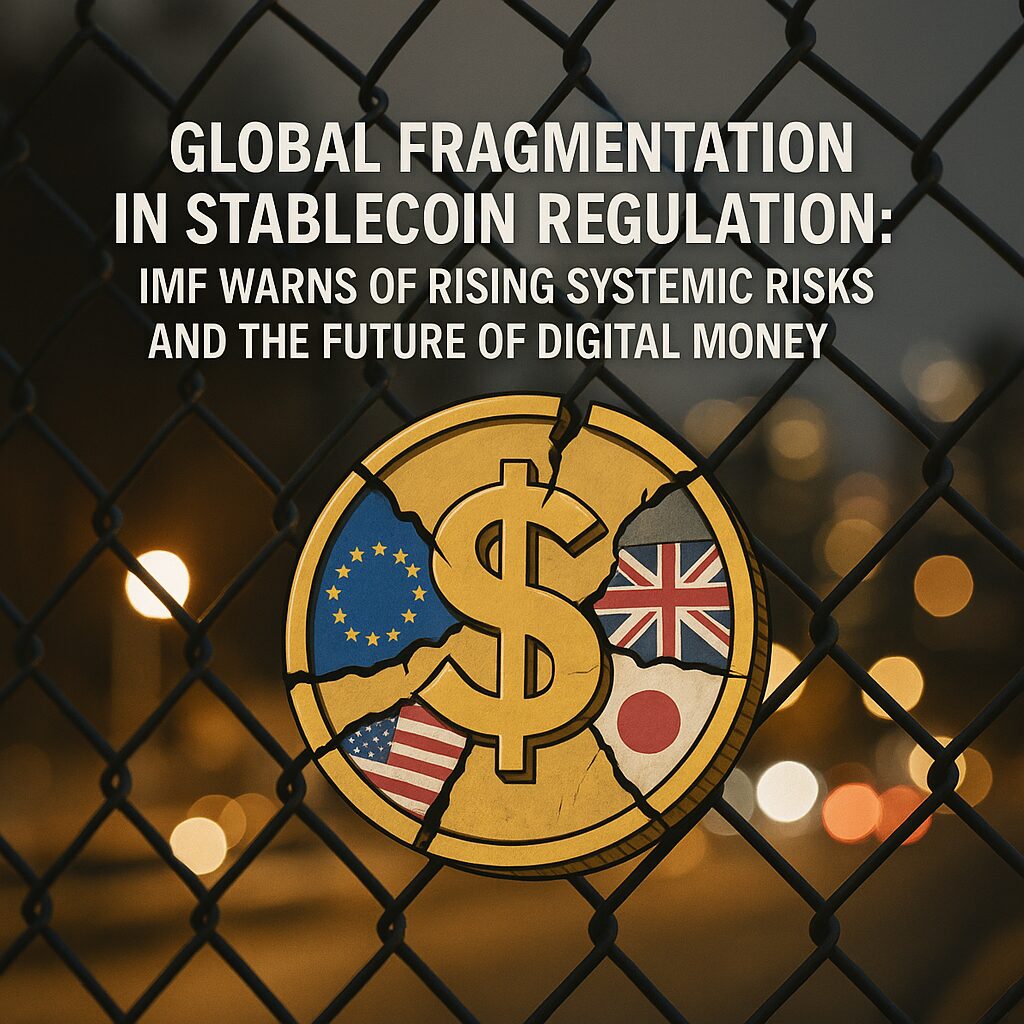
- Global regulatory fragmentation in stablecoins is increasing systemic risk, according to the IMF.
- Divergent rules across the U.S., EU, U.K., Japan, and emerging markets create arbitrage risks and weaken oversight.
- Technical fragmentation across blockchains increases cost, slows adoption, and complicates cross-border settlement.
- Stablecoins are now a $300B+ global asset class dominated by USD-pegged tokens (mainly USDT and USDC).
- Large reserve exposures to U.S. Treasury markets mean stablecoins are now tightly linked to traditional finance.
- IMF warns of monetary sovereignty risks—especially in emerging markets where “digital dollarization” is accelerating.
- The report calls for a unified global definition, harmonized reserve rules, and shared cross-border supervision.
📊 Insert Graph 1 Here: Global Stablecoin Market Share
(Use file: /mnt/data/stablecoin_market_share.png)📊 Insert Graph 2 Here: USDT Reserve Composition
(Use file: /mnt/data/usdt_reserve_composition.png)
Introduction: Why Stablecoin Regulation Now Matters More Than Ever
Stablecoins—crypto-tokens pegged to stable assets such as the U.S. dollar—have transformed from niche blockchain utilities to a core pillar of global digital finance. Their explosive growth, now exceeding $300 billion, has driven innovation in payments, decentralized finance (DeFi), cross-border remittances, and on-chain financial products.
Yet this rapid growth has come with major disparities in global oversight. Today, the International Monetary Fund (IMF) warns that the world is moving toward regulatory fragmentation that threatens financial stability, weakens investor protection, and slows the development of efficient global payment rails.
In its latest report, “Understanding Stablecoins,” the IMF analyzes the United States, European Union, United Kingdom, Japan, and major emerging markets—concluding that the regulatory environment is inconsistent, incomplete, and vulnerable to regulatory arbitrage.
This article summarizes the IMF findings, integrates recent developments from the U.S. SEC, EU MiCA framework, Asia’s regulatory shifts, and trends from stablecoin issuers such as Circle and Tether. It also examines the potential implications for investors, startups, payment networks, and VASP/EMI operators.
I. Global Fragmentation: A System at Risk
The IMF outlines a critical concern: different countries treat stablecoins in completely different ways, creating a patchwork of rules that fails to address cross-border flows.
1. Divergent Legal Classifications
- Some countries treat stablecoins as securities.
- Others regulate them as payment instruments.
- Certain jurisdictions permit only bank-issued tokens.
- Many emerging markets have no framework at all.
This inconsistency enables issuers to operate from lightly regulated jurisdictions while serving users in more heavily regulated markets—limiting the ability of authorities to enforce reserve requirements, oversee redemption mechanisms, or monitor AML/KYC compliance.
2. Regulatory Arbitrage Risks
The IMF notes a rise in:
- Offshore issuance
- Insufficient reserve transparency
- Misaligned liquidity controls
- Cross-border flows that bypass local oversight
This leads to weakened supervisory capabilities, and increases systemic risk—especially when large stablecoins hold enormous portfolios of short-term sovereign debt.
3. Dependence on U.S. Treasury Markets
IMF data shows the composition of major stablecoin reserves:
- USDC: ~40% short-term U.S. Treasuries
- USDT: ~75% short-term U.S. Treasuries, ~5% Bitcoin
This means stablecoins are directly exposed to traditional financial markets. A large wave of redemptions could trigger forced selling, pressuring Treasury markets and impacting global liquidity.
II. Technical Fragmentation: A Hidden Barrier to Global Payments
In addition to regulatory gaps, the IMF highlights technical fragmentation—stablecoins operate across diverse blockchains that are not fully interoperable.
Examples include:
- Ethereum
- Tron
- Solana
- BNB Chain
- Polygon
- Stellar
Because not all tokens are supported across all chains or exchanges, users face:
- Higher transaction costs
- Complex settlement paths
- Lack of universal messaging standards
- Slower global payment development
For enterprises or VASPs building global settlement rails, this fragmentation significantly increases development and compliance overhead.
III. The Dollar Dominates the Digital Currency Battlefield
Stablecoins have become a form of “digital dollar”, with profound geopolitical consequences.
The IMF confirms that:
USD-pegged tokens dominate the market, with USDT and USDC representing the vast majority of supply.
This trend:
- Undermines local currency demand
- Accelerates “digital dollarization”
- Impacts monetary policy transmission
- Reduces the effectiveness of capital controls
In markets where inflation is high, stablecoins naturally become a tool for savings and remittances—further eroding local financial sovereignty.
IV. Wider Financial Stability Risks Identified by the IMF
The IMF highlights several systemic vulnerabilities:
1. Redemption Shock Scenario
If users rush to redeem stablecoins:
- Issuers must rapidly liquidate Treasury bills
- This disrupts short-term funding markets
- Money market liquidity tightens
- Yields could spike
- Financial policy transmission becomes unstable
This is similar to risks seen in money market funds.
2. Interconnectedness of Digital and Traditional Finance
Stablecoin ecosystems are now tightly linked to:
- Banks
- Custodians
- Crypto exchanges
- Investment funds
- Payment processors
These interdependencies increase the risk of contagion—digital asset volatility can spill into traditional finance.
3. Use in AML, Evasion, and Capital Flight
Stablecoins can circumvent capital controls using:
- Unhosted wallets
- Offshore platforms
- Cross-chain bridges
Regulators increasingly highlight this as a national-level risk.
V. IMF Policy Recommendations: Toward a Unified Global Framework
The IMF calls for a coordinated global effort and proposes the following:
1. A Unified Global Definition of Stablecoins
Avoiding ambiguity such as “payment instrument,” “security token,” or “digital commodity.”
2. Harmonized Reserve Requirements
Covering:
- Liquidity standards
- Redemption windows
- Composition limits
- Mandatory disclosures
3. Cross-Border Supervisory Cooperation
Shared databases and unified monitoring mechanisms.
4. Technical Standards for Interoperability
Including blockchain messaging and settlement frameworks.
5. Integration With the Coming Era of CBDCs
Central bank digital currencies may coexist or interoperate with stablecoins—but require aligned standards.
VI. Recent Global Developments (Additional Research)
To complement the IMF data, here are recent 2024–2025 stablecoin developments:
1. United States
- Ongoing legislative proposals for a Stablecoin Regulation Act
- SEC tightening rules on reserve disclosures
- Circle applying for U.S. national bank charter
2. European Union (MiCA)
- MiCA stablecoin rules start full implementation in 2025
- Issuers must meet strict capital requirements
- Daily transaction limits for e-money tokens
3. United Kingdom (FCA)
- Required approval for crypto asset promotions
- Emphasis on custodial segregation
- Stablecoin payment regulations expanding in 2025
4. Asia
Japan: allows only bank-type or trust-backed stablecoins
Singapore: MAS introducing risk-based reserve rules
Hong Kong: exploring retail stablecoin licensing
5. Tether and Circle Developments
- Tether now publishes monthly reserve attestations
- Circle expanding USDC to new blockchains
- Both are investing in tokenized Treasury products
These trends reinforce the IMF’s conclusion: fragmentation is increasing, not decreasing.
Conclusion: A Defining Moment for the Future of Digital Money
The IMF’s findings serve as a turning point. Stablecoins are no longer experimental—they are systemic, globally connected, and economically influential.
For innovators, exchanges, and VASPs, the message is clear:
The future belongs to stablecoin systems that are transparent, well-reserved, interoperable, and compliant with globally harmonized standards.
As regulation evolves, we will likely see:
- Consolidation of issuers
- Greater institutional adoption
- Integration with CBDC frameworks
- Emergence of global settlement networks
- More stablecoin-based payment corridors
Stablecoins will continue to grow—and the institutions that prepare for unified oversight and cross-border interoperability will shape the next era of digital finance.



