
Main Points :
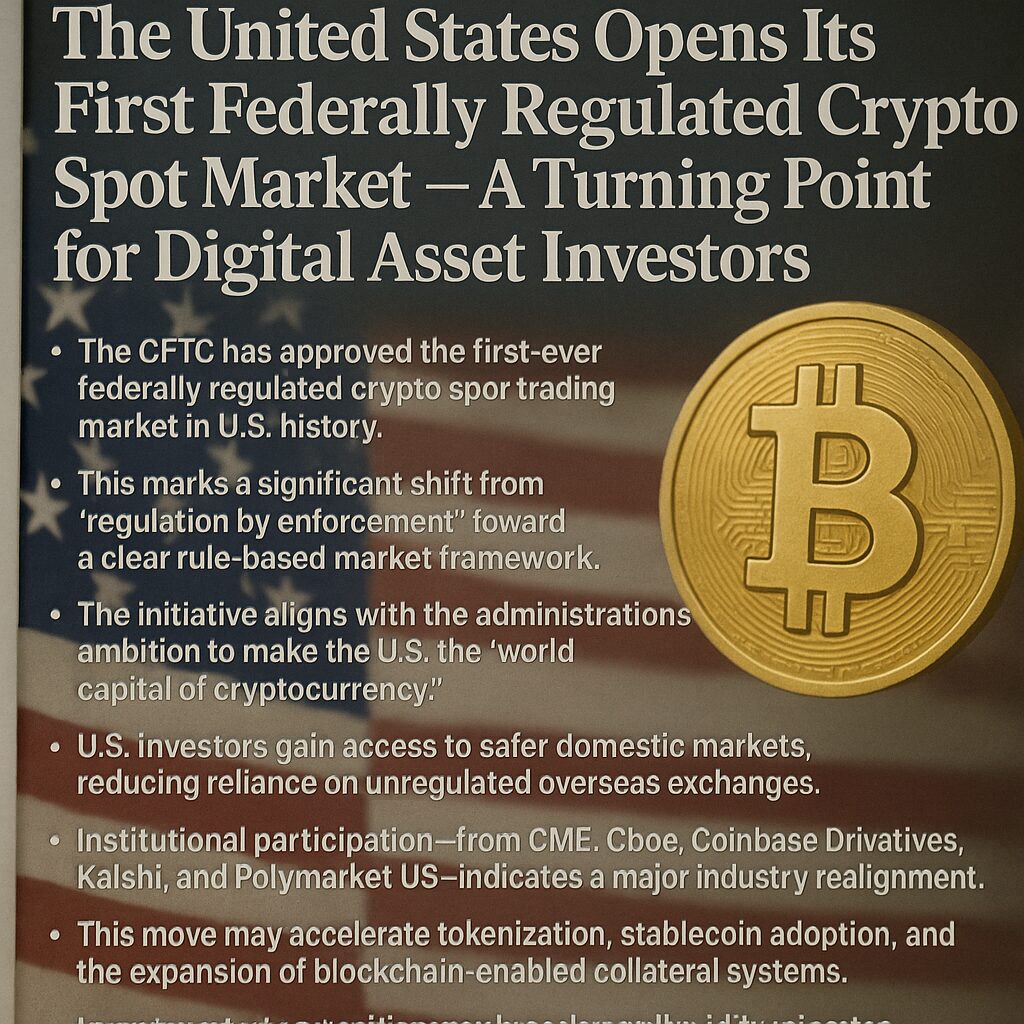
- The CFTC has approved the first-ever federally regulated crypto spot trading market in U.S. history.
- This marks a significant shift from “regulation by enforcement” toward a clear rule-based market framework.
- The initiative aligns with the administration’s ambition to make the U.S. the “world capital of cryptocurrency.”
- U.S. investors gain access to safer domestic markets, reducing reliance on unregulated overseas exchanges.
- Institutional participation—from CME, Cboe, Coinbase Derivatives, Kalshi, and Polymarket US—indicates a major industry realignment.
- This move may accelerate tokenization, stablecoin adoption, and the expansion of blockchain-enabled collateral systems.
- Investment opportunities may broaden as liquidity migrates into fully regulated U.S. venues.
1. Introduction: A Historic Shift in U.S. Crypto Regulation
For nearly a decade, the United States has struggled to define a stable regulatory structure for digital assets. Although Bitcoin and Ethereum futures have traded on U.S. regulated exchanges for years, the absence of crypto spot trading within federal market infrastructure presented a glaring inconsistency: American investors could speculate on derivatives of digital assets domestically but were forced offshore to purchase the underlying assets themselves.
This contradiction has now been resolved.
On December 4, Acting Chair Caroline Pham of the Commodity Futures Trading Commission (CFTC) announced that a CFTC-registered futures exchange is officially authorized to offer spot cryptocurrency trading. This is the first instance in U.S. federal market history—nearly 100 years of regulatory tradition rooted in the gold standard era—where crypto spot assets can be traded on an exchange that carries full federal oversight.
Pham framed this development as a direct response to recent security breaches and collapses at overseas exchanges, emphasizing that American users urgently need access to safe, transparent, and well-regulated trading venues.
2. Why This Matters for Investors and Builders
2.1 A Safer Alternative to Offshore Markets
For years, U.S. traders have relied on platforms located in jurisdictions with minimal investor protection. Billions of dollars in trading volume flowed offshore, exposing users to:
- Hacks
- Mismanagement
- Insolvency
- Manipulative trading practices
With CFTC-regulated spot markets now available domestically, this balance shifts dramatically. Investors gain:
- Federal-standard custodial safeguards
- Capital adequacy requirements
- Transparent order books
- Surveillance and manipulation-prevention systems
This marks the beginning of an institutional-grade spot market—something many asset managers and financial advisers have demanded before allocating to digital assets.
3. The Political and Regulatory Context
3.1 A Strategic Fulfillment of Policy Goals
The administration has framed digital assets as a competitive priority, previously pledging to make the United States the “world capital of cryptocurrency.” Establishing a regulated spot framework is essential to that goal.
Pham noted that regulators spent more than a decade acknowledging demand for clearer rules but defaulted instead to “regulation by enforcement.” This led to:
- Massive fines on crypto firms
- Frequent litigation
- Lack of predictable rules for investors
- Absence of federally supervised trading venues
The new framework addresses this gap and introduces standardized protections for all participants.
3.2 Coordination With SEC and Inter-Agency Task Forces
The decision draws on:
- Recommendations from the Presidential Working Group for Digital Asset Markets
- Outputs from the CFTC’s Digital Asset Sprint, evaluating stakeholder input and technological requirements
- Ongoing discussions with the Securities and Exchange Commission
These collaborative efforts clarify responsibilities between agencies and open the door to integrated supervision across both commodities and securities markets.
4. A Broader Technological Shift: Tokenization, Stablecoins, and Market Infrastructure
One overlooked detail in the announcement is the explicit recognition of tokenized collateral and stablecoins as part of the evolving derivatives ecosystem.
The CFTC’s Digital Asset Sprint suggested modernizing rules to support:
- Tokenized cash equivalents
- Blockchain-based settlement workflows
- Programmable collateral management
This is particularly relevant for institutional investors seeking real-time margining, faster settlement cycles, and better cross-border liquidity access.
5. The Industry Responds: CME, Cboe, Coinbase, Kalshi, Polymarket
Major players—including traditional derivatives giants and leading crypto-native organizations—participated in the discussions that shaped this approval:
- Chicago Mercantile Exchange (CME)
- Cboe Futures Exchange (CFE)
- ICE Futures
- Coinbase Derivatives
- Kalshi
- Polymarket US
Their involvement underscores a broader trend: digital assets are converging with mainstream financial infrastructure, and regulated spot markets are the missing keystone.
6. Recent Global Developments Strengthening the Case
Beyond the U.S., global regulatory momentum has accelerated:
- The EU has implemented MiCA, a sweeping regulatory framework for exchanges and stablecoin issuers.
- The UK is approaching a full licensing model for crypto service providers.
- Japan continues to refine its tokenized securities system and stablecoin issuance structure.
- Singapore and Hong Kong are competing to attract institutional digital asset liquidity.
The U.S. entry into regulated spot trading reduces the risk of losing global market leadership to other jurisdictions.
7. Market Impact: How This Could Affect Crypto Prices and Investment Trends
7.1 Liquidity Returning to the United States
With a federally regulated spot market, institutional money—previously cautious due to legal uncertainty—is expected to re-enter:
- Pension funds
- Hedge funds
- Insurance companies
- Corporate treasuries
Greater liquidity usually leads to narrower spreads, healthier price discovery, and reduced volatility—conditions that benefit long-term investors.
7.2 A Boost to Bitcoin and Ethereum Market Structure
BTC and ETH remain the dominant assets for institutional portfolios. A regulated spot market could increase demand significantly, similar to how gold benefited from futures approval in the early 1970s and ETFs in the 2000s.
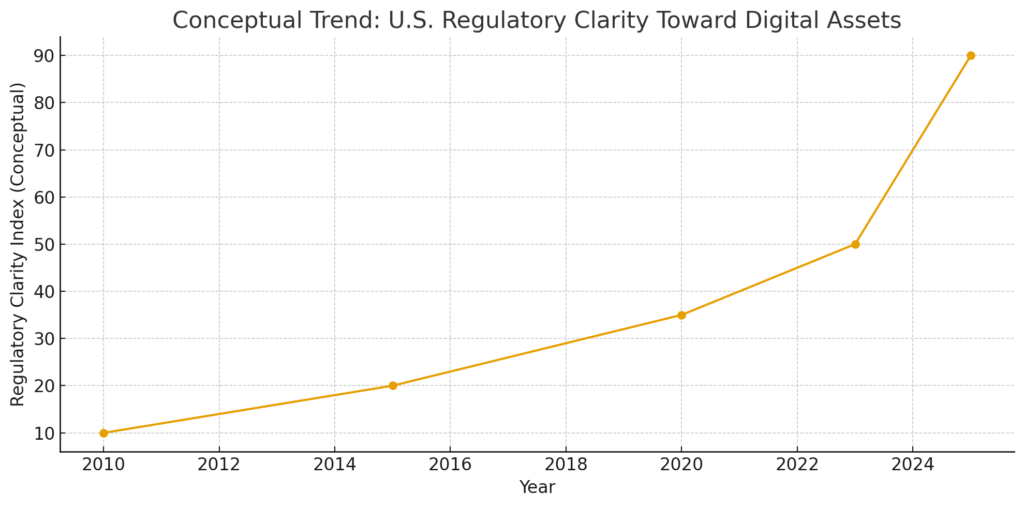
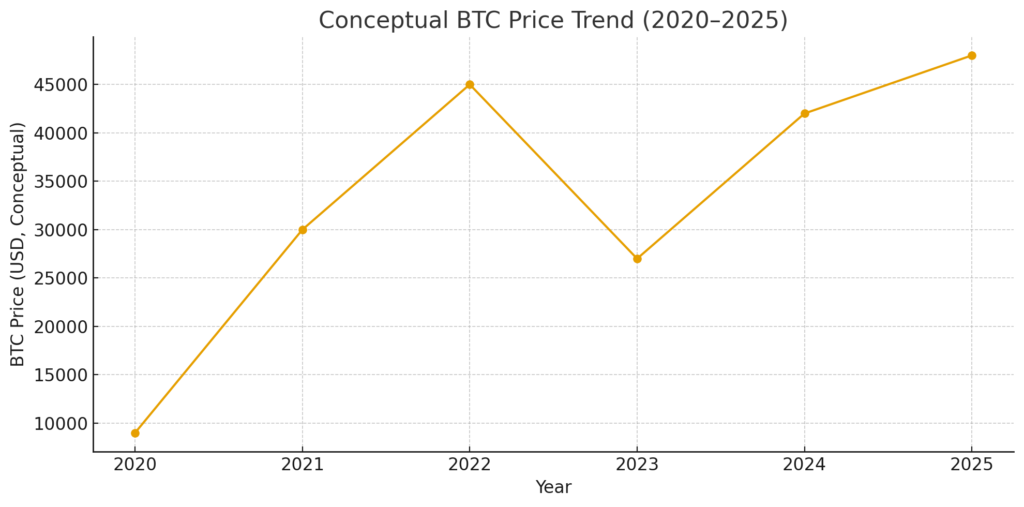
8. Price Context: Conceptual Overview of BTC’s Trend (2020–2025)
A conceptual illustration below helps contextualize the correlation between regulatory clarity and asset market maturity:
9. Implications for New Token Projects and Builders
For developers, the emergence of regulated spot markets may unlock:
- Compliance-ready token listings
- Improved banking access
- Lower counterparty risk
- Expanded developer ecosystems
- Institutional-grade liquidity pools
New tokens that conform to transparent governance and compliance frameworks may see stronger early-stage adoption.
10. Implications for Yield Seekers and Alternative Asset Investors
For readers actively seeking new income sources or emerging crypto assets:
- Regulated spot venues provide safer exposure options.
- Tokenization markets could introduce interest-bearing digital instruments.
- On-chain derivatives may expand under clearer rules.
- Stablecoin-based yield products may gain legitimacy under federal oversight.
Investors no longer need to rely solely on opaque offshore yield platforms.
11. Conclusion: A Defining Moment for Crypto in America
The CFTC’s authorization of the first federally regulated crypto spot market is more than a policy decision—it is a structural transformation of how digital assets integrate into the U.S. financial system.
For investors, it delivers safer and more accessible trading environments.
For developers, it opens a path toward compliant innovation.
For institutions, it resolves long-standing uncertainty and unlocks mainstream adoption.
This milestone shifts the center of gravity of the crypto market back toward the United States and may set the stage for the next major expansion of blockchain-based financial products.



