

Main Points :
- JP Morgan analysts argue Strategy’s liquidity strength is more important for BTC’s short-term outlook than miner activity.
- Bitcoin production cost is estimated at $90,000, pressuring high-cost miners amid rising energy prices.
- Strategy’s enterprise-value-to-BTC ratio remains above 1.0, signaling reduced risk of forced BTC liquidation.
- A newly created $1.44B USD reserve allows Strategy to cover dividend and interest payments for up to two years.
- MSCI index removal risk is mostly priced in after a 40% stock decline since October.
- Long-term investors should monitor liquidity resilience among major corporate BTC holders, not hashrate fluctuations alone.
Subtitle: Introduction — Why Strategy Now Matters More Than Miners
In the evolving landscape of Bitcoin economics, much of the traditional short-term analysis has focused on miner behavior—hashrate, mining difficulty changes, forced liquidations, and profitability cycles. However, newly published research from JP Morgan challenges this premise and places corporate Bitcoin treasuries—especially Strategy—at the center of market stability.
Strategy, the largest institutional holder of Bitcoin, now owns more than 650,000 BTC, a treasury that exceeds the reserves of many sovereign entities. JP Morgan argues that the company’s balance-sheet resilience has become a decisive factor in the BTC price outlook, overshadowing even large-scale miner behavior.
Their new report highlights three critical pressures affecting Bitcoin today:
- Falling hashrate and mining difficulty as China re-tightens mining restrictions.
- Rising global energy prices, which have pushed miner profitability to unsustainable levels.
- Concerns around Strategy’s ability to avoid BTC liquidation during dividend and debt cycles.
The third factor, JP Morgan says, is the most powerful.
Below, we examine the reasoning behind this shift, incorporate recent market data, and outline what investors looking for new crypto revenue opportunities should pay attention to as 2025 progresses.
Subtitle: Miner Stress Grows, but It Isn’t the Key Driver Anymore
For years, miner capitulation cycles have served as reliable indicators for Bitcoin macro bottoms. When energy costs surge or BTC price drops below mining cost, weak miners often liquidate holdings, temporarily creating market pressure.
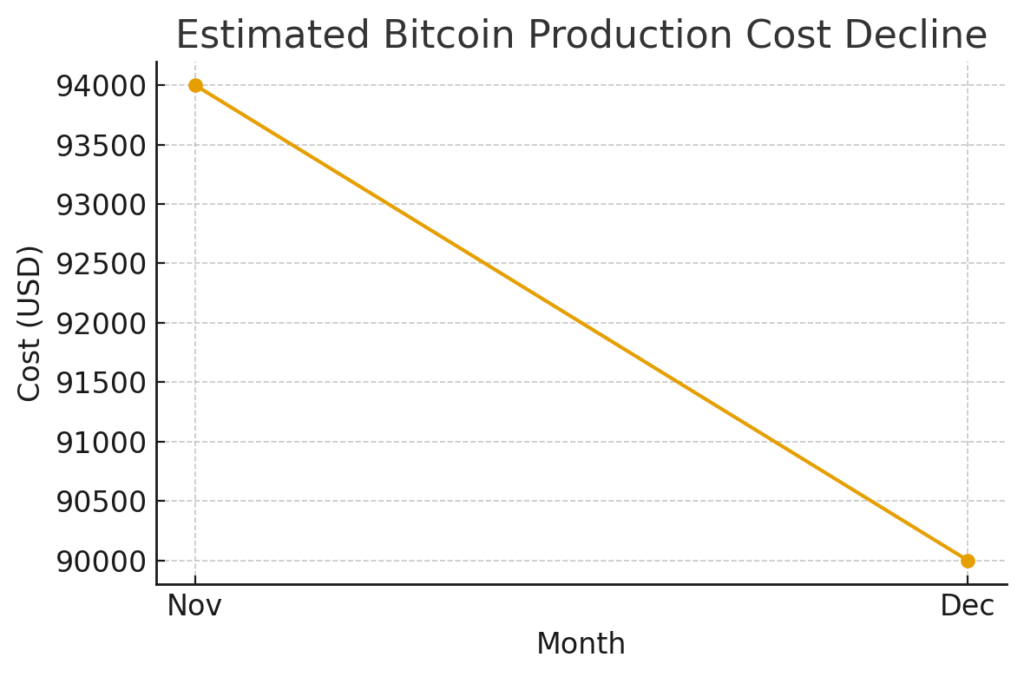
JP Morgan estimates the current global Bitcoin production cost at $90,000, down from $94,000 last month, assuming an electricity rate of $0.05/kWh. According to their model, each $0.01/kWh increase in electricity price raises production cost by $18,000 for high-cost miners.
This means:
- Miners operating above the cost threshold are already underwater.
- Some miners have begun selling BTC to survive the current energy-price environment.
- These sales may create localized pressure but do not define the direction of the market.
Why? Because miner BTC holdings are now dwarfed by the reserves held by corporate treasuries like Strategy.
Subtitle: Strategy’s Liquidity Strength Determines Market Sentiment
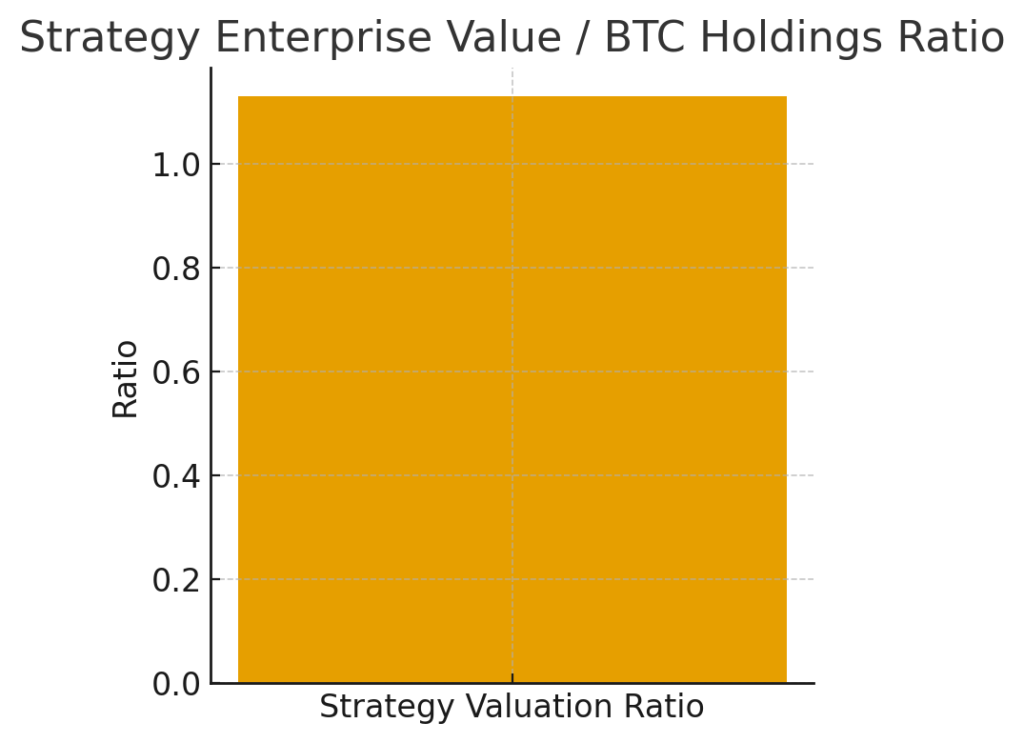
The most important metric JP Morgan identifies is the enterprise-value-to-BTC-holdings ratio, currently sitting at 1.13. This ratio compares the total market capitalization, preferred shares, and liabilities of Strategy with the market value of its Bitcoin holdings.
A ratio above 1.0 means:
- Strategy’s corporate valuation exceeds the value of its BTC treasury.
- The company is unlikely to be forced into selling BTC to cover dividends or debt.
- Market fears around forced liquidation may be overestimated.
JP Morgan notes that this ratio fell sharply earlier this year, causing panic, but has since recovered above 1.0. That recovery has helped stabilize BTC sentiment despite broader macroeconomic uncertainty.
The analysts conclude that as long as Strategy can avoid liquidating BTC, the worst of BTC’s price pressure may have already passed.
Subtitle: The $1.44B USD Reserve — A Game-Changer for BTC Stability
One of the most significant developments this quarter is Strategy’s creation of a $1.44 billion USD reserve, enough to cover two years of dividend and interest obligations.
This is strategically critical because:
- Forced liquidation of BTC would have created severe downward pressure.
- A multi-year USD buffer insulates Strategy from macro volatility.
- It buys time for BTC markets to recover naturally without corporate-level selling.
Additionally, Strategy has slowed BTC accumulation in recent weeks, with several weeks of no new purchases. Yet its long-term strategy remains intact, and the company now holds more than 650,000 BTC, strengthening its position as Bitcoin’s dominant corporate custodian.
Subtitle: MSCI Index Removal — Risk Already Priced In
Another factor weighing on market sentiment is the possibility that MSCI may remove Strategy and other digital-asset-treasury (DAT) companies from their equity indices.
According to JP Morgan:
- The downside risk from removal is limited.
- Markets have already priced in the likelihood of exclusion.
Since MSCI began consultations on October 10:
- Strategy’s stock price has fallen 40%.
- It has underperformed BTC by 20%.
- It has lost approximately $18 billion in market capitalization.
JP Morgan argues that this scale of underperformance suggests the market has already assumed the worst-case scenario. Any final decision from MSCI is thus unlikely to create new significant downward pressure.
TD Cowen’s analysts also adjusted Strategy’s price target from $535 to $500, reflecting dilution concerns around raising cash for preferred-dividend obligations. Strategy’s stock currently trades around $186, down 25% this month.
Subtitle: Macro Indicators — What Other Analysts Are Seeing
Recent research from The Block, Decrypt, and several independent market strategists converge on a few shared observations:
1. Bitcoin’s macro bottom may form when miner capitulation slows.
But this alone is no longer sufficient—corporate treasury behavior now plays an equally large, if not larger, role.
2. Institutional flows into BTC ETFs remain steady.
BlackRock and Fidelity continue absorbing spot-market BTC even during downturns, helping stabilize liquidity.
3. Energy markets will influence mining trends throughout 2025.
A new wave of energy shortages across Asia and parts of Europe could further impact miner viability.
4. Bitcoin’s correlation with tech equities remains elevated.
Any significant correction in the NASDAQ or semiconductor sector could spill over into crypto.
Subtitle: What This Means for Investors Seeking New Crypto Assets or Yield Opportunities
For readers looking for:
- new crypto opportunities,
- long-term yield strategies,
- or practical blockchain applications,
this analysis contains several important lessons.
1. Corporate BTC holders have become systemic players.
Strategy’s balance sheet influences BTC more than hashrate fluctuations.
2. Miner capitulation still matters—but less than before.
Investing in mining stocks or hosting operations now requires deeper risk assessment around energy markets.
3. Liquidity buffers are more important than leverage in 2025.
Firms with USD or stablecoin reserves are best positioned to endure volatility.
4. MSCI index changes create opportunities for contrarian investors.
If Strategy stabilizes its valuation ratio and the BTC price rebounds, its stock may present high-risk, high-reward potential.
Subtitle: Final Conclusion — A Market Quietly Resetting for the Next Cycle
JP Morgan’s research introduces a critical shift in how we should evaluate Bitcoin’s short-term cycles. The market is no longer driven primarily by miners but by institutional balance-sheet resilience, especially that of Strategy.
The company’s:
- strong EV/BTC ratio above 1.0,
- newly secured $1.44 billion cash reserve,
- ongoing BTC accumulation strategy,
- and MSCI risks already priced into its equity valuation
all point toward a market gradually moving past its most intense period of downside pressure.
For investors looking for new crypto assets, yield models, or practical blockchain deployment opportunities, the message is clear:



