

Main Points :
- Strategy Inc.’s explicit disclosure of its final liquidation conditions—even when mNAV falls below 1×—sends a strong message of institutional long-term conviction.
- Transparent “strategic liquidation rules” reduce market uncertainty and stabilize expectations.
- Institutional adoption continues to shift from speculation to fundamental belief in Bitcoin as a strategic, long-duration asset.
- Emerging macro trends—U.S. Bitcoin ETF flows, sovereign crypto reserves, and miner consolidation—reinforce the structural bullish outlook.
- Strategy Inc.’s stance may serve as a model for corporate treasuries, regulated financial institutions, and public companies contemplating crypto exposure.
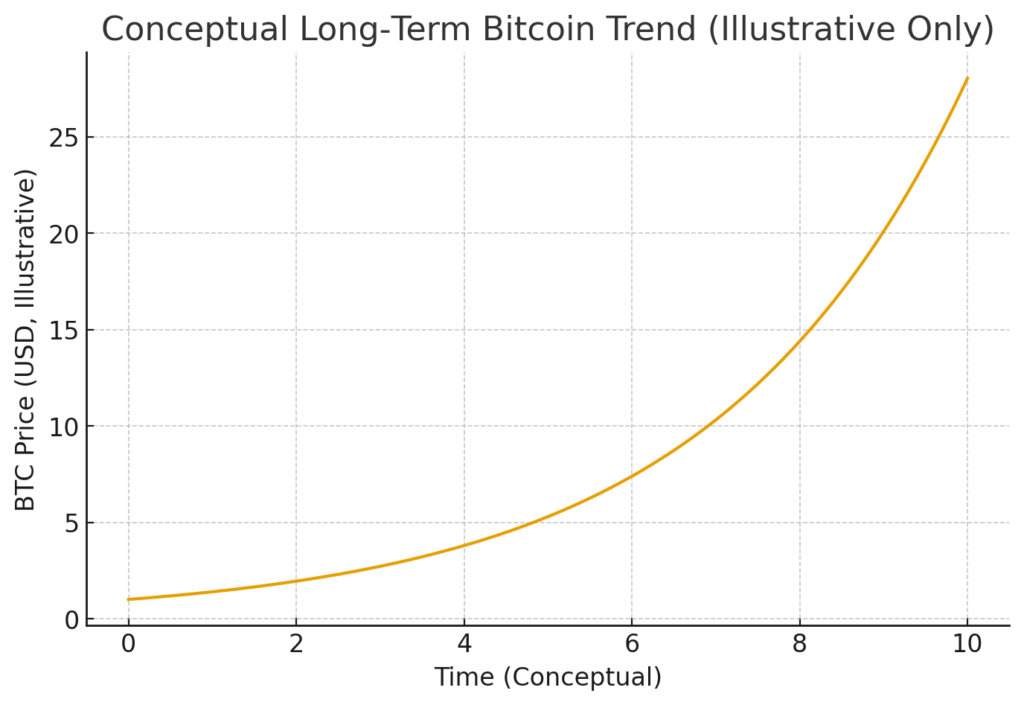
(This chart illustrates a conceptual long-term Bitcoin trend for readers.)
Introduction: A Clear Signal of Long-Term Commitment
Strategy Inc.’s decision to publicly articulate the exact conditions under which it would liquidate its Bitcoin holdings—even at a time when its mining-entity net asset value (mNAV) has fallen below 1×—is not just a corporate announcement. It is a market signal. In fact, it is one of the strongest expressions of institutional confidence the Bitcoin market has seen in 2025.
At its core, Strategy Inc.’s message is simple:
“Short-term valuation swings will not dictate our long-term Bitcoin strategy.”
For an industry accustomed to volatility, leverage-driven liquidations, and “weak hands” selling into fear cycles, the arrival of a highly disciplined, transparent institutional framework marks a pivotal shift. This article explores that shift—building on the original Japanese report but expanding significantly with recent global developments, structural market trends, and insights relevant to investors seeking emerging assets and new sources of return.
1. Unshaken by Unrealized Losses — The Institutional Mindset Behind Long-Term Value
The key insight behind Strategy Inc.’s announcement is the company’s willingness to withstand periods where the value of its Bitcoin portfolio may temporarily fall below acquisition cost or mNAV metrics. Even when the mining-entity net asset value dropped below parity—a moment when many companies would seek to reduce exposure or hedge—Strategy Inc. instead communicated the opposite:
“We will not liquidate unless extreme, clearly defined triggers are met.”
This position reflects three critical institutional beliefs:
1.1 Bitcoin is a long-duration asset, not a trading instrument
Institutional participation increasingly treats Bitcoin like a macro hedge or long-duration technological asset rather than a speculative instrument. Similar to how corporations hold gold reserves or strategic foreign currency balances, Bitcoin is being viewed as a hedge against:
- Dilutive monetary policy
- Declining real yields
- Rising geopolitical and currency fragmentation
- The long-term digital monetization cycle
Strategy Inc.’s stance indicates that it sees Bitcoin not merely as an investment but as a reserve-grade asset.
1.2 Short-term accounting losses ≠ long-term strategic failure
Accounting rules can show impairments even when the underlying thesis remains intact. This is similar to how energy companies or airlines may show temporary losses on fuel hedges while still maintaining strong operational expectations.
Strategy’s emphasis on “final defense line” suggests:
- Market price dips do not change strategic conviction
- Liquidity risk is managed by long-view planning, not reactive selling
- The company understands Bitcoin’s historical drawdowns but focuses on long-term supply-demand fundamentals
1.3 A cultural shift: institutions are no longer afraid of volatility
Once Bitcoin is integrated into a corporate or treasury strategy, the mindset shifts from “trade the volatility” to “endure the volatility”.
Strategy Inc.’s announcement encapsulates this evolution.
2. Transparency and Market Stability — The Role of a Public Liquidation Policy
The most significant aspect of Strategy Inc.’s move is not the content of its liquidation conditions—it is the transparency itself.
2.1 Why transparency matters
In traditional markets, opacity often triggers speculation. But in crypto markets—still young, fragmented, and amplifying fear through social media cycles—opacity leads to:
- Panic selling
- Rumors of forced liquidation
- Cascading liquidations due to leverage and algorithmic strategies
- Loss of confidence among smaller or newer investors
By publishing clear liquidation conditions, Strategy Inc. addressed these risks directly.
2.2 What the “final liquidation defense line” accomplishes
It communicates to the market:
- There will be no unexpected dumping of corporate Bitcoin reserves.
- Sales, if ever required, will be deliberate and pre-signaled by predefined rules.
- The company prioritizes long-term strategic stability over short-term market fluctuations.
In effect, this is not just a corporate policy—it’s a form of market guidance.
2.3 A new standard for financial reporting in crypto
Investor anxiety often stems from uncertainty about whether institutional holders could become forced sellers during downturns.
Strategy Inc.’s approach enhances:
- Trust
- Predictability
- Investor confidence
This type of transparency may become a future compliance expectation once regulatory bodies mature frameworks for corporate digital asset disclosures.
3. Institutional Adoption Deepens — Beyond Speculation Toward Strategic Belief
Strategy Inc.’s disclosure reinforces a broader global phenomenon in 2024–2025:
Institutional Bitcoin adoption has entered a new phase—based on belief, not speculation.
3.1 ETF flows reveal structural demand
Since U.S. spot Bitcoin ETFs launched in 2024, the market has observed:
- Significant daily inflows from pension funds, insurance companies, and sovereign wealth allocations
- A shift toward dollar-cost averaging and strategic treasury positions
- Reduced reactive selling during market corrections
Even when Bitcoin experienced 10–15% retracements, ETF flows remained net positive—showing institutional conviction mirroring that of Strategy Inc.
3.2 Sovereign accumulation begins to influence supply dynamics
Countries such as:
- El Salvador
- Multiple Middle Eastern wealth funds
- Several Southeast Asian sovereign fintech programs
have begun treating Bitcoin as strategic reserves—creating a new class of long-term holders.
3.3 Miner consolidation and mNAV metrics refine industry fundamentals
As mining operations consolidate into larger, financially robust entities:
- mNAV becomes more stable
- Miner reserves act as strategic buffers
- Forced selling becomes less common
Thus, even when mNAV dips below 1×, sophisticated miners (like Strategy Inc.) do not panic sell.
3.4 Corporate balance sheet integration expands
Following early adopters like MicroStrategy, more regulated companies are exploring:
- Bitcoin-denominated treasury buffers
- Crypto-integrated fintech services
- Tokenized cash flow instruments
- Dual-asset hedging strategies
This corporate adoption cycle is much broader and deeper than the 2021 bull run.
4. Why Strategy Inc.’s Policy Matters for the Next Bull Cycle
The disclosure of a long-term liquidation threshold has implications that extend beyond one company.
4.1 It establishes a model for responsible institutional Bitcoin management
Regulators, auditors, and financial institutions increasingly expect:
- Risk management frameworks
- Transparency of holdings
- Stress-testing scenarios
Strategy Inc. provides a blueprint for compliance-aligned Bitcoin strategy.
4.2 It reduces systemic risks of sudden institutional dumping
In every previous market cycle, one major risk was that large holders would abruptly sell into downturns.
With this framework:
- Panic selling becomes less likely
- Market stability improves
- Retail investors gain confidence
4.3 It reinforces the narrative of Bitcoin as a maturing asset class
When companies consciously adopt “defense lines,” they treat Bitcoin similar to:
- Gold reserves
- Strategic commodities
- Long-term investment portfolios
This elevates Bitcoin’s role in global finance.
5. Macro Trends Supporting Strategy Inc.’s Conviction
5.1 Liquidity shifts after global monetary easing cycles
As quantitative easing resumes in parts of Asia and Europe, real yields continue to weaken—making Bitcoin’s fixed supply appealing.
5.2 Rising adoption of stablecoins and on-chain settlement
Stablecoins (USDC, USDT, PYUSD) now settle over $1 trillion monthly globally. This deepens trust in blockchain rails and boosts the surrounding asset ecosystem—including BTC.
5.3 Increasing institutional demand for transparent assets
Institutions prefer assets whose issuance schedules are predictable. Bitcoin’s halving cycles align perfectly with long-term asset allocation frameworks.
Conclusion: A Fundamental Shift in Market Psychology
Strategy Inc.’s explicit disclosure of its Bitcoin liquidation line is more than transparency—it is a declaration of belief.
It demonstrates that:
- Institutional adoption is no longer speculative
- Bitcoin is being integrated as a strategic reserve asset
- Corporate governance and regulatory frameworks are maturing
- Long-term conviction is replacing short-term trading behavior
As more institutions adopt similar policies, Bitcoin’s volatility will likely decrease while its structural upward drift strengthens. For investors seeking new digital assets, income opportunities, or practical blockchain applications, this marks a critical moment:
Bitcoin is entering its institutional era—and Strategy Inc.’s policy is a milestone in that transformation.




