Main Points :
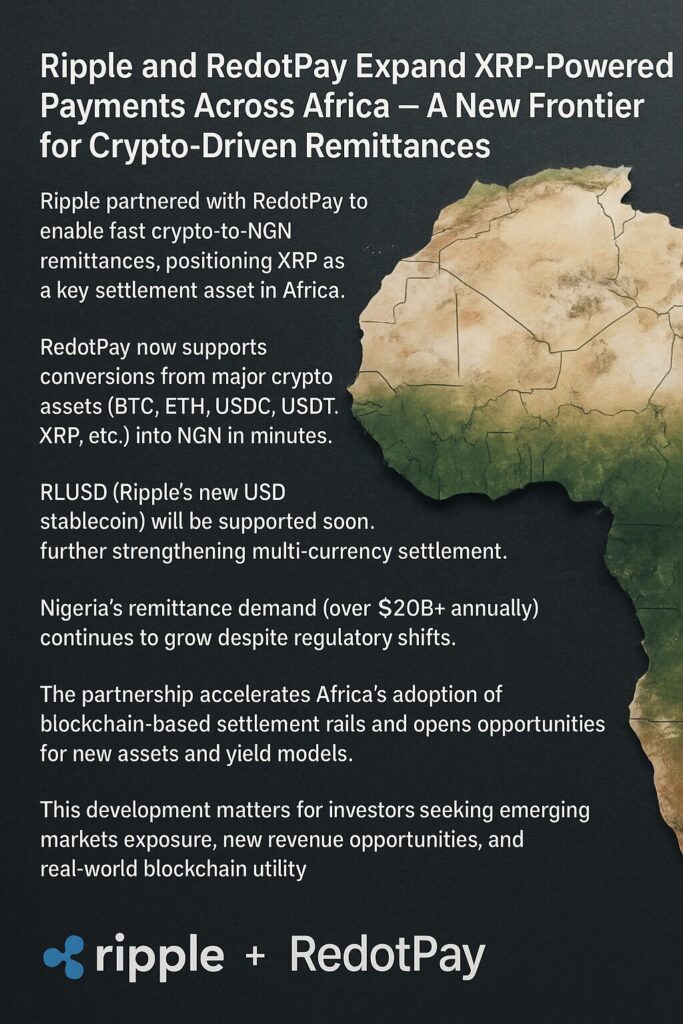
- Ripple partnered with RedotPay to enable fast crypto-to-NGN remittances, positioning XRP as a key settlement asset in Africa.
- RedotPay now supports conversions from major crypto assets (BTC, ETH, USDC, USDT, XRP, etc.) into NGN in minutes.
- RLUSD (Ripple’s new USD stablecoin) will be supported soon, further strengthening multi-currency settlement.
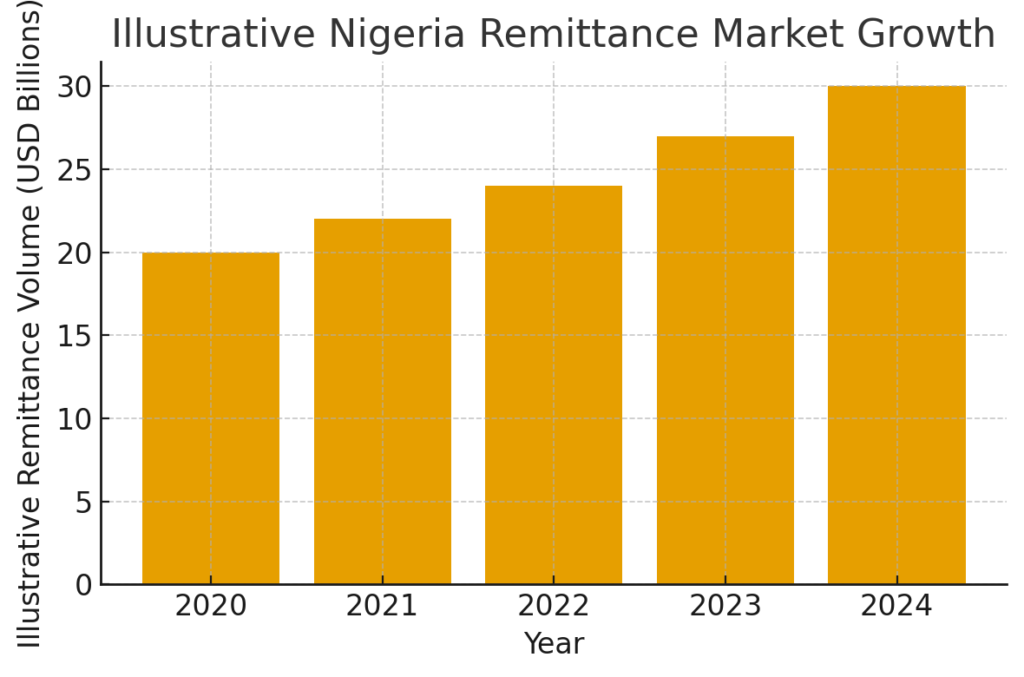
- Nigeria’s remittance demand (over $20B+ annually) continues to grow despite regulatory shifts.
- The partnership accelerates Africa’s adoption of blockchain-based settlement rails and opens opportunities for new assets and yield models.
- This development matters for investors seeking emerging markets exposure, new revenue opportunities, and real-world blockchain utility.
Ripple’s Strategic Push Into Africa Through RedotPay
Ripple’s newly announced partnership with RedotPay marks one of the most significant expansions of blockchain-powered payments into the African continent. By enabling near-instant conversion of digital assets—including XRP—into Nigeria’s national currency, the naira (NGN), Ripple reinforces its strategy of positioning crypto not merely as a speculative investment opportunity but as a true payments infrastructure layer.
This move taps directly into Africa’s rapidly expanding digital finance ecosystem. Nigeria, which has one of the world’s youngest populations and one of the highest crypto adoption rates globally, has become a testing ground for new financial technologies. Ripple’s collaboration attempts to solve real-world inefficiencies: slow settlement times, high fees, and fragmented cross-border payment routes.
The implications extend well beyond remittances. For crypto investors and builders seeking the next high-growth region, Africa remains one of the most promising yet underserved markets. Blockchain-driven payment rails represent both a social utility and a financial opportunity.
The Core Function: Crypto-to-NGN Settlement in Minutes
RedotPay now allows verified users with Nigerian bank accounts to send cryptocurrency and receive NGN almost instantly. Supported assets include:
- USDC
- USDT
- BTC
- ETH
- SOL
- TON
- S
- TRX
- XRP
- BNB
And importantly, Ripple confirmed that RLUSD—its USD-denominated stablecoin—will be supported in the coming phase.
This functionality eliminates two historical pain points:
1. Expensive Brokerage Layers
Traditional methods often require intermediaries who convert crypto to USDT, then to USD, and finally into NGN, each adding spread and commission fees.
2. Long Settlement Delays
Bank transfers through SWIFT or regional corridors can take hours or even days.
Crypto settlement reduces this process to minutes, allowing users to treat digital assets as liquid instruments, not static investments.
The ability to convert directly into NGN is notable because Nigeria commands one of the largest demand profiles for remittances and digital payment services in Africa. Even with regulatory complexities, users consistently seek faster and more cost-efficient alternatives to legacy banking infrastructure.
Expansion of Ripple Payments Into Multi-Market Operations
RedotPay is integrating Ripple Payments into its multi-market settlement stack. This allows the company to seamlessly expand beyond Nigeria into other emerging markets.
This expansion is already underway:
- Brazil: RedotPay supports outbound remittances.
- Mexico: One of the largest crypto-to-fiat corridors in the world (boosted by US remittance flows).
- Nigeria: Now fully supported for crypto-to-NGN conversions.
Africa’s remittance demand alone exceeds $95B annually, and Nigeria accounts for more than $20–$30B of that flow depending on the year (USD equivalent).
For crypto investors, this trend demonstrates a rising opportunity for utility tokens, stablecoins, liquidity providers, and yield-generating treasury structures in emerging markets.
Why Ripple Chose Nigeria
Nigeria is a natural first step for scaling crypto-based payment infrastructure in Africa due to:
1. Extremely High Digital Adoption
Nigeria consistently ranks among the world’s top countries for crypto usage.
Younger users adopt blockchain technology rapidly due to:
- Low trust in local banking systems
- High inflation
- Capital controls
- A large population of freelancers, remote workers, and digital-native entrepreneurs
2. Massive Remittance Needs
Nigeria depends heavily on foreign remittances for household income.
Cross-border payments therefore represent a large, stable demand base.
3. Regulatory Evolution, Not Rejection
Although Nigeria previously imposed restrictions on crypto operations, the government has since clarified that regulated businesses may operate.
This creates a controlled but open environment in which Ripple and compliant partners like RedotPay can introduce responsible financial products.
Regulatory Landscape: Nigeria’s Transition Toward Supervised Crypto Activity
In recent years, Nigeria’s Securities and Exchange Commission (SEC) has updated regulations on:
- Crypto marketing
- Exchange operations
- Consumer protection
- Risk disclosure
While previous enforcement actions focused on addressing harmful practices, the current environment is more nuanced: compliant digital payment providers are allowed to continue operating.
This is particularly important for international providers because it signals regulatory acceptance of stable, corporate-grade infrastructure. Ripple’s enterprise-focused approach places it in a favorable position compared to unlicensed exchanges or consumer speculation platforms.
The collaboration with RedotPay reflects this regulatory shift: rather than bypassing local rules, the companies are aligning with them.
What This Means for Ripple’s RLUSD Stablecoin
Ripple’s upcoming stablecoin, RLUSD, plays a major role in the next phase of this ecosystem. By integrating RLUSD into RedotPay’s settlement stack, Ripple can:
- Provide a regulated USD-backed asset for remittances
- Compete with USDT and USDC in emerging markets
- Expand on/off-ramps into Africa
- Reduce volatility risk for users
For investors, RLUSD’s adoption in markets with high USD demand—such as Nigeria—creates opportunities for:
- Liquidity provision
- Treasury management
- Market-making revenue
- On-chain FX products
If RLUSD usage grows in Africa, Ripple may shape one of the world’s largest stablecoin corridors outside the United States.
Africa’s Growing Blockchain Adoption: A Wider Perspective
While Nigeria is the focus of this announcement, Africa’s overall crypto momentum is accelerating. Several trends highlight this:
1. Informal FX Markets Drive Crypto Demand
In countries with currency instability, crypto provides a parallel alternative for value storage and cross-border transfer.
2. Mobile-First Finance Supports Crypto Rails
Africa’s fintech ecosystem is mobile-native.
This reduces adoption barriers because users do not need traditional banking infrastructure.
3. Government Digital Currency Experiments
Nigeria already launched the eNaira, a central bank digital currency (CBDC).
While adoption has been slow, the government remains open to digital financial innovation.
This environment makes Africa an ideal testbed for blockchain payment systems, and major players—including Ripple—are positioning themselves early.
Why This Partnership Matters for Crypto Investors
Users of your platform may be seeking:
- New digital assets
- New yield or revenue opportunities
- Practical blockchain utility
- Market expansion potential
This Ripple–RedotPay partnership signals several key opportunities:
1. XRP’s Increasing Role in Real-World Utility
When XRP acts as a settlement bridge between currencies, it gains non-speculative demand.
2. Stablecoin Revenue in High-Volume Corridors
Markets like Nigeria have strong USD demand.
Liquidity providers can capture revenue from spreads, swaps, and FX-like transactions.
3. Emerging Market Penetration
Africa is modernizing rapidly, and crypto-native companies are replacing old payment infrastructure.
4. Infrastructure Expansion for Developers
For builders, access to seamless crypto-to-fiat rails allows:
- Wallet integrations
- Treasury products
- Fiat settlement APIs
- Yield products built on top of these rails
Ripple’s payments infrastructure may power the next generation of African fintech.
Future Outlook: A Potential Pan-African Crypto Payments Network
RedotPay’s expansion across Nigeria, Brazil, and Mexico points toward a larger vision:
- Multi-country settlement
- Multi-asset liquidity aggregation
- Stablecoin corridors
- Cross-border business payments
- Instant remittances
If Ripple continues to expand through strategic partners, Africa could soon host one of the most advanced blockchain-based payment ecosystems in the world.
For investors and businesses seeking long-term global expansion, this partnership signals that Africa is entering a new phase of digital finance—one in which blockchain is not merely an experiment but the preferred infrastructure.
Conclusion
Ripple’s alliance with RedotPay is more than a technical integration—it is a strategic move into Africa’s high-demand remittance and payments markets. By enabling fast, low-cost conversions from major cryptocurrencies into NGN and soon RLUSD, Ripple establishes itself as a leading infrastructure provider.
For readers seeking new crypto assets, yield opportunities, or real-world blockchain utility, Africa represents a rapidly emerging frontier. This partnership showcases how crypto-based settlement can address genuine economic challenges and generate sustainable value—not only for users on the ground but also for global investors and developers.