Main Points :
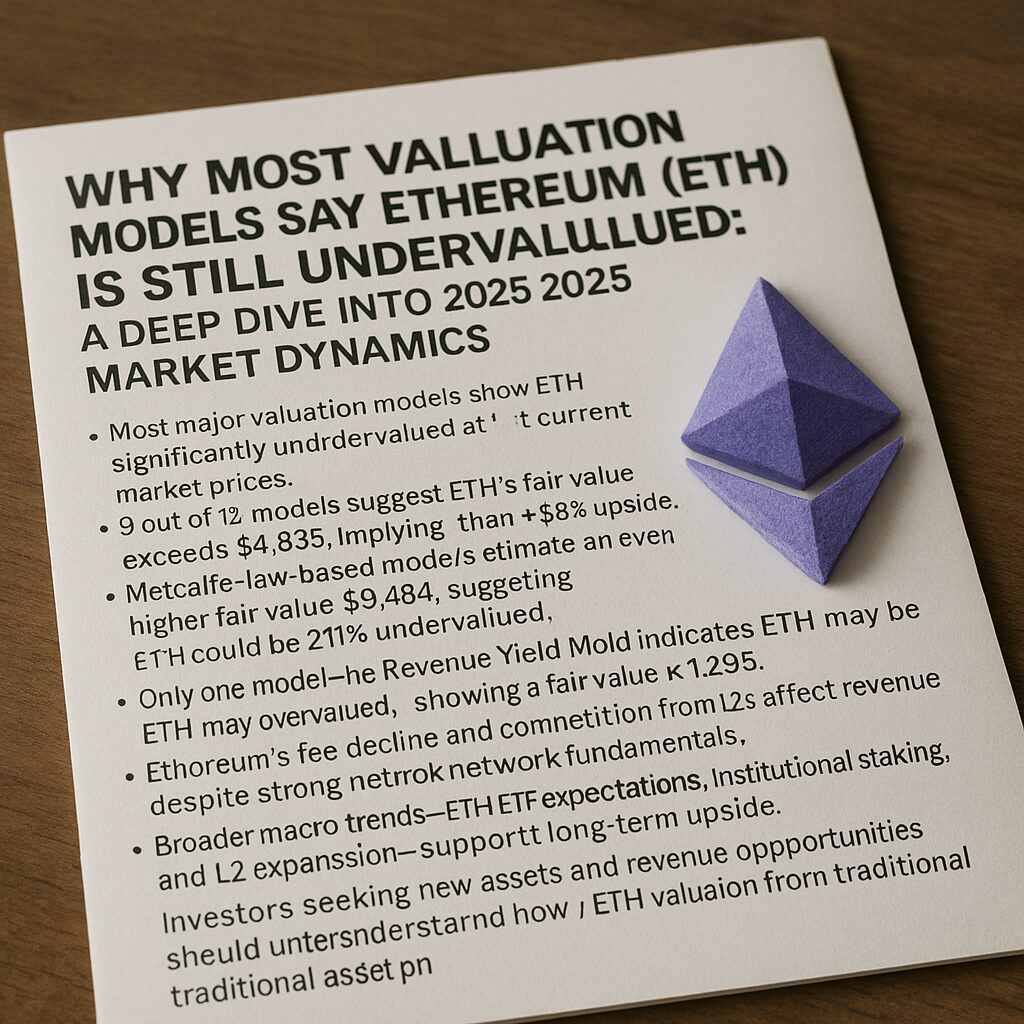
- Most major valuation models show ETH is significantly undervalued at current market prices.
- 9 out of 12 models suggest ETH’s fair value exceeds $4,836, implying more than +58% upside.
- Metcalfe-law-based models estimate an even higher fair value of $9,484, suggesting ETH could be 211% undervalued.
- Only one model—the Revenue Yield Model—indicates ETH may be overvalued, showing a fair value near $1,296.
- Ethereum’s fee decline and competition from L2s affect revenue metrics despite strong network fundamentals.
- Broader macro trends—ETH ETF expectations, institutional staking, and L2 expansion—support long-term upside.
- Investors seeking new assets and revenue opportunities should understand how ETH valuation differs from traditional asset pricing.
Introduction: The New Phase of Ethereum Valuation
Ethereum has entered a new era where both fundamental metrics and on-chain economics have matured enough for analysts to apply increasingly rigorous valuation frameworks. According to recent analysis from CryptoQuant CEO Ju Kyung, 9 out of 12 widely recognized valuation models currently show that ETH is undervalued, often by a substantial margin. For investors seeking new opportunities in digital assets and blockchain-based earning strategies, this insight reshapes how ETH should be considered—not only as a store of value or smart contract fuel, but as a core component of a growing on-chain economic system.
The composite fair price estimated by these valuation models sits at $4,836, far above ETH’s current market price slightly above $3,000. This suggests that market pricing continues to lag behind Ethereum’s ecosystem fundamentals.
1. Broad Overview of ETH Valuation Models
1.1 Composite Model Result: ETH Fair Value at $4,836
The composite model aggregates 12 major valuation frameworks, weighting them by academic reliability and historical accuracy. Based on the current analysis:
- Fair Value Estimate: $4,836
- Upside from Current Price: +58%
This result alone places ETH as one of the most undervalued top-tier assets in the digital asset market.
1.2 Model Credibility Weights
Each valuation model is graded on a three-tier reliability scale.
- 8 out of 12 models rated “2” or higher
- Many frameworks were developed by academic researchers or traditional finance specialists
This suggests that Ethereum’s valuation methodology has evolved beyond speculative metrics and is increasingly grounded in cross-disciplinary financial theory.
2. Key Undervaluation Models Pointing Toward Long-Term Upside
2.1 App Capital Model – Fair Value: $4,918
One of the most compelling models is the App Capital valuation approach. It treats Ethereum as a platform whose value is derived from the assets and applications built on top of it. This includes:
- Stablecoins
- ERC-20 tokens
- NFTs
- Real-world-asset (RWA) tokens
- Bridged assets from other chains
The resulting fair value of $4,918 closely matches the composite model’s result, reinforcing ETH’s undervalued state.
2.2 Metcalfe’s Law Model – Fair Value: $9,484
Metcalfe’s Law posits that network value grows in proportion to the square of the number of active participants (users or nodes). When applied to Ethereum:
- Fair Value Estimate: $9,484
- Implied Undervaluation: 211%
This is the most aggressive valuation among all models and reflects Ethereum’s role as a foundational settlement layer for global decentralized applications.
2.3 L2 TVL-Based Model – Fair Value: $4,633
Layer-2 solutions have become crucial contributors to Ethereum’s transaction ecosystem, dramatically expanding its throughput and reducing costs. When valuing ETH based on the total value locked (TVL) across the L2 ecosystem:
- Fair Value Estimate: $4,633
- Implied Undervaluation: ~52%
This framework acknowledges that Ethereum’s economic gravity extends well beyond its L1 activity.
3. Why One Model Shows ETH Is Overvalued
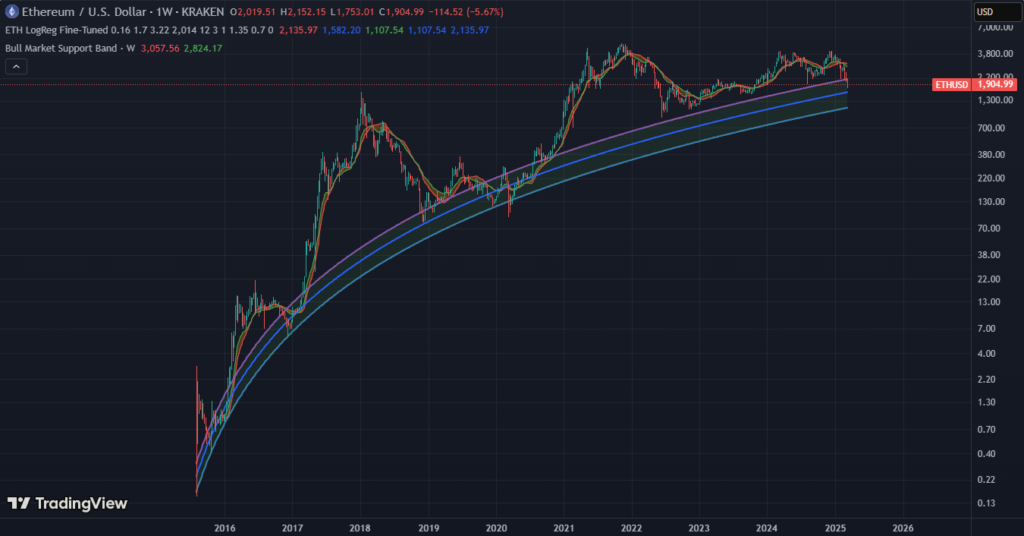
3.1 Revenue Yield Model – Fair Value: $1,296
In contrast, the Revenue Yield model—rated as “high credibility” by ETHval—suggests ETH may actually be 57% overvalued. This method calculates valuation by:
- Measuring Ethereum’s annualized network revenue (transaction fees + MEV)
- Dividing by ETH’s staking yield
3.2 Why Revenue Is Down
The model reflects several recent structural shifts:
- Ethereum fees are at historically low levels due to L2 adoption
- User activities and capital have migrated across multiple chains
- Some revenue elements (e.g., MEV) have become more diffuse due to rollups
Thus, while Ethereum’s ecosystem is expanding, its L1 revenue stream has temporarily weakened, pulling down the revenue-yield-based valuation metric.
4. Perspectives from the Ethereum Community
ETH’s valuation has become a topic of active debate among analysts, developers, and investors. Many argue that traditional valuation models—built for equities or commodities—do not fully capture:
- Tokenized economic systems
- Cross-chain liquidity migration
- Network effects of decentralized applications
- L2 expansion and modular blockchain architectures
- Ethereum’s role in real-world asset tokenization
This has led to a broader acceptance of alternative models, such as App Capital, Network Effects metrics, and Staking-adjusted models.
5. Broader Market Trends Supporting ETH’s Long-Term Value
5.1 Institutional Participation and ETH Staking
Institutional staking continues to rise, driven by:
- Regulated custodians
- ETH staking ETFs under consideration
- Corporate treasury diversification
Staking yields denominated in ETH create a compounding effect that parallels dividend growth investing.5.2 Expansion of Layer-2 Networks
L2s such as Optimism, Arbitrum, Base, and zkSync contribute significantly to Ethereum’s economic activity. Their growth enhances:
- Total network revenue
- User accessibility
- On-chain liquidity
- Application diversity
This further validates valuation models that account for Ethereum’s broader scaling ecosystem rather than L1 metrics alone.5.3 Ethereum as a Platform for Real-World Assets
RWA tokenization (e.g., U.S. Treasuries, bonds, equities, property interests) has become a leading use case for Ethereum. BlackRock, JPMorgan, and major fintech firms have already used Ethereum for tokenized settlements.
This macro trend is expected to push Ethereum’s economic throughput to new highs over the next decade.
6. What This Means for Investors Seeking New Opportunities
Investors looking for new digital assets or revenue-generating blockchain opportunities should consider:
- ETH continues to serve as the backbone of decentralized finance
- Staking returns increase as ETH supply becomes deflationary during high activity cycles
- The valuation gap—especially among high-credibility models—suggests long-term upside
- Understanding which model best fits your investment thesis is essential
For income-seeking strategies, ETH staking combined with exposure to L2 ecosystems offers an attractive yield-risk profile.
Conclusion: ETH Remains a Core Undervalued Asset for the Future
While one high-credibility model indicates ETH is overvalued due to declining transaction revenue, the overwhelming majority—especially those based on network effects and ecosystem capitalization—suggest that Ethereum is significantly undervalued.
As real-world asset tokenization expands, L2 adoption accelerates, and staking participation rises, ETH stands at the center of a rapidly maturing digital economy. For investors looking ahead to the next wave of blockchain-driven opportunities, Ethereum remains one of the strongest candidates for long-term growth and strategic positioning.