Main Points :
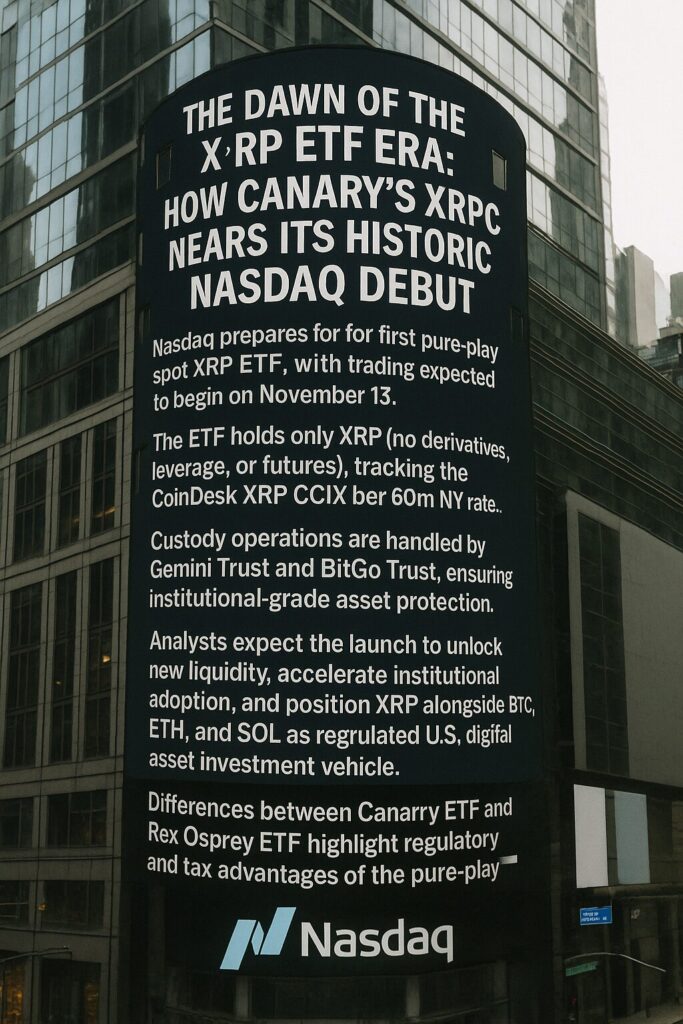
- Nasdaq prepares for the first pure-play spot XRP ETF (XRPC), with trading expected to begin on November 13.
- The ETF holds only XRP (no derivatives, leverage, or futures), tracking the CoinDesk XRP CCIXber 60m NY rate.
- Custody operations are handled by Gemini Trust and BitGo Trust, ensuring institutional-grade asset protection.
- Analysts expect the launch to unlock new liquidity, accelerate institutional adoption, and position XRP alongside BTC, ETH, and SOL as a regulated U.S. digital asset investment vehicle.
- Differences between the Canary ETF and Rex Osprey ETF highlight regulatory and tax advantages of the pure-play XRPC structure.
Introduction: A Milestone Years in the Making
For more than a decade, digital asset investors have anticipated the moment when XRP—a top-tier cryptocurrency with a global settlement use case—would finally achieve institutional-level integration through a regulated U.S. exchange-traded fund. That moment is now on the horizon. On November 12, Bloomberg ETF analyst Eric Balchunas confirmed via social media that Nasdaq had issued the official notice of listing for the Canary XRP ETF (XRPC), signaling that trading is set to commence on November 13, pending final regulatory clearance.
This event is not merely a new listing—it marks a structural shift in how institutional capital can access XRP. Just as Bitcoin, Ethereum, and Solana saw accelerated inflows following their spot ETF approvals, the arrival of a pure-play XRP ETF signals a new chapter for one of the world’s most widely used blockchain assets.
Section 1 — Why the Nasdaq Listing Matters Now
The approval of XRPC arrives at a crucial moment in market evolution. In 2024–2025, the investment world has moved decisively toward regulated digital asset exposure, and investors now prefer vehicles with transparent holdings, audited storage, and clear custodial oversight.
Until now, XRP lacked a dedicated U.S. spot ETF due to regulatory uncertainty. The recent developments represent:
- Regulatory clarity after years of dispute.
- Growing institutional appetite for alternative digital assets beyond BTC and ETH.
- Recognition of XRP’s utility in payment settlements and liquidity operations.
XRPC represents the first real conduit for U.S. institutions to allocate capital directly into XRP without maintaining self-custody or navigating offshore exchanges.
Section 2 — How XRPC Is Structured: Pure-Play, No Derivatives
The Canary Capital Group LLC filing describes XRPC as:
- 100% spot XRP holdings
- No leverage
- No derivatives exposure
- No futures contracts
This is critically important for risk-sensitive institutional allocators. A pure-play structure means that:
- The ETF’s value directly mirrors XRP’s market price.
- Investors avoid the distortions and inefficiencies associated with futures-based ETFs.
- Capital efficiency improves because all fund assets remain in physical XRP.
The benchmark used is the CoinDesk XRP CCIXber 60m New York Rate, an aggregated index reflecting major XRP trading venues.
This transparent valuation approach aligns XRPC with the most successful spot ETFs already on the market.
Section 3 — Key Custodians and Compliance Infrastructure
Two major institutional custodians support the ETF:
- Gemini Trust Company
- BitGo Trust Company
Both organizations hold long-standing reputations in digital asset security, offering cold storage, insurance layers, and SOC compliance.
Management and regulatory oversight are handled by:
- U.S. Bancorp Fund Services
- Parallel Distributors LLC
This multi-institutional framework mirrors the structure seen in Bitcoin and Ethereum ETFs and provides full operational transparency for institutional investors who require secure custody and audited controls before allocating large capital.
Section 4 — How XRPC Differs from the Rex Osprey XRP ETF
Crypto in America journalist Eleanor Terrett recently clarified major differences between the two XRP ETF candidates:
| Category | Canary XRPC (Pure-Play) | Rex Osprey XRP ETF |
|---|---|---|
| Asset Composition | 100% XRP only | Partial XRP exposure |
| Regulatory Basis | Securities Act “33 Act” | Investment Company “40 Act” |
| Tax Efficiency | High | Lower efficiency |
| Structure | Simple, spot-based | Hybrid structure |
The market overwhelmingly prefers 33-Act spot ETFs because they:
- Track the underlying asset more accurately
- Avoid derivative complexity
- Offer better tax treatment
This positions XRPC as the leading competitor for institutional capital.
Section 5 — Market Expectations Ahead of Launch
Analysts predict several developments:
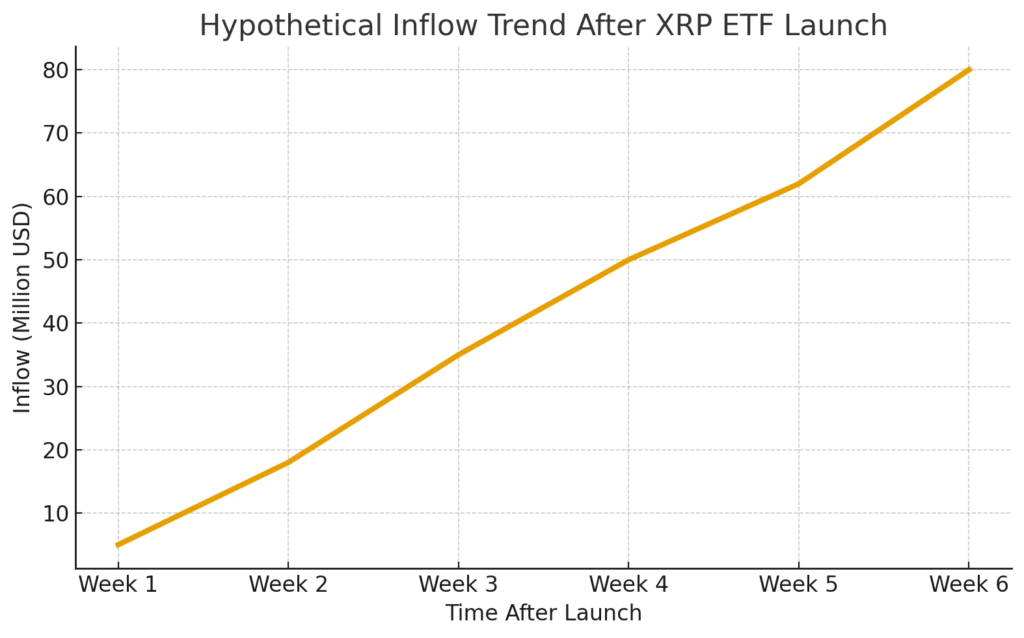
- Significant inflows in the first 30–60 days, similar to early BTC and ETH ETFs
- Increased liquidity across XRP spot markets
- A new gateway for banks and asset managers seeking regulated XRP exposure
- Potential long-term impact on XRP price stability and market depth
The tone in the institutional community is similar to the early days of Bitcoin ETFs:
“Once the gateway exists, capital will find its way through it.
(A conceptual chart illustrating ETF asset growth trends)
Section 6 — Recent Developments in the Global XRP Ecosystem
Beyond the ETF launch, several macro trends increase the importance of XRP ETFs:
1. Global Institutional Settlement
Banks in the Middle East and Asia continue testing or deploying solutions built on Ripple technology for cross-border settlement.
2. XRP Ledger (XRPL) Upgrades
Recent amendments—including hooks, sidechains, and improved AMM functionality—enhance the chain’s capability for:
- On-chain liquidity
- Algorithmic market-making
- Cross-network interoperability
3. Growing Tokenization Sector
XRP Ledger is becoming increasingly attractive for tokenized real-world assets (RWAs), with early experiments in:
- Tokenized treasury products
- Tokenized commodities
- Tokenized credit instruments
These developments strengthen XRP’s long-term investment thesis, making a U.S. ETF not only timely but necessary.
Section 7 — Future Outlook: Will an XRP ETF Change the Market?
Yes—because ETFs reshape market structure.
Liquidity
Spot ETFs often create sustained demand because issuers must purchase the physical asset to back shares.
Accessibility
Institutions previously unable to hold XRP directly—due to custody rules or risk frameworks—now gain exposure through a compliant wrapper.
Price Impact
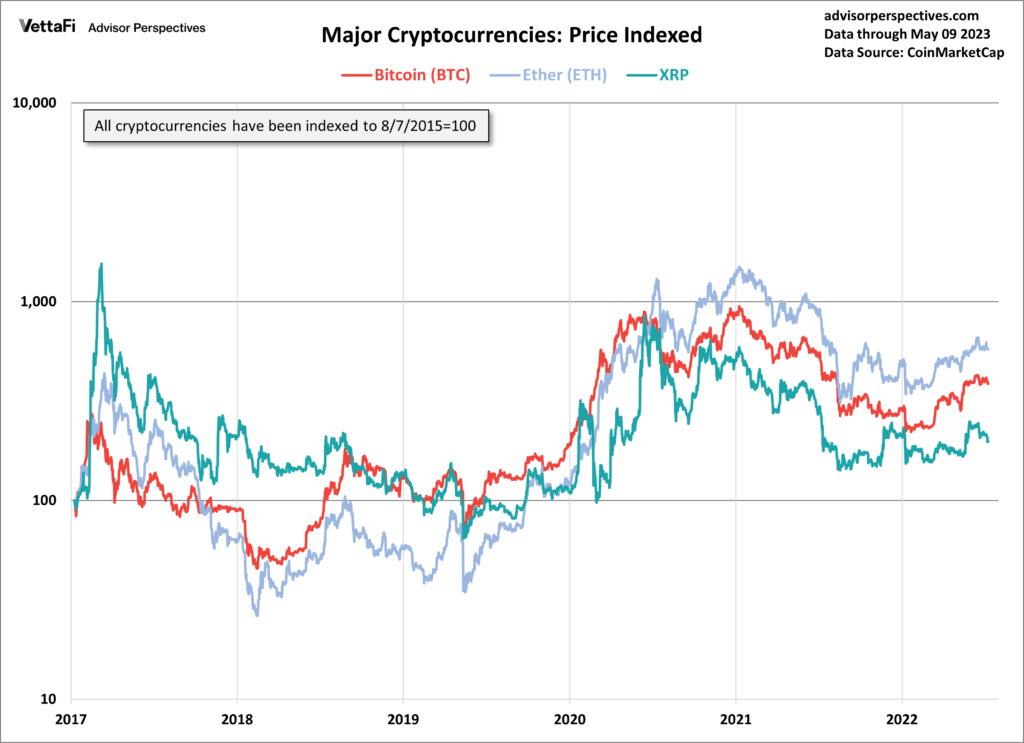
Although no guarantees can be made, BTC and ETH ETF precedents suggest:
- Price floors tend to rise
- Market volatility decreases
- Long-term inflows support structural upward pressure
If XRPC follows even a fraction of Bitcoin’s ETF adoption curve, XRP could enter a new multi-year growth phase.
Conclusion
The imminent launch of the Canary XRP ETF (XRPC) marks one of the most important milestones in XRP’s history. By securing a Nasdaq debut, the asset joins Bitcoin, Ethereum, and Solana in the class of regulated U.S. digital investment products.
For investors searching for new crypto opportunities, new revenue streams, or practical blockchain use cases, the arrival of XRPC:
- Validates XRP’s utility
- Opens institutional liquidity channels
- Accelerates global adoption
- Defines a new era of compliant digital asset integration
The stage is now set. The next chapter of XRP’s evolution begins not on an exchange—but on Nasdaq, the gateway to the world’s institutional capital.