
Main Points :
- Artificial Intelligence (AI) is emerging as a long-term structural driver of economic growth, not a short-lived hype cycle
- Massive AI infrastructure investments are reshaping capital markets, credit allocation, and systemic risk
- Stablecoins have evolved from crypto-native settlement tools into a financial bridge connecting traditional finance and digital finance
- Regulatory clarity in the US and growing participation by global banks are accelerating real-world stablecoin adoption
- By 2026, financial markets are shifting decisively from “expectations” to “real economic utility”
1. BlackRock’s Vision for the 2026 Financial Landscape
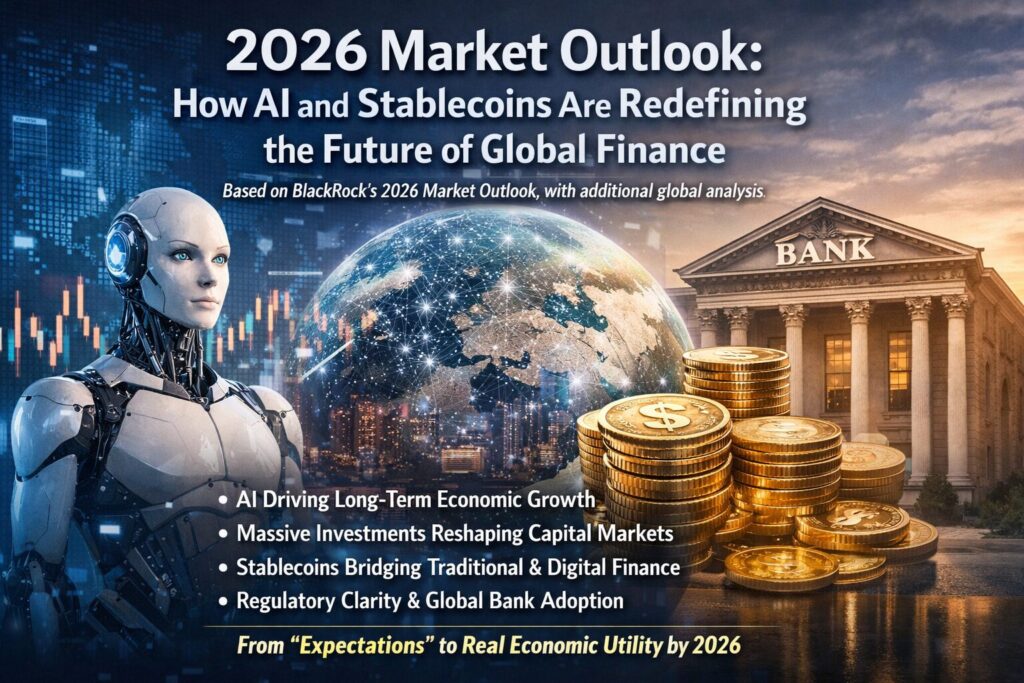
BlackRock, the world’s largest asset manager, released its 2026 Global Market Outlook, presenting a clear thesis: the future of finance will be shaped by two megaforces—AI and stablecoins.
BlackRock characterizes AI as a structural transformation force capable of reshaping productivity, corporate profitability, labor markets, and capital allocation. Unlike cyclical technology trends, AI is described as a persistent engine of economic re-architecture, comparable to electricity or the internet.
At the same time, BlackRock highlights stablecoins as a rapidly maturing financial instrument—no longer confined to crypto trading, but increasingly embedded in payments, settlement, and cross-border liquidity infrastructure.
As of late 2025, the total market capitalization of stablecoins exceeded $250 billion, reflecting their growing role as digital representations of the US dollar within both crypto and traditional financial systems.
2. AI as a Megaforce: Beyond the Hype Cycle
BlackRock explicitly rejects the idea that AI is merely another speculative bubble. While acknowledging concerns about “AI exuberance,” the report draws parallels with past technological revolutions.
Historically, transformative technologies—railways, electricity, semiconductors, the internet—experienced periods of over-investment before delivering outsized long-term economic returns. AI appears to be following a similar trajectory.
In 2025, AI-related equities drove US stock markets to record highs. Critics warned of an “AI bubble,” yet BlackRock argues that the scale of future productivity gains may justify today’s aggressive capital deployment.
AI’s economic impact spans multiple layers:
- Automation of cognitive labor
- Optimization of logistics and supply chains
- Acceleration of scientific research
- Creation of entirely new digital markets
This breadth distinguishes AI from narrower tech trends of the past.
3. Financial Risks from Massive AI Investment
While maintaining a bullish stance on AI, BlackRock also emphasizes new systemic risks.
AI infrastructure—data centers, advanced chips, cloud computing—requires enormous upfront capital. Many AI builders rely heavily on debt financing, increasing leverage across both private and public balance sheets.
At the same time, government debt levels remain elevated globally. This dual expansion of public and private borrowing heightens vulnerability to:
- Interest rate shocks
- Liquidity stress
- Credit tightening cycles
BlackRock therefore recommends a strategic shift:
- Overweight US equities, particularly AI beneficiaries
- Underweight long-duration US government bonds, which are more exposed to rising yields
- Increase exposure to private credit and infrastructure, which directly finance AI build-out
AI Investment vs. Global Interest Rates
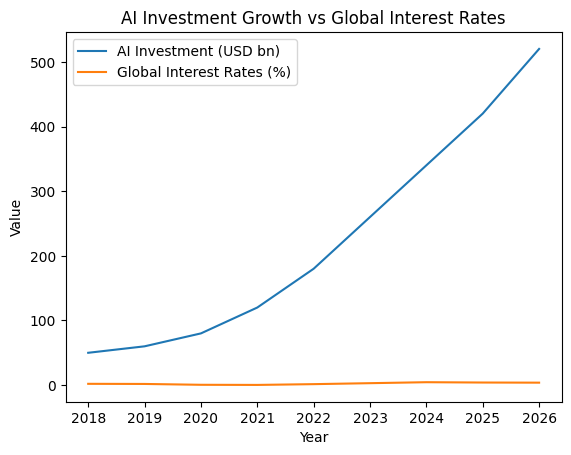
- “AI infrastructure investment growth chart”
- “global interest rates vs technology investment”
4. Stablecoins: From Crypto Utility to Financial Bridge
BlackRock’s report marks a turning point in institutional thinking about stablecoins.
Once viewed primarily as crypto-exchange settlement tools, stablecoins are now described as connective tissue between traditional finance and digital finance.
Major stablecoins such as Tether (USDT) and Circle’s USDC together account for the majority of the $250+ billion stablecoin market.
Their use cases now extend to:
- Cross-border remittances
- On-chain liquidity management
- Corporate treasury operations
- Emerging-market dollar access
This evolution reflects demand for programmable, borderless dollar liquidity.
5. Regulatory Breakthrough: The US GENIUS Act
A critical catalyst for stablecoin adoption was the passage of the GENIUS Act in the United States in mid-2025.
For the first time, stablecoins operate under a federal-level regulatory framework, placing issuers under formal supervision while prohibiting direct interest payments to users.
However, the law allows alternative incentive mechanisms such as marketing rewards, enabling competitive product design without classifying stablecoins as bank deposits.
BlackRock notes that regulatory clarity significantly reduces institutional adoption barriers, allowing banks, asset managers, and payment companies to integrate stablecoins into their offerings.
6. Stablecoins and Banking: Competition or Evolution?
As stablecoins scale, BlackRock raises a crucial question: What happens if stablecoins begin to compete with bank deposits and money market funds?
Potential impacts include:
- Reduced deposit bases for traditional banks
- Pressure on banks’ credit creation function
- Shifts in monetary policy transmission mechanisms
Yet BlackRock does not frame this as pure disruption. Instead, it sees a coexistence phase, where tokenized dollars complement existing financial rails while gradually transforming them.
Stablecoin Market Growth and Use Cases
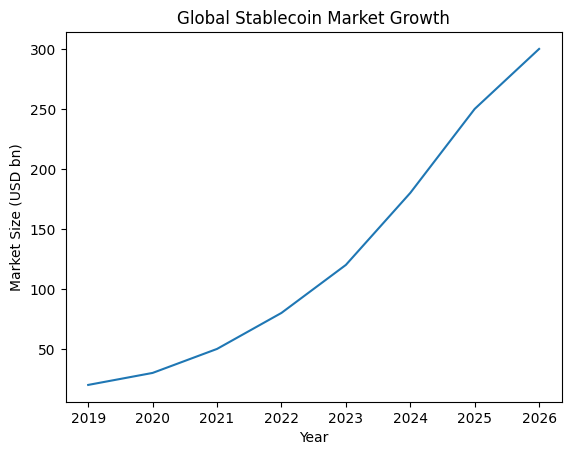
- “stablecoin market cap growth chart”
- “stablecoin payment use cases diagram”
7. Emerging Markets: Dollar Access and Monetary Challenges
Stablecoins play a particularly powerful role in emerging markets.
In countries with volatile local currencies, dollar-pegged stablecoins offer:
- Inflation hedging
- Faster settlement than correspondent banking
- Lower remittance costs
However, widespread stablecoin adoption may weaken local monetary sovereignty, creating tension between financial inclusion and policy control.
BlackRock frames this as a structural trade-off that policymakers must confront as digital dollars spread globally.
8. Institutional Acceleration: Banks and Big Capital Enter
Since late 2025, global banks have accelerated their involvement in stablecoins.
A consortium of major banks—including Bank of America, Deutsche Bank, and Mitsubishi UFJ Financial Group—announced exploratory plans for G7-currency-linked stablecoins.
Meanwhile, the International Monetary Fund reported that global stablecoin market size surpassed $300 billion in Q3 2025, underscoring their systemic relevance.
9. AI Capital Frenzy: The OpenAI–SoftBank Signal
AI investment momentum reached a symbolic peak when SoftBank Group completed a $41 billion investment in OpenAI, acquiring approximately 11% ownership.
SoftBank CEO Masayoshi Son declared an “all-in” commitment to AI, betting on explosive demand for computational infrastructure.
This deal reflects a broader reality: AI is no longer a software-only story—it is a capital-intensive industrial transformation.
Global AI Capital Flows and Major Investors
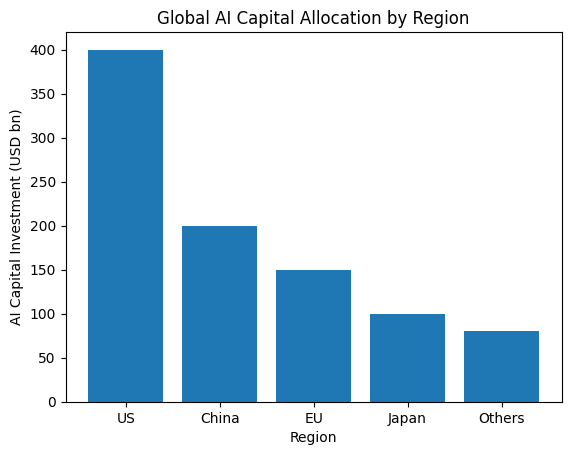
- “global AI investment map”
- “AI data center investment visualization”
10. From Expectation to Real Demand: 2026 and Beyond
Echoing perspectives from firms like Coinbase, BlackRock concludes that 2026 marks a transition from speculative narratives to tangible utility.
AI is becoming embedded in enterprise operations, while stablecoins are integrating into real payment flows.
Together, they represent the financial operating system of the next decade.
Conclusion: The Architecture of Tomorrow’s Finance
BlackRock’s 2026 outlook offers a rare synthesis: AI as the engine of economic transformation, and stablecoins as the rails of digital finance.
For investors, builders, and policymakers, the message is clear:
- AI reshapes how value is created
- Stablecoins reshape how value moves
- Finance itself is being rewritten at the infrastructure level
Those who understand—and strategically engage with—both forces will define the next era of global markets.
