
Main Points :
- Japan’s Finance Minister Satsuki Katayama publicly framed 2026 as “Digital Year One”, signaling a policy-level shift rather than a symbolic slogan.
- Blockchain-based digital assets are increasingly positioned as market-integrated financial instruments, not fringe technology.
- Crypto ETFs, particularly in the U.S., demonstrate how digital assets are becoming inflation hedges and institutional products.
- Exchanges and market infrastructure are explicitly identified as the core enablers of large-scale crypto adoption.
- For investors and builders, the message is clear: regulation, liquidity, and usability—not speculation alone—will define the next phase of crypto growth.
1. The Meaning of “Digital Year One” at the Tokyo Stock Exchange Opening
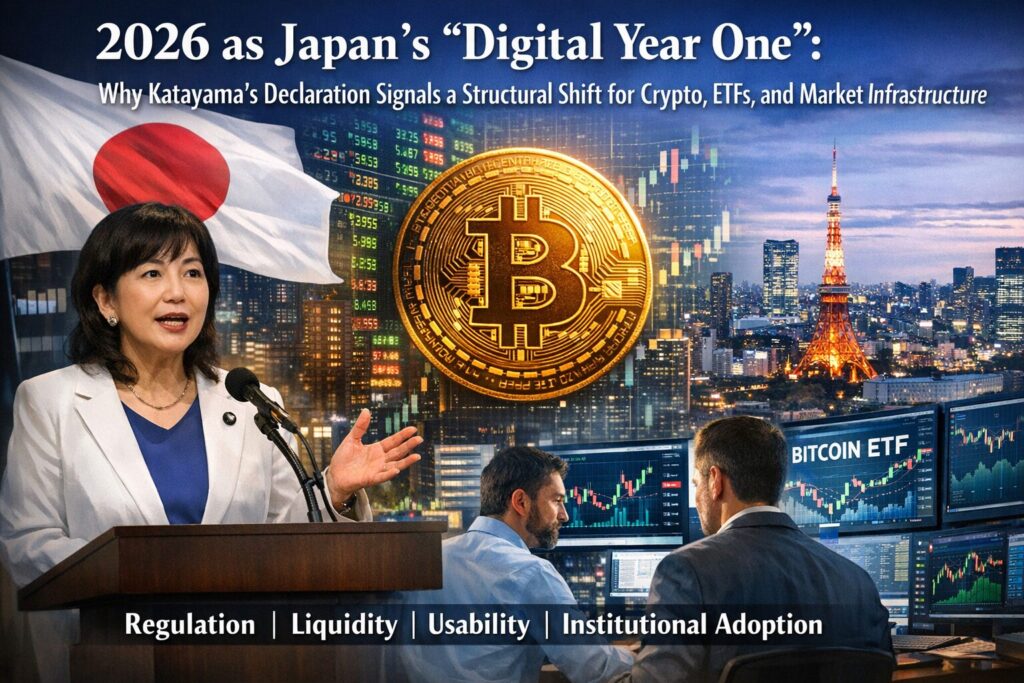
On January 5, 2026, during the annual opening ceremony at the Tokyo Stock Exchange, Japan’s Finance Minister Satsuki Katayama delivered a speech that may later be regarded as a historical inflection point for Japan’s digital finance strategy.
By explicitly calling 2026 “Digital Year One,” Katayama elevated digital transformation—particularly blockchain-based assets—from a policy topic to a national economic narrative. This was not delivered at a technology conference or a fintech meetup, but at the symbolic heart of Japan’s capital markets.
The choice of venue matters. The opening ceremony (大発会) is where Japan signals its economic direction to global investors. By framing digital assets in this context, Katayama implicitly placed crypto alongside equities, bonds, and ETFs as part of the mainstream financial system.
This framing suggests that Japan’s next phase of economic competitiveness will not come from resisting digital assets, but from structuring, regulating, and integrating them.
2. Digital Assets as Market Infrastructure, Not Experiments
A key line in Katayama’s speech deserves careful attention:
“If we are to benefit from blockchain-based digital assets, we must leverage the power of commodity and securities exchanges.”
This statement reframes crypto adoption away from retail speculation and toward institutional market design.
Rather than emphasizing decentralized ideology, Katayama emphasized infrastructure—order matching, clearing, settlement, custody, surveillance, and compliance. In other words, crypto’s value proposition is no longer limited to peer-to-peer transfers, but extends to how efficiently markets can function.
This aligns with a broader global trend:
- Digital assets are being absorbed into existing financial plumbing
- Exchanges act as bridges between innovation and trust
- Liquidity, transparency, and governance become the decisive factors
For builders and operators, this suggests that future winners will not merely issue tokens, but embed them into reliable market systems.
3. Lessons from the U.S.: Crypto ETFs as Inflation Hedges
Katayama also pointed to developments in the United States, where crypto ETFs have rapidly expanded in scale and legitimacy.
In the U.S., Bitcoin and Ethereum ETFs have transformed digital assets into passive, regulated investment products. These ETFs are increasingly viewed not just as speculative vehicles, but as:
- Portfolio diversifiers
- Inflation hedges
- Alternatives to gold-like assets
By referencing U.S. ETF growth, Katayama implicitly acknowledged a reality:
Retail adoption follows institutional validation.
Once digital assets become available through familiar instruments—brokerage accounts, pension allocations, ETF wrappers—adoption accelerates dramatically.
“Growth of Crypto ETF Trading Volume (USD)”
A line chart showing cumulative ETF trading volume surpassing $2 trillion.
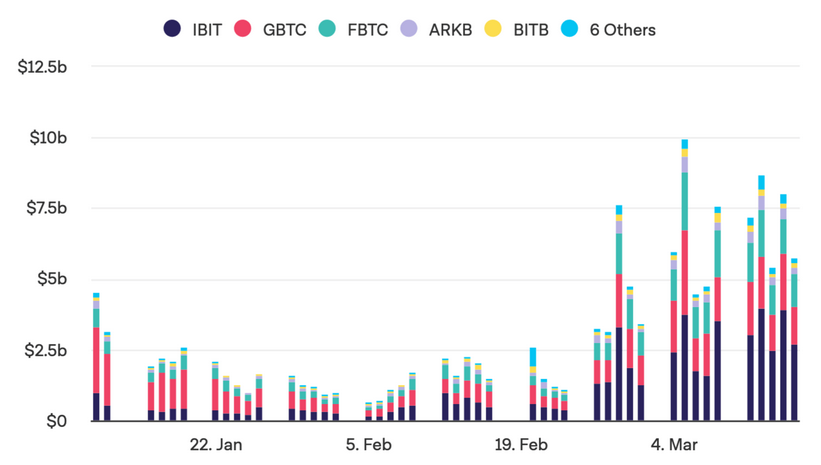
This development matters deeply for Japan, where household financial assets exceed $14 trillion, much of which remains in cash. Even marginal reallocation toward regulated digital assets would have systemic impact.
4. From Speculation to Financial Utility
The subtext of Katayama’s remarks is that crypto’s next chapter is about utility, not hype.
Earlier crypto cycles were driven by:
- Token price appreciation
- Retail-driven speculation
- Fragmented liquidity
The emerging cycle, however, emphasizes:
- Structured products (ETFs, ETPs)
- Integration with existing exchanges
- Compliance with AML, custody, and reporting standards
For investors seeking new revenue sources, this shift reduces asymmetric risk. Yield and opportunity now emerge from:
- Market making
- Custody services
- On-chain settlement rails
- Tokenized real-world assets (RWAs)
Crypto is no longer “outside” finance—it is becoming financial infrastructure software.
5. Why Exchanges Matter More Than Ever
Katayama’s focus on exchanges is not accidental.
Exchanges serve as:
- Liquidity concentrators
- Price discovery engines
- Risk management hubs
- Regulatory choke points
Without credible exchanges, digital assets remain fragmented and volatile. With them, assets become investable at scale.
This is why Japan Exchange Group’s role is critical. If Japan succeeds in combining:
- Strong consumer protection
- Transparent rulemaking
- Advanced trading systems
It could position itself as Asia’s most trusted digital asset hub, distinct from offshore, lightly regulated jurisdictions.
6. Implications for Investors: Where Opportunity Lies
For readers seeking the “next” opportunity, Katayama’s message suggests a reframing of strategy.
Rather than asking:
“Which token will 10x?”
The more relevant questions become:
- Which assets will be ETF-eligible?
- Which blockchains support institutional-grade compliance?
- Which projects integrate smoothly with exchanges and custodians?
Opportunities increasingly exist around crypto, not just in crypto:
- Infrastructure tokens
- Settlement-layer blockchains
- Compliance and analytics platforms
- Tokenization frameworks
7. Implications for Builders and Operators
For entrepreneurs and engineers, “Digital Year One” is an invitation—but also a warning.
The bar is rising. Systems must now satisfy:
- Regulatory auditability
- Operational resilience
- User-level simplicity
Japan’s stance suggests that future projects must be boringly reliable, not just innovative.
This favors builders who understand:
- Finance
- Regulation
- User experience
- Blockchain mechanics simultaneously
8. Japan’s Strategic Position in Global Digital Finance
Japan occupies a unique position:
- High household savings
- Strong regulatory institutions
- Advanced exchange infrastructure
- Historically cautious but deliberate policymaking
By moving deliberately rather than reactively, Japan may avoid the boom-bust cycles seen elsewhere and instead cultivate sustainable digital finance ecosystems.
Katayama’s declaration signals that Japan does not intend to ban or ignore crypto—but to domesticate it within its financial system.
Conclusion: A Policy Signal, Not a Sloga
Calling 2026 “Digital Year One” is not mere rhetoric. It is a policy signal to markets, institutions, and innovators.
The message is clear:
- Digital assets are here to stay
- Market infrastructure is the priority
- ETFs and regulated products are the gateway
- Practical utility will outpace speculation
For investors, this is a call to look beyond hype.
For builders, it is a call to build systems that last.
For Japan, it is a step toward redefining its role in the global financial order.
