
Key Points :
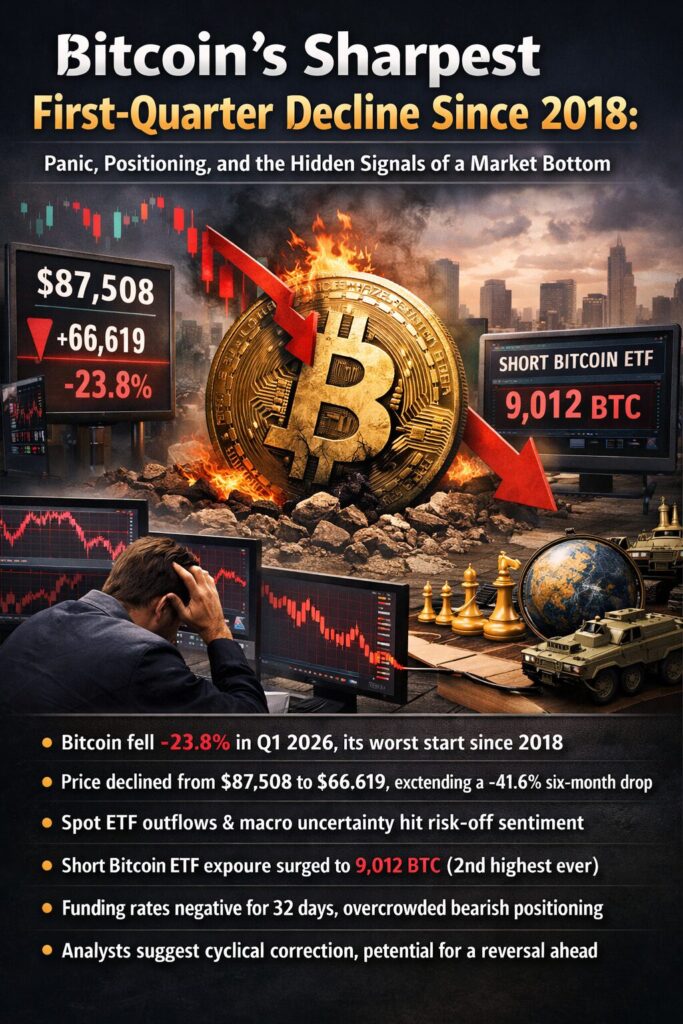
- Bitcoin fell -23.8% in Q1 2026, its worst start since 2018
- Price declined from $87,508 to $66,619, extending a -41.6% six-month drop
- Spot ETF outflows and macro uncertainty (inflation, Fed stance) drove risk-off sentiment
- Short Bitcoin ETF exposure surged to 9,012 BTC (2nd highest ever)
- Funding rates stayed negative for 32 consecutive days, signaling overcrowded bearish positioning
- Analysts suggest no structural breakdown, but a cyclical correction
- Potential reversal catalysts: geopolitical easing, ETF inflows, regulatory clarity
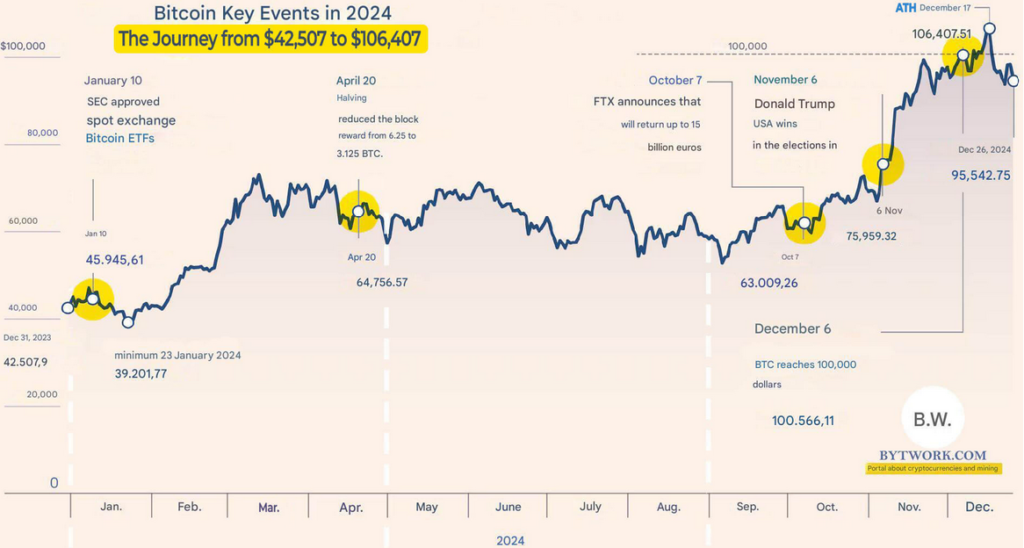
BTC Price Trend (Q1 2026)
1. The Worst Start Since 2018: A Market Under Pressure
The first quarter of 2026 has delivered a sobering reminder that even in a maturing digital asset market, volatility remains deeply embedded. Bitcoin (BTC), the bellwether of the crypto ecosystem, recorded a -23.8% decline between January and March, marking its steepest first-quarter drop since 2018.
Starting the year at approximately $87,508, Bitcoin gradually lost momentum and closed March near $66,619, reflecting sustained selling pressure. This decline did not occur in isolation. It extended a broader downward trajectory that began in late 2025, bringing the cumulative six-month loss to -41.6%.
This magnitude of drawdown naturally raises a critical question for investors:
Is this the beginning of a structural downturn, or simply a cyclical reset within a longer-term bullish framework?
2. Macro Forces Driving the Decline
2.1 Geopolitical Risk and Global Instability
A key driver behind the recent downturn has been escalating geopolitical tensions, particularly in the Middle East. Markets across asset classes tend to react negatively to uncertainty, and crypto—despite its decentralized narrative—has increasingly behaved like a risk asset.
Capital flows have shifted toward safer instruments, reducing demand for volatile assets such as Bitcoin.
2.2 Persistent Inflation and Central Bank Policy
Another major pressure point has been inflation. Despite expectations of easing, inflation has remained stubbornly persistent, forcing the Federal Reserve to maintain a cautious stance.
Higher interest rates reduce liquidity in financial markets, making speculative investments less attractive. Crypto, which thrives in liquidity-rich environments, has therefore faced sustained headwinds.
3. ETF Outflows: The Institutional Signal Turning Negative
ETF Flow Trend
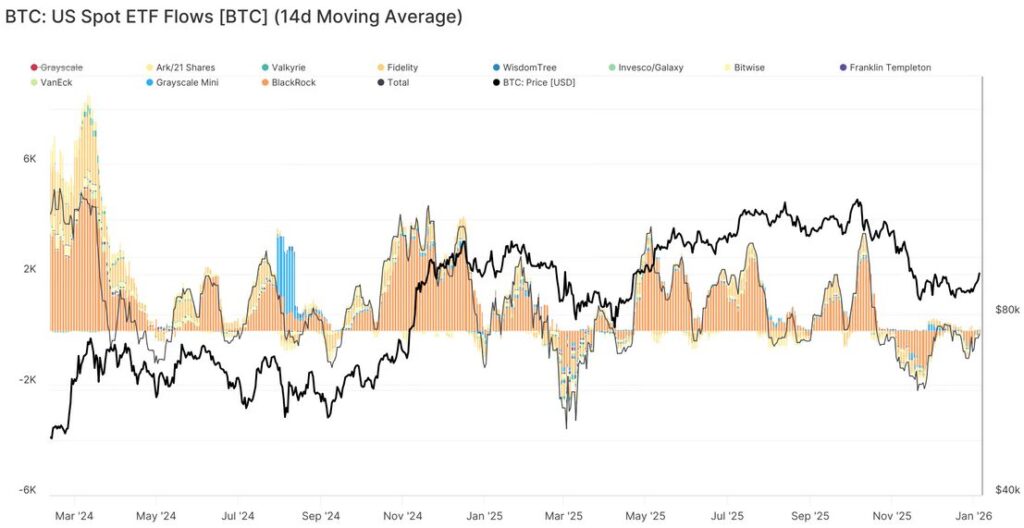
One of the most important developments in Q1 2026 has been the shift in institutional behavior. Spot Bitcoin ETFs, once seen as the gateway for institutional adoption, recorded net outflows during the quarter.
This reversal is significant because ETFs have become a primary channel for large-scale capital entering the crypto market. When inflows reverse, it signals not only reduced demand but also active de-risking by institutional investors.
This aligns with broader macro sentiment: investors are reducing exposure to high-volatility assets amid uncertainty.
4. The Surge in Short Positions: Defensive or Opportunistic?
Short ETF Exposure
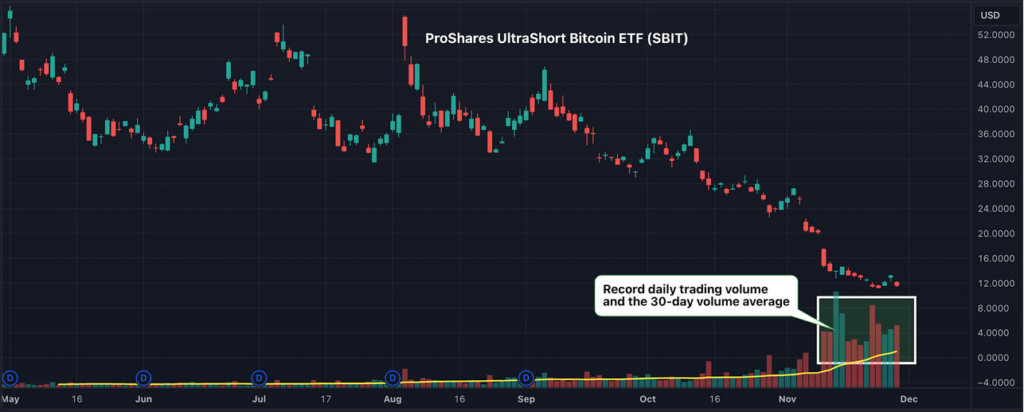
According to K33 Research, short Bitcoin ETF exposure surged to 9,012 BTC, the second-highest level on record. This sharp increase—up 22% in just a few days—reflects an aggressive shift toward defensive positioning.
Such behavior suggests that market participants are not merely cautious; they are actively betting on further downside.
However, history shows that extreme consensus in one direction often precedes reversals.
5. Funding Rates and the Psychology of Capitulation
One of the most telling indicators is the funding rate in perpetual futures markets. For 32 consecutive days, funding rates have remained negative.
This implies that:
- Short sellers are paying long holders
- Bearish positioning dominates the market
- Sentiment is heavily skewed toward downside expectations
In previous market cycles, extended periods of negative funding rates have often coincided with late-stage capitulation phases—the point at which selling pressure becomes exhausted.
This does not guarantee an immediate rebound, but it suggests that the market may be approaching a local bottom.
6. Structural Strength vs Cyclical Weakness
Despite the sharp decline, analysts emphasize that the current correction does not reflect a collapse in fundamentals.
6.1 Institutional Adoption Remains Intact
The long-term trend of institutional participation remains largely unchanged. Financial institutions, asset managers, and even sovereign entities continue to explore and integrate digital assets.
6.2 Long-Term Holder Conviction
On-chain data indicates that long-term holders are not significantly capitulating. This is critical because sustained sell-offs typically require long-term investors to exit positions en masse.
6.3 Market Cycles Still Apply
Crypto markets, like traditional markets, operate in cycles. Corrections—sometimes severe—are a natural part of price discovery and capital reallocation.
From this perspective, the current downturn may be better understood as a macro-driven cyclical adjustment, rather than a structural breakdown.
7. What Could Trigger a Reversal?
7.1 Geopolitical Stabilization
A de-escalation of tensions, particularly involving Iran, could restore market confidence and shift capital back toward risk assets.
7.2 Return of ETF Inflows
A resumption of inflows into Bitcoin ETFs would signal renewed institutional demand—arguably the most important catalyst for sustained price recovery.
7.3 Regulatory Clarity in the United States
Clearer regulatory frameworks—such as proposed crypto legislation—could reduce uncertainty and unlock sidelined capital.
8. Seasonal Liquidity and Short-Term Outlook
The upcoming Easter holiday period is expected to reduce trading volumes and volatility. Historically, trading activity during this period has been below annual averages.
Lower liquidity environments often result in:
- Reduced directional conviction
- Increased susceptibility to sudden moves
- Range-bound price action
In the short term, this suggests that Bitcoin may consolidate rather than trend strongly.
9. Strategic Implications for Investors
For readers seeking new crypto opportunities and income strategies, this environment presents both risks and opportunities:
Opportunities
- Accumulation during oversold conditions
- Identifying altcoins with strong fundamentals amid market weakness
- Yield strategies in derivatives or DeFi (with risk controls)
Risks
- Continued macro deterioration
- Further ETF outflows
- Prolonged bearish sentiment
A disciplined approach—balancing long-term conviction with short-term risk management—is essential.
Conclusion: Panic or Opportunity?
Bitcoin’s steep decline in Q1 2026 reflects a confluence of macroeconomic pressure, geopolitical instability, and shifting institutional flows. On the surface, the data paints a bearish picture: falling prices, ETF outflows, and rising short positions.
However, beneath this pessimism lies a more nuanced reality.
The absence of fundamental deterioration, combined with extreme bearish positioning and negative funding rates, suggests that the market may be entering a late-stage correction phase.
For experienced investors, such environments have historically represented the transition from fear to opportunity.
The key question is no longer whether volatility will persist—it will—but whether this volatility marks the end of a downtrend or the beginning of the next accumulation phase.
