

Main Points :
- Bitcoin briefly fell below $67,000 during early U.S. trading on February 17, before recovering above that level.
- The decline coincided with a continued sell-off in U.S. software stocks, particularly those tracked by the iShares Expanded Tech-Software Sector ETF (IGV), which is down roughly 32% since October.
- The episode highlights the persistent correlation between crypto and growth equities, especially AI- and software-related stocks.
- Market participants suggest crypto is entering a consolidation phase, searching for a fresh narrative to attract capital away from AI equities and commodities.
- For investors and builders, the environment underscores the importance of infrastructure, yield strategies, and real-world blockchain applications beyond speculative momentum.
1. Market Shock: Bitcoin Briefly Breaks Below $67,000
In early U.S. trading on February 17, Bitcoin (BTC) slipped below the psychologically important $67,000 mark, triggering a wave of liquidations across derivatives exchanges. While prices recovered above $67,000 by the following Asian session, the episode reinforced the fragile balance currently defining the digital asset market.
This decline was not isolated. It occurred in tandem with renewed weakness in U.S. software stocks—particularly companies tied to cloud infrastructure, AI platforms, and enterprise SaaS. The synchronized move once again raised questions: Is Bitcoin truly decoupling from equities, or has it become structurally intertwined with the growth-stock complex?
Over the past several cycles, Bitcoin has oscillated between narratives: digital gold, risk-on technology proxy, macro hedge, and liquidity sponge. In the current environment, it appears that the market is treating BTC less as a hedge and more as a high-beta extension of technology equities.
The dip below $67,000 is less about that specific price level and more about what it represents: a market searching for conviction.
2. Software Stocks Under Pressure: IGV Down 32% Since October
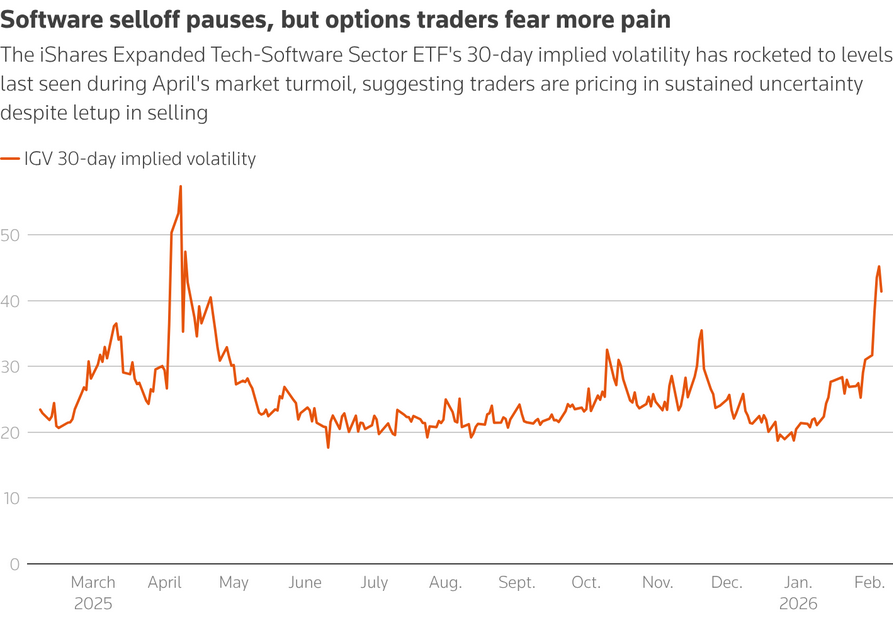
The iShares Expanded Tech-Software Sector ETF (IGV), a widely followed benchmark for U.S. software companies, has fallen approximately 32% since October and dropped another 3% during the session in question.
This drawdown reflects several converging forces:
- Elevated valuations following AI-driven rallies.
- Concerns about corporate IT spending.
- Rising real yields and persistent macro uncertainty.
- Rotation toward defensive sectors and commodities.
Bitcoin’s concurrent weakness suggests that crypto remains embedded in the broader “growth asset” category. When investors de-risk from AI and software equities, digital assets are often sold alongside them.
This structural linkage challenges the thesis that Bitcoin has fully matured into an uncorrelated macro asset. Instead, at least in the short to medium term, BTC continues to behave like a liquidity-sensitive risk instrument.
3. Correlation or Coincidence? Bitcoin and Tech Equities
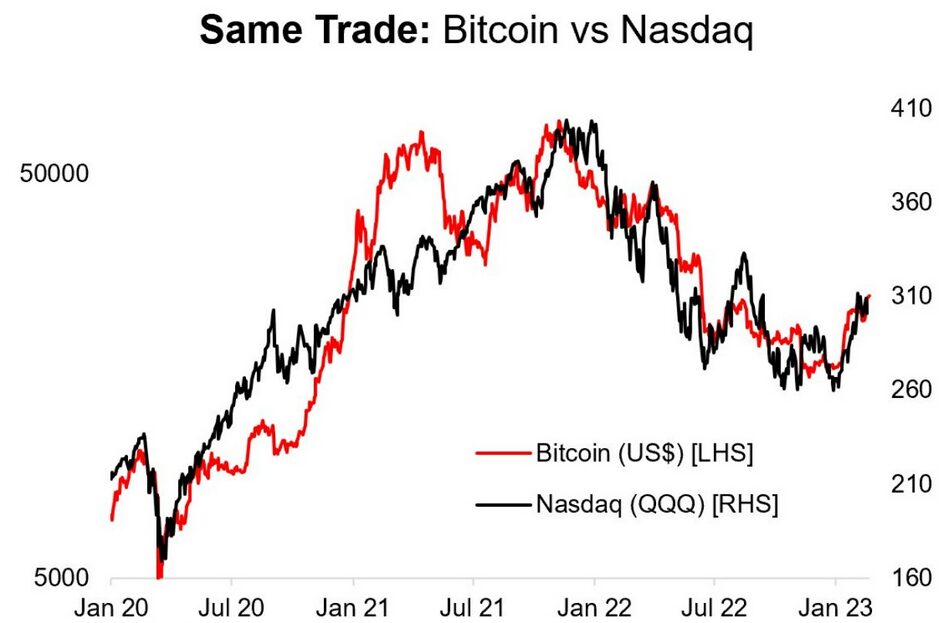
Over the past several years, rolling 90-day correlations between Bitcoin and the Nasdaq have periodically surged above 0.6–0.8 during macro stress episodes. Although correlations fluctuate, they tend to increase during periods of tightening liquidity or equity volatility.
Why does this happen?
- Shared Investor Base: Institutional allocators often categorize Bitcoin alongside high-growth technology exposure.
- Liquidity Sensitivity: Both asset classes respond sharply to changes in real yields and Federal Reserve policy.
- Speculative Capital Flows: Leveraged traders operate across crypto and tech equities simultaneously.
When software stocks fall, portfolio managers often reduce overall risk exposure, leading to simultaneous selling in crypto. The February 17 episode appears to follow this familiar pattern.
4. A Market in Search of a New Narrative
Paul Howard of Wincent suggested that crypto may enter a consolidation phase while it searches for a fresh narrative capable of drawing capital away from AI equities and commodities.
This insight is critical.
In previous cycles, crypto rallies were fueled by powerful narratives:
- 2017: ICO and decentralized fundraising.
- 2020–2021: DeFi, NFTs, and monetary debasement hedging.
- 2023–2024: Spot ETF approvals and institutional adoption.
- 2025: AI-token convergence and on-chain compute speculation.
Today, many of those themes are either priced in or losing momentum. Meanwhile, AI hardware manufacturers, semiconductor firms, and energy commodities have absorbed substantial speculative capital.
For crypto to outperform, it may need:
- A breakthrough in real-world asset (RWA) tokenization.
- Institutional-grade yield products.
- Scalable payment infrastructure.
- Regulatory clarity enabling broader participation.
Without such a catalyst, consolidation between $60,000 and $72,000 appears plausible.
5. Consolidation: A Pause Before Expansion?
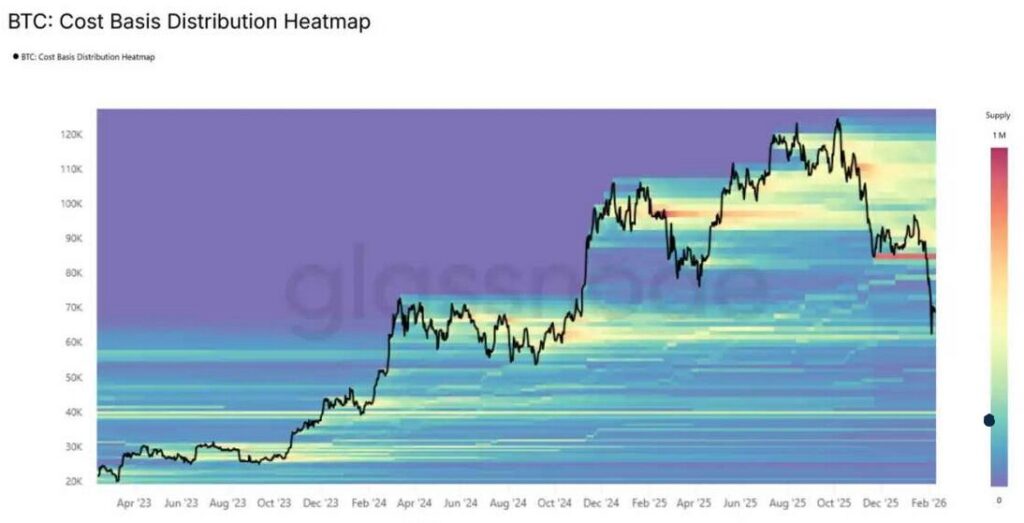
Technical analysts note that Bitcoin has been oscillating between approximately $60,000 and $72,000. This range-bound behavior suggests a balance between long-term accumulation and short-term profit-taking.
Consolidation phases often serve as:
- Volatility compression periods before major moves.
- Accumulation zones for institutional participants.
- Psychological reset phases following rapid advances.
For sophisticated investors, sideways markets can be productive environments. Yield strategies, basis trades, options premium capture, and structured products become more attractive when directional momentum slows.
Rather than viewing consolidation as stagnation, builders and allocators may see it as infrastructure-building time.
6. Capital Rotation: AI, Commodities, and Crypto
Recent capital flows show strong allocation into AI-linked equities and certain commodities. Energy markets, in particular, have attracted attention amid geopolitical tensions and data-center power demands.
Crypto’s challenge is not simply price performance—it is narrative competition.
When AI stocks promise exponential revenue growth and commodities offer inflation hedging, crypto must articulate its differentiated value proposition:
- Borderless settlement rails.
- Programmable financial infrastructure.
- Tokenized liquidity layers.
- Digital collateral for emerging markets.
If Bitcoin is to reclaim sustained upside beyond $72,000, it may require macro tailwinds or internal innovation-driven momentum.
7. Implications for Investors and Builders
For readers seeking new crypto assets, revenue opportunities, or practical blockchain applications, this environment offers several lessons:
- Macro Awareness Matters
Crypto no longer trades in isolation. Monitoring equity indices, real yields, and ETF flows is essential. - Diversified Strategy Beats Pure Directional Bets
Structured yield, arbitrage, and market-neutral strategies can outperform in consolidation phases. - Infrastructure Outlasts Hype
Wallet UX improvements, compliance-ready custody, payment rails, and cross-chain liquidity solutions may offer more durable value than speculative tokens. - Correlation Is Opportunity
When crypto trades as a tech proxy, dislocations between BTC and equity volatility can create tactical entry points.
Conclusion: A Transitional Moment for Digital Assets
Bitcoin’s brief drop below $67,000 is not merely a headline—it is a signal of a market in transition.
The continued slide in software stocks, particularly those tracked by IGV, underscores that crypto remains sensitive to growth-equity sentiment. Yet consolidation does not imply weakness. It may represent preparation.
The next sustained rally in digital assets may not be driven by meme speculation or short-term hype. Instead, it could emerge from real-world integration: tokenized assets, institutional yield frameworks, and scalable global payments.
For long-term participants, this phase is less about panic and more about positioning.
Markets rotate. Narratives evolve. Infrastructure compounds.
Bitcoin’s path forward may depend not on escaping correlation—but on redefining what correlation means in a world where digital assets are increasingly woven into the broader financial system.
