

Key Takeaways :
- Bitcoin has sharply rebounded from a sell-off below $84,000 and is trading back around $91,000, with derivatives positioning suggesting traders see $80,000–$85,000 as a key support zone.
- Vanguard’s policy reversal now allows more than $11 trillion in client assets to access crypto-focused ETFs, opening the door to mainstream demand for Bitcoin, Ether, XRP, Solana, and others.
- Bank of America will allow its wealth advisers to recommend 1–4% allocations in spot Bitcoin ETFs starting January 2026, signaling that a modest Bitcoin weight is becoming “normal” in traditional portfolios.
- Macro risks are rising, especially from higher Japanese government bond (JGB) yields, which could pull capital out of risk assets and hit highly leveraged crypto trading venues sensitive to yen and yuan flows.
- Altcoins like ETH, XRP, SOL, and DOGE are rebounding alongside Bitcoin, but flows are still dominated by BTC and ETF-linked products.
- For investors hunting new assets, new income streams, and practical blockchain use cases, this environment favors Bitcoin-led exposure plus selective bets on high-conviction altcoins and real-world adoption themes, rather than blind speculation.
1. From Flash Crash to Fast Rebound: Bitcoin Finds Its Feet Above $80,000
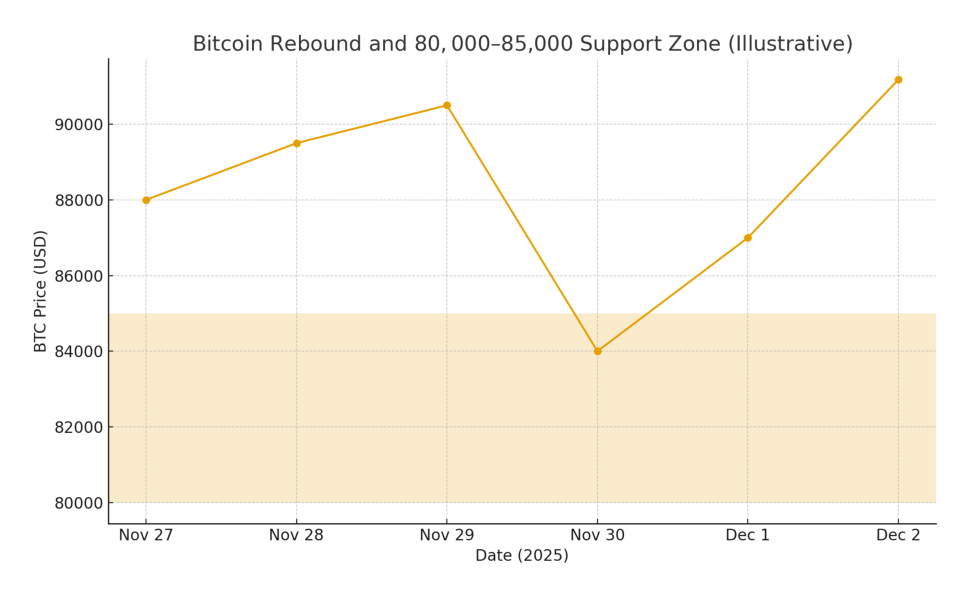
In the final days of November, Bitcoin (BTC) reminded traders what “crypto volatility” really means. After pushing into the high $80,000s, it suddenly dumped below $84,000 around November 30 to December 1, triggering forced liquidations and a wave of nervous social media posts. The move briefly raised the question: Was the cycle already over?
By December 2, that fear looked premature. Bitcoin had bounced back into the $91,000 area, retracing most of the drop in just a couple of days. At the time referenced in the original article, BTC was trading near $91,180, up roughly 8% over 24 hours. Altcoins followed the move:
- Ethereum (ETH) climbed back into the $3,000 range,
- XRP, Solana (SOL), and Dogecoin (DOGE) gained around 7–10% from their recent lows,
- Overall crypto market capitalization expanded in tandem with BTC’s recovery.
What stands out is not only the speed of the rebound but also where the market seems to be drawing a line in the sand. Options traders and derivatives desks report heavy positioning around the $80,000–$85,000 zone, with put options being sold (collecting premium) in that area while longer-dated call options are selectively accumulated at higher strikes. This structure implies that many professional traders:
- View $80,000–$85,000 as a support band,
- Are willing to carry long exposure into year-end while generating income from selling downside volatility,
- Still believe in the possibility of higher highs in 2026, especially if macro conditions become more supportive.
In short, the dip did not break the bull market. It created a reference zone where risk-tolerant investors may look to add exposure—while understanding that this “support” is only as strong as the next macro shock.
2. Vanguard’s U-Turn: Why an $11 Trillion Giant Suddenly Matters for Crypto
The single biggest narrative shift is not on-chain. It is happening inside the most conservative pockets of traditional finance.
After years of refusing to touch digital assets, Vanguard has reversed its long-standing crypto ban. The firm will now allow its brokerage clients to trade ETFs and mutual funds that primarily hold crypto assets, including:
- Bitcoin,
- Ether,
- XRP,
- Solana,
- And other regulated crypto funds issued by rival asset managers such as BlackRock, Fidelity, and Bitwise. DL
Vanguard manages around $11 trillion in assets globally. Opening its platform means:
- Tens of millions of individual and retirement investors can now gain crypto exposure without leaving the Vanguard ecosystem.
- Flows into spot Bitcoin ETFs and related products can now be sourced from an even broader base of conservative investors.
- Crypto exposure is no longer a “fringe add-on” that forces investors onto specialist platforms; it’s just another line item in their existing brokerage account.
Crucially, Vanguard is not launching its own Bitcoin ETF. Instead, it is acting as a distribution gateway for other issuers. This is important: it lowers operational risk for Vanguard while still granting its clients access to the performance of crypto assets via regulated wrappers.
For investors seeking new revenue opportunities and blockchain exposure, this institutional validation has two important implications:
- Spot Bitcoin ETFs are becoming a structural demand engine. As more platforms (like Vanguard) open up, ETF flows become less dependent on short-term hype and more tied to long-term portfolio allocation decisions.
- Tokens that benefit from ETF attention and regulated access — primarily BTC and ETH for now — are likely to remain at the core of institutional crypto portfolios, while altcoins still live in a more speculative zone.
3. Bank of America’s 1–4% Bitcoin Allocation: Normalizing Crypto in Wealth Portfolios
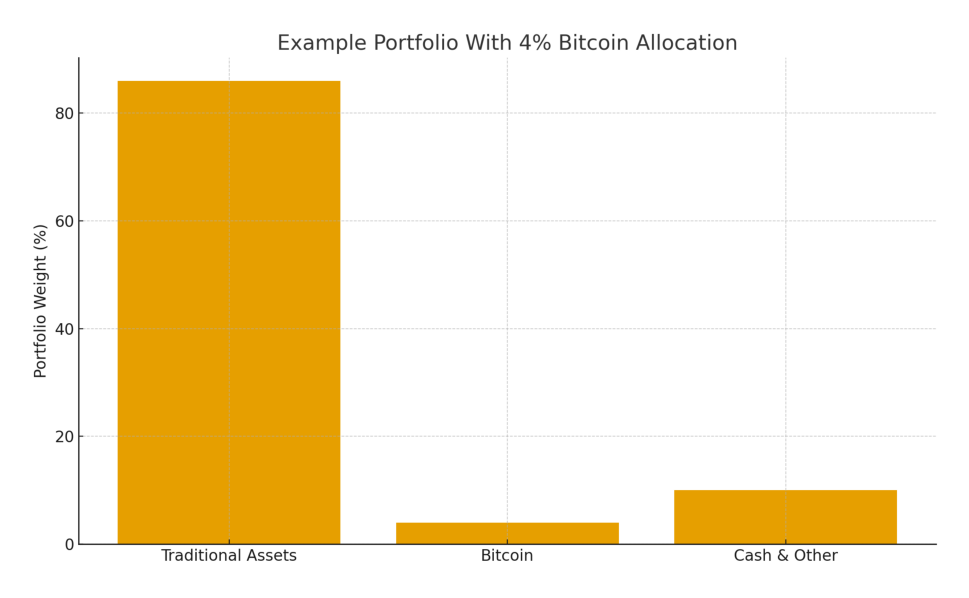
Alongside Vanguard’s shift, Bank of America (BofA) announced that its wealth management advisors will be allowed to recommend allocations of 1–4% to Bitcoin via spot ETFs starting in early January 2026.
This change applies to clients at:
- Merrill (formerly Merrill Lynch),
- Merrill Edge,
- Bank of America Private Bank.
Previously, most large US wealth platforms either:
- Prohibited advisors from initiating crypto exposure, or
- Allowed only passive client-initiated trading with limited guidance.
BofA’s move means that, for eligible investors:
- Bitcoin will be treated like any other high-volatility, high-growth asset within a diversified portfolio.
- Formal research, model portfolios, and risk frameworks can now include Bitcoin allocations explicitly.
- Advisors may use 1–4% BTC weights as a standard tool to enhance return potential or hedge against certain macro scenarios.
For readers who are actively searching for new income sources and practical blockchain use, this matters because:
- More regulated, yield-oriented products (like covered-call Bitcoin ETFs or structured notes on Bitcoin ETFs) are likely to appear, targeting this 1–4% allocation bucket.
- The cost of capital for crypto projects and infrastructure could decline as large institutions grow more comfortable with the asset class.
4. The Japan Yield Shock: A Macro Risk Hanging Over Bitcoin
While institutional news is strongly bullish, the macro backdrop is more complicated.
The 10-year Japanese Government Bond (JGB) yield has climbed to around 1.86–1.88%, levels not seen since 2008, as markets anticipate possible further tightening by the Bank of Japan (BOJ).
Why does this matter for Bitcoin?
- Capital flows: Higher domestic yields in Japan can pull money back into JGBs from global risk assets. Japanese institutions and households have historically been large investors in overseas bonds and stocks.
- Risk-off shocks: When JGB yields spike, global markets can experience sharp risk-off moves, with equities, high-yield credit, and risk assets like Bitcoin sold to reduce leverage.
- Leverage sensitivity in Asia: Major crypto exchanges that serve Asian clients, including those offering up to 50x leverage, are particularly sensitive to FX and funding shifts in yen (JPY) and yuan (CNY). If funding conditions tighten or volatility spikes, forced liquidations can cascade through crypto markets.
Some macro strategists argue that Bitcoin may be leading risk-off signals: BTC weakness has sometimes preceded corrections in major equity indices like the S&P 500. If that pattern holds, further JGB shocks could trigger another leg down in risk assets, including crypto.
For active traders, this means:
- Respect the $80,000–$85,000 support zone, but do not treat it as unbreakable.
- Monitor BOJ meetings, JGB yields, and USD/JPY as key risk indicators.
- Be careful with leverage, especially on platforms heavily exposed to Asian funding flows.
5. Derivatives Point to a “Short Vol, Long Upside” Market
The original article highlights insights from professional derivatives desks:
- Traders are selling put options around the $80,000–$85,000 zone (earning premium while expressing confidence that BTC will stay above or not spend much time below that range).
- At the same time, they are buying longer-dated call options further out, positioning for potential upside into 2026.
This combination implies a market that is:
- Short volatility in the near term – expecting sideways-to-up price action and willing to sell downside insurance.
- Long convexity in the long term – anticipating that if Bitcoin breaks higher, it could move sharply (for example, into the $100,000+ region) and wanting exposure to that tail.
For investors looking for income strategies, this environment can support:
- Covered call strategies on Bitcoin and Ethereum (selling calls against spot holdings to generate yield).
- Cash-secured put selling at levels where you are genuinely happy to accumulate BTC (e.g., $80,000–$85,000), accepting the risk of being assigned if price falls.
However, these are advanced strategies with real downside risk. They should be approached cautiously and usually within a regulated platform that clearly discloses margin and collateral requirements.
6. Beyond Bitcoin: Opportunities in ETH, SOL, XRP, DOGE and the “Next Trade”
While Bitcoin remains the clear leader, altcoins are moving with it:
- ETH rebounded above $3,000, supported by spot ETH ETFs in markets where they are approved and by the ongoing narrative of Ethereum as settlement and execution infrastructure for DeFi and tokenization.
- SOL continues to act as a high-beta layer-1, often amplifying Bitcoin’s moves both up and down. Its ecosystem benefits from NFT activity, fast finality, and growing DeFi liquidity.
- XRP remains tied to the theme of cross-border payments and remittances, with ongoing interest from traders whenever regulatory or banking-related headlines emerge.
- DOGE still trades largely as speculative meme beta, moving aggressively during periods of retail excitement.
Data from multiple news and analytics sites indicate that during the latest rebound:
- BTC led the charge, but XRP and SOL posted 7–10% daily gains,
- Trading volumes in perpetual futures and options picked up across major exchanges,
- Retail interest, especially in “next 100x crypto” narratives, surged again once BTC reclaimed the $90,000 area.
For readers hunting new assets and sources of yield, a few high-level approaches stand out:
- Core + Satellite:
- Core: Bitcoin and Ethereum via spot holdings or ETFs.
- Satellite: A small allocation to high-conviction altcoins (SOL, key DeFi/L2 tokens) based on technology, developer traction, and real usage.
- Practical Use Cases:
- Tokens tied to stablecoin infrastructure, cross-border payments, or tokenized real-world assets (RWA) can generate fee revenue and on-chain cash flows.
- Some protocols share fees or buy back tokens using protocol revenue, effectively creating an income-like profile for token holders (though with very high risk and complexity).
- Risk Layering:
- Start from spot and simple ETF exposure, build understanding of the ecosystem, then cautiously layer more complex strategies (staking, restaking, options) as your risk tolerance and technical competence grow.
7. Practical Blockchain Utilization: Where the Real-World Value Is Emerging
From a practical, business-focused perspective, the most interesting blockchain use cases in this environment include:
- Global Payments and Settlement:
Networks like Bitcoin (via Lightning or L2 solutions), Ethereum, and XRP are being used or tested for faster, cheaper cross-border transfers, remittance rails, and treasury operations. - Tokenized Assets and Collateral:
Ethereum and EVM-compatible chains are increasingly used to tokenize fiat, treasuries, credit, and other real-world collateral, allowing global investors to access these assets 24/7 with programmable settlement. - On-Chain Market Making and RFQ (Request-for-Quote) Systems:
OTC desks and professional traders use blockchain rails for instant settlement of large trades, reducing counterparty risk. - Yield from Real Economic Activity:
Some protocols generate yield from lending to businesses, factoring invoices, or financing inventory, and then pass a portion of that income to token or LP holders. These are still early and risky, but they move beyond pure speculation.
In the context of Vanguard and BofA entering the picture, these practical use cases matter because they:
- Make it easier for conservative allocators to justify exposure: they are not betting only on “number go up,” but on infrastructure that supports real economic transactions.
- Create a bridge from traditional finance (TradFi) to decentralized finance (DeFi), with Bitcoin and Ethereum ETFs acting as the first “on-ramp” into a broader universe of blockchain-based products.
8. Conclusion: A Market at the Crossroads of Maturity and Volatility
Bitcoin’s return to the $91,000 region after a sharp dip below $84,000 shows that this market is still volatile, but increasingly supported by institutional flows and sophisticated derivatives positioning.
On the bullish side:
- Vanguard’s policy reversal opens crypto ETF access to tens of millions of conservative investors and trillions of dollars in capital.
- Bank of America’s 1–4% Bitcoin allocation guidance signals that BTC is becoming a normalized component of wealth portfolios, not just a fringe speculation.
- Options markets suggest that professional traders are comfortable seeing $80,000–$85,000 as a support band while betting on higher prices in 2026.
On the risk side:
- Rising Japanese bond yields and broader macro uncertainties could trigger renewed risk-off waves, hitting leveraged crypto positions and pushing BTC back to or even below that support zone.
- Altcoin rallies can still overextend quickly, and liquidity can vanish just as fast as it appears.
For readers looking for new assets, new income streams, and practical blockchain use:
- Treat Bitcoin and Ethereum ETFs/spot holdings as your core, with position sizes tied to your risk tolerance (for many, that might be in the 1–4% range highlighted by large banks).
- Add targeted exposure to high-conviction altcoins and real-world use-case projects as a smaller, higher-risk satellite.
- Explore income strategies (staking, lending, covered calls, cash-secured puts) only after understanding their risks, margin requirements, and potential for loss in a stress scenario.
The story of this rebound is not just that Bitcoin survived another dip. It is that, even as macro clouds gather, the infrastructure around Bitcoin is maturing: ETFs, major asset managers, and large banks are starting to treat crypto as a serious, allocatable asset class. For investors who can navigate the volatility, this combination of institutional adoption and practical utility may define the next generation of opportunities in digital assets.
