
Main Points :
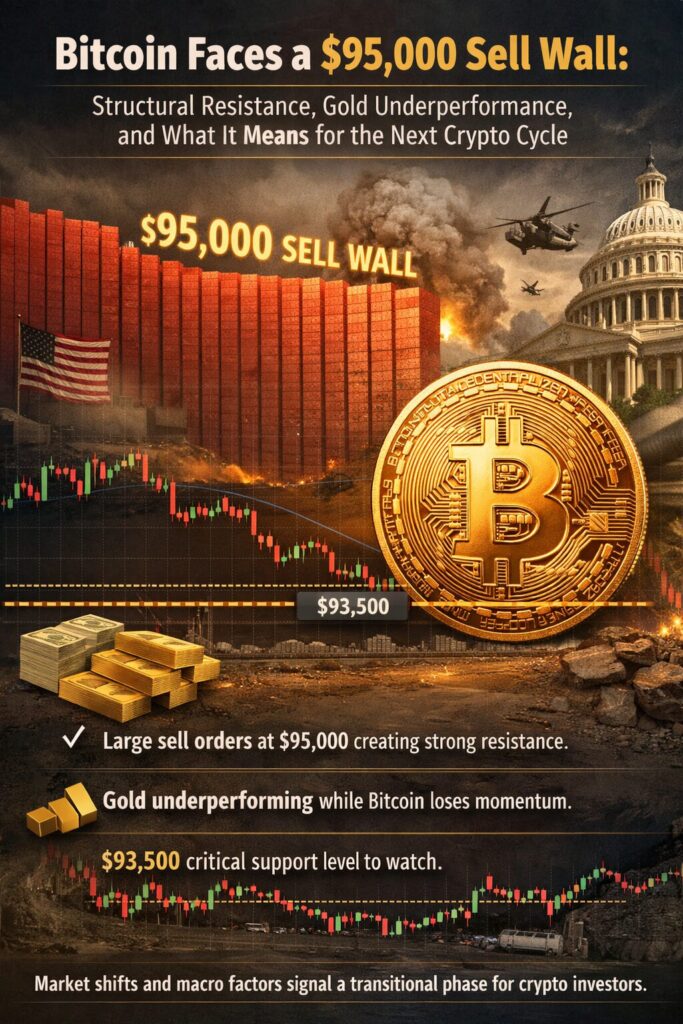
- Bitcoin is facing a major sell wall around $95,000, where large passive sellers are consistently absorbing buying pressure.
- Short-term price action shows weakening momentum relative to both risk assets and precious metals, particularly gold.
- Despite near-term exhaustion, weekly structure remains intact, with $93,500 as a critical weekly close level.
- Macro factors—including US equities, geopolitical tensions, and shifting crypto regulation narratives—are reshaping market correlations.
- For investors seeking new crypto assets, income opportunities, and practical blockchain use cases, this phase represents a structural transition rather than a simple bull or bear signal.
1. Bitcoin’s Struggle at $95,000: Understanding the Sell Wall
Bitcoin entered the US trading session on Tuesday struggling to extend its rebound, as market attention focused sharply on the $95,000 level. According to TradingView data, BTC/USD reached an intraday high of $94,800, marking its highest price since November 17, before momentum stalled.
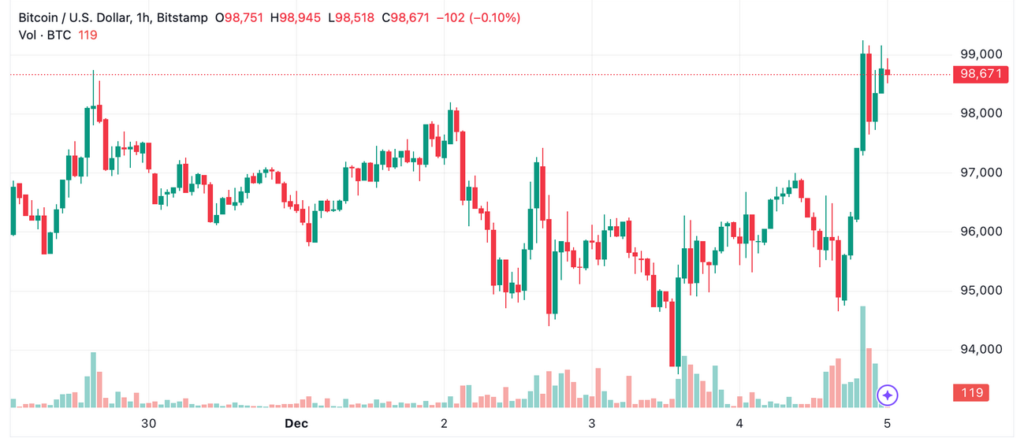
This price behavior is not merely psychological. Market participants observed significant sell-side liquidity clustered around $95,000, creating what traders commonly refer to as a “sell wall.” These large resting orders effectively cap upward price movement unless buyers bring sufficient volume to absorb them.
Trader Skew noted in an analysis shared on X that market data is beginning to display unstable behavior at this level. He identified the presence of passive sellers around $94,000, entities that continuously place sell orders as price rises, rather than reacting dynamically. This behavior often indicates distribution rather than speculative shorting.
According to Skew, during the second approach toward $94,000:
- Long positions begin to unwind cautiously.
- Late short sellers start building positions.
- Liquidity becomes fragmented, leading to exhausting, low-efficiency trading sessions.
Such conditions often precede either a sharp breakout (if liquidity is absorbed) or a decisive rejection.
2. Order Books, Liquidation Heatmaps, and Market Microstructure
Beyond price charts, order-book data reinforces the structural nature of this resistance. Analysts examining spot order books—particularly on major exchanges—have pointed out dense sell orders stacked at $95,000.
Market commentator Exit Pump emphasized that this level represents a decisive battleground:
“There is a large spot sell wall at $95,000. Today will determine whether price breaks through or gets rejected.”
Meanwhile, liquidation heatmaps indicate limited forced-liquidation fuel above current prices, suggesting that a clean breakout would require genuine spot demand rather than leverage-driven momentum.
This matters especially for institutional or semi-institutional participants. Without cascading liquidations, price must move through organic accumulation, which is slower but structurally healthier.
3. Macro Context: Risk Assets Rise, Bitcoin Lags Gol
While Bitcoin struggled, traditional markets told a different story. US equities maintained upward momentum, while precious metals surged amid geopolitical uncertainty.
Gold climbed to approximately $4,491 per ounce, and silver reclaimed levels above $80. These moves were driven partly by geopolitical developments involving Venezuela and broader risk-hedging behavior.
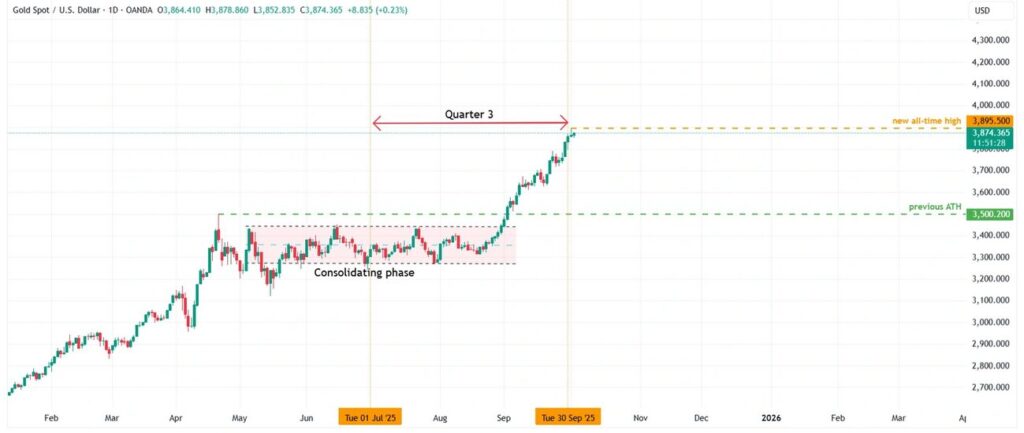
In contrast, Bitcoin underperformed gold on an intraday basis, signaling a temporary shift in market preference toward hard-asset hedges rather than digital risk proxies.
A comparative BTC/XAU chart highlights this divergence clearly. Bitcoin, often positioned as “digital gold,” failed to keep pace with physical gold during this risk-off moment.
4. Correlation Regimes and the QCP Capital Perspective
In its latest Asia Color report, trading firm QCP Capital noted that cryptocurrencies have recently re-synchronized with broader risk assets.
According to QCP:
- Strengthening year-start bullish narratives.
- The fading impact of year-end tax-loss selling.
- Anticipation of upcoming crypto-related legislation.
Together, these factors may suggest a regime shift, where crypto trades more like high-beta risk assets rather than a standalone macro hedge.
However, QCP also cautioned that much of this optimism may already be priced in. In that context, geopolitical shocks—particularly those emerging from Washington—could act as short-term catalysts for Bitcoin, but not necessarily guarantee sustained upside.
5. The Critical Weekly Level: Why $93,500 Matters
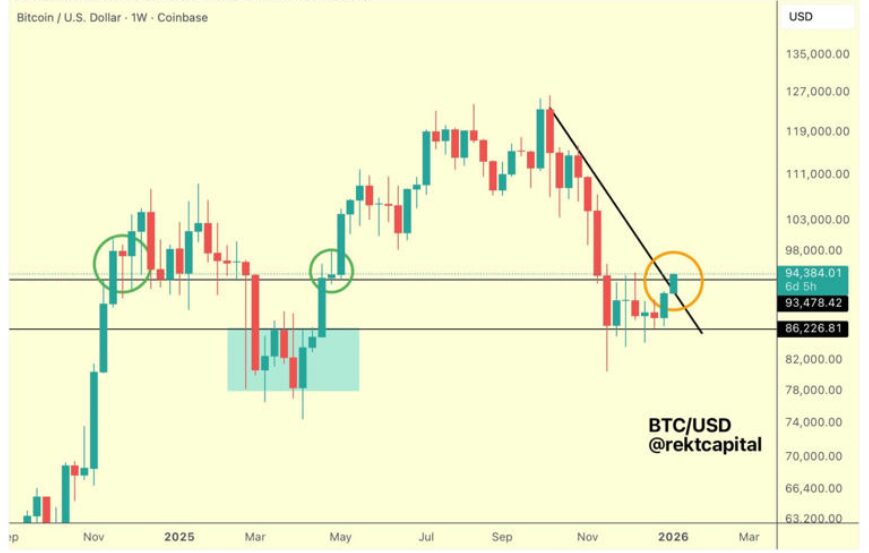
From a medium-term perspective, trader and analyst Rekt Capital introduced a more constructive view. He observed that Bitcoin successfully defended the lower boundary of its weekly range.
However, he stressed that the market must achieve a weekly close above $93,500, which also corresponds to early-2025 levels.
Such a close would:
- Confirm a breakout from the current range.
- Mark the end of the weekly downtrend that began in mid-October 2025.
- Reinforce a medium-term bullish bias.
Importantly, Rekt Capital emphasized that holding $93,500 as support is the foundational condition for maintaining constructive market structure.
6. What This Means for Investors and Builders
For readers searching for new crypto assets, emerging revenue models, or practical blockchain applications, this phase is best understood as a structural digestion period.
Key implications include:
- Momentum alone is insufficient: Markets are increasingly rewarding real liquidity, revenue, and usage.
- Correlation awareness matters: Bitcoin’s behavior relative to equities and gold offers clues about broader capital flows.
- Infrastructure and yield narratives are gaining importance: Beyond price, attention is shifting to on-chain activity, payments, and regulated financial integration.
This environment favors disciplined accumulation, strategic allocation, and a focus on utility-driven crypto ecosystems rather than purely speculative rotations.
Conclusion: Resistance Today, Structure Tomorrow
Bitcoin’s struggle at $95,000 is not a sign of systemic weakness, but rather evidence of large-scale distribution and cautious positioning at elevated levels. The underperformance against gold highlights shifting macro preferences, while the defense of weekly support underscores resilience beneath the surface.
Whether Bitcoin breaks higher or consolidates further will depend less on sentiment and more on liquidity absorption, macro alignment, and structural demand.
For long-term participants, this moment represents neither euphoria nor capitulation—but a transition phase that often precedes the next meaningful trend.
