
Main Points :
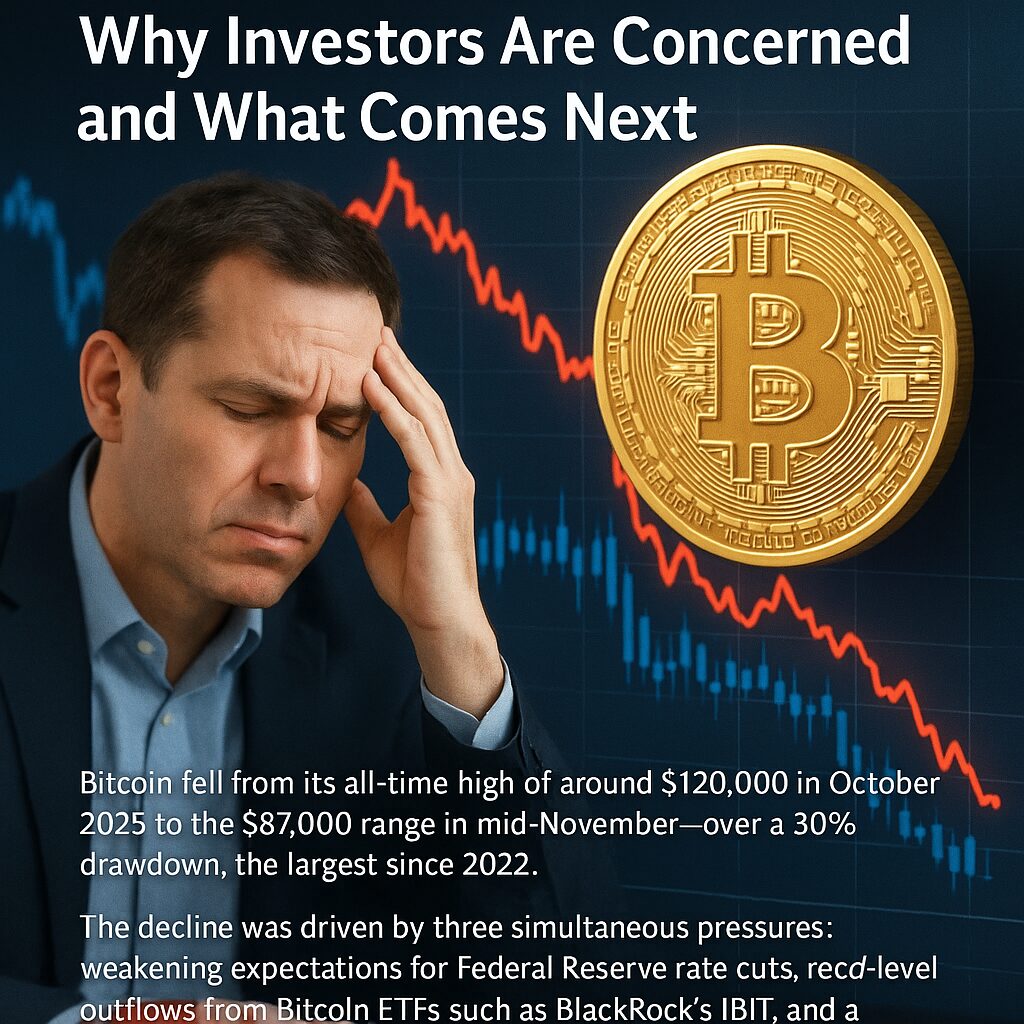
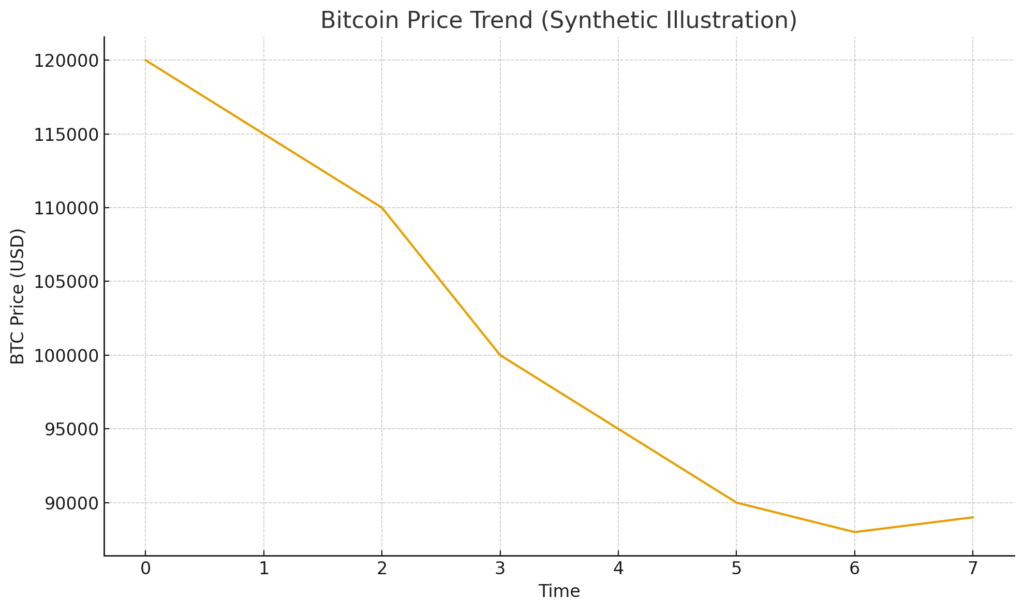
- Bitcoin fell from its all-time high of around $120,000 in October 2025 to the $87,000 range in mid-November—over a 30% drawdown, the largest since 2022.
- The decline was driven by three simultaneous pressures: weakening expectations for Federal Reserve rate cuts, record-level outflows from Bitcoin ETFs such as BlackRock’s IBIT, and a cascade of technical selling as key support levels broke.
- Despite short-term volatility, long-term investors—including institutions—are viewing this as a major cyclical correction, not the end of the broader uptrend.
1. What Is Happening to Bitcoin: A Clear Breakdown of the Sub-$90k Drop
Bitcoin’s sharp decline in November 2025 caught many investors off guard. After hitting a historic peak above $120,000 in October, optimism surged and media narratives centered on Bitcoin’s role as a macro hedge and institutional asset. But sentiment shifted dramatically within weeks.
By November 18, Bitcoin fell briefly below $90,000, touching the $87,000 zone—its lowest level in over seven months. The speed of the drop intensified fear, especially among short-term traders and leveraged positions.
Price Movement and Sentiment Shift
- Early October: Bitcoin surged to $120,000, supported by expectations of pro-crypto policy, institutional adoption, and strong ETF inflows.
- Late October – Early November: U.S. long-term yields rose, global risk sentiment deteriorated, and equities corrected. Bitcoin, being a high-beta risk asset, followed.
- Mid-November: BTC plunged to the high-$80,000 range, breaking critical psychological levels and triggering widespread liquidations.
- Following Days: Prices stabilized between $87,000–90,000 as long-term holders and institutions began accumulating again.
This volatility created an atmosphere where many retail investors “could not bear looking at the chart,” a phenomenon common in deep corrective phases of every Bitcoin market cycle.
2. Why Bitcoin Crashed: The Triple Pressure of Macro, ETFs, and Technicals
The 2025 correction is not the result of one factor—it is the convergence of three powerful forces.
2-1. Macro: Fading Expectations for Fed Rate Cuts
Throughout early 2025, markets priced in aggressive rate cuts by the U.S. Federal Reserve. But stronger-than-expected economic data pushed these expectations back.
Key impacts:
- Higher interest rates reduce the attractiveness of risk assets like cryptocurrencies.
- Investors shifted toward safer instruments, pressuring equities and Bitcoin simultaneously.
- Bitcoin’s steep rally created a crowded positioning, making it vulnerable to sudden reversals.
In short, macro conditions formed the groundwork for a broad risk-off environment.
2-2. ETF Outflows: BlackRock’s IBIT Sees Record Withdrawals
One of the strongest bull drivers earlier in the year—ETF inflows—briefly turned into a headwind.
Notable developments:
- BlackRock’s IBIT recorded over $500 million in net outflows in a single day.
- Outflows translate into real Bitcoin selling pressure, as custodians must liquidate BTC to meet redemptions.
- The narrative that “as long as ETFs keep buying, the price will rise indefinitely” broke down.
This reversal cooled market optimism and highlighted that ETF flows can amplify both rallies and corrections.
2-3. Technical Breakdown: Support Levels Triggered a Cascade of Stops
As Bitcoin slid toward $93,000 and then $90,000, automated selling intensified.
Key signals:
- Multiple support levels broke in succession.
- Stop-loss orders and margin liquidations created forced selling, deepening the drop.
- RSI fell into the 20s, signaling oversold conditions, yet short-term traders continued to unwind risk.
Analysts now highlight $80,000–74,000 as the next major support zone—levels that may attract institutional bids if tested.
3. What Individual Investors Should Do During a Sharp Decline
For most investors, the right question is not “Why did Bitcoin fall?” but rather “How should I respond to increased volatility?”
3-1. Actions to Avoid Immediately
- Increasing leverage to “win back losses.”
- Emotional averaging-down without proper sizing rules.
- Trading based solely on hype or social media sentiment.
These behaviors have historically caused catastrophic losses during accelerated downtrends.
3-2. Three Core Principles to Follow
1. Keep leverage minimal
Beginners and intermediate investors should either avoid leverage entirely or limit it to 1–2x.
2. Use time-based diversification
Avoid lump-sum buying. Instead, invest gradually over weeks or months to reduce timing risks.
3. Manage risk at the portfolio level
Rather than concentrating entirely in Bitcoin:
- Hold cash
- Include bonds or equities
- Predetermine your maximum allowable drawdown
This avoids emotional decisions and maintains long-term stability.
3-3. Practical Step-by-Step Approach
- List all current positions and unrealized P/L.
- Define the maximum acceptable loss in dollar terms.
- Trim positions exceeding your risk limits.
- Establish a recurring buy strategy with fixed amounts and frequencies.
- Execute your plan mechanically—not emotionally.
In high-volatility markets like Bitcoin, rules matter more than predictions.
4. Exchange Selection: Why It Matters More During Volatility
Choosing the right exchange becomes essential when markets turn unstable.
4-1. Start With a Needs Assessment
Ask yourself:
- Do you trade frequently or invest long-term?
- Do you need advanced tools or simple UI?
- How important are fees and liquidity?
4-2. Critical Factors When Evaluating an Exchange
- Security measures (cold wallets, audits, monitoring).
- Fee structure (maker/taker, withdrawal costs).
- Asset variety (especially new altcoins and stablecoins).
- Regulatory compliance (especially crucial for global users).
- Mobile app quality and user experience.
5. Frequently Asked Question
Q1: Did regulations cause Bitcoin to crash below $90k?
No. There were no significant regulatory changes during the decline. The drop was driven mainly by macro and market-based factors.
Q2: During a sell-off, which costs should investors pay attention to?
Exchange fees, spread costs, and funding rates for leveraged positions.
Q3: What are the minimum security checks?
Two-factor authentication, withdrawal whitelisting, and strong custody frameworks.
Q4: Is now a good time for beginners to start investing?
Yes—if they use time-diversified purchasing and avoid leverage.
6. Conclusion: Discipline Over Emotion
The sub-$90,000 drop is dramatic, but it fits a historical pattern seen in every major Bitcoin cycle: rapid ascents followed by deep corrections.
For long-term investors, the key is not to predict the exact bottom but to:
- Maintain disciplined rules
- Spread risk over time
- Ensure proper asset allocation
- Use regulated, secure platforms
Corrections are difficult but also create opportunity—especially for readers seeking new digital assets, income streams, or emerging blockchain applications.
