
Key Takeaways :
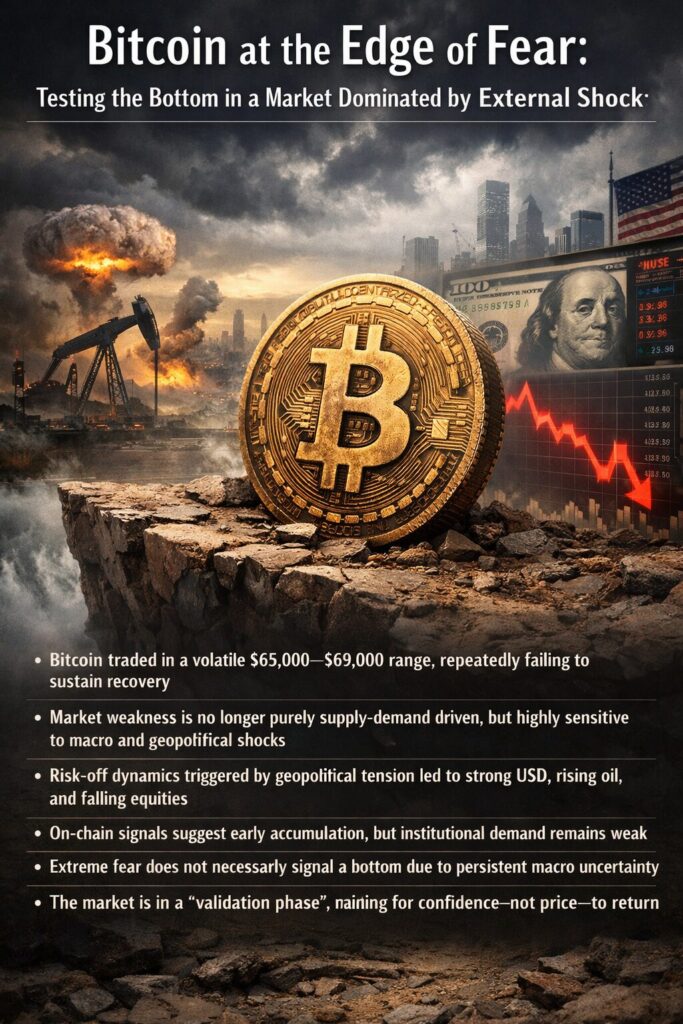
- Bitcoin traded in a volatile $65,000–$69,000 range, repeatedly failing to sustain recovery
- Market weakness is no longer purely supply-demand driven, but highly sensitive to macro and geopolitical shocks
- Risk-off dynamics triggered by geopolitical tension led to strong USD, rising oil, and falling equities
- On-chain signals suggest early accumulation, but institutional demand remains weak
- Extreme fear does not necessarily signal a bottom due to persistent macro uncertainty
- The market is in a “validation phase”, waiting for confidence—not price—to return
1. Market Overview: A Range-Bound but Fragile Structure
The past week in the Bitcoin market can best be described as a collision between extreme fear and external macro shocks. Prices oscillated within a relatively tight range of $65,000 to $69,000, yet the underlying structure revealed significant fragility.
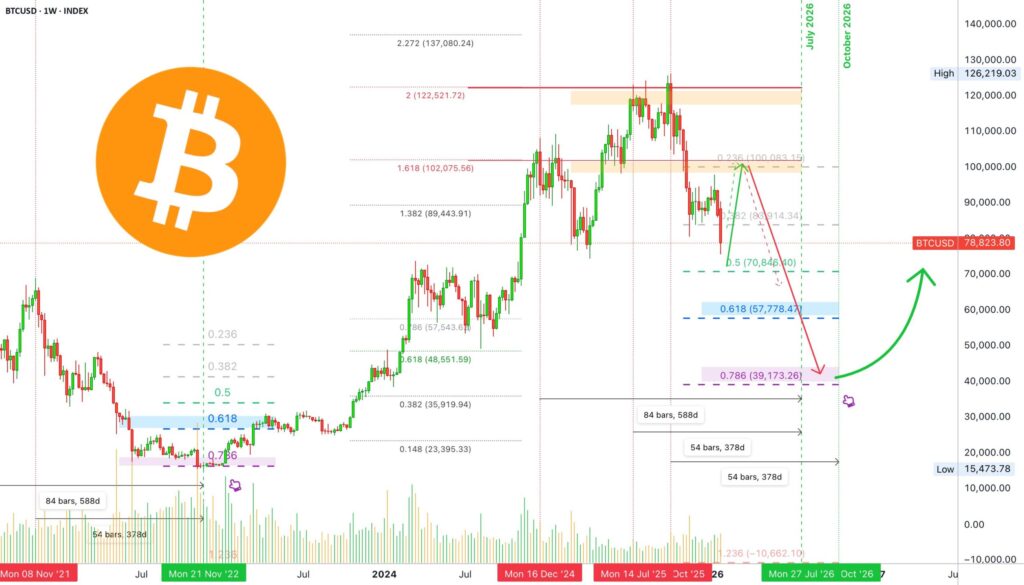
Despite intermittent rebounds, each upward movement was met with persistent selling pressure. This created a defining pattern: a market capable of bouncing, but incapable of sustaining recovery.
Such behavior typically signals one of two things:
- Strong distribution at higher levels
- Lack of conviction from buyers
In this case, evidence points to both.
2. The Real Shift: From Supply-Demand to External Shock Sensitivity
The most critical transformation this week was not in price action itself, but in what is driving it.
Historically, Bitcoin markets have been influenced heavily by:
- Liquidity cycles
- Halving narratives
- On-chain accumulation/distribution
However, this week revealed something more concerning:
the market is increasingly reactive to external macro events.
A key trigger was geopolitical tension linked to statements from Donald Trump regarding potential military action in Iran.
This single narrative shift disrupted prior assumptions of near-term stabilization and triggered a cascade of reactions across global markets.
3. The Risk-Off Chain Reaction
Following the geopolitical escalation, markets exhibited a textbook risk-off response:
- Oil prices surged
- The U.S. dollar strengthened
- Equity markets declined
- Crypto assets experienced accelerated selling
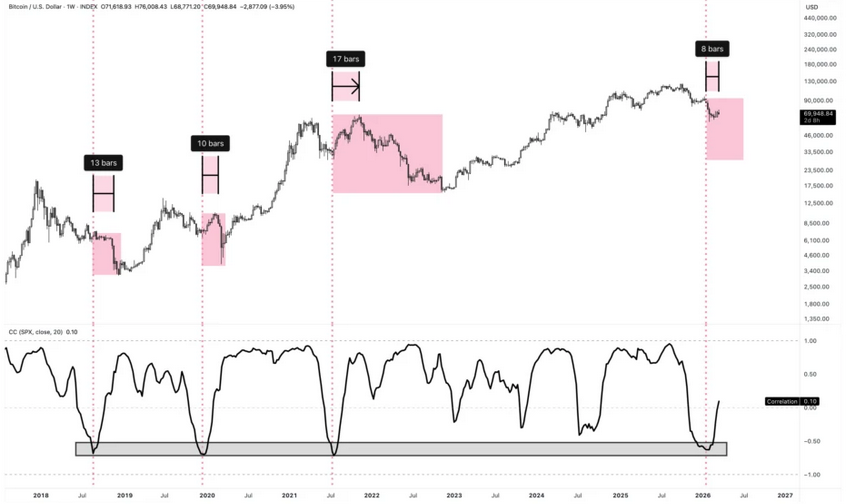
What is crucial here is not the direction of Bitcoin alone, but its correlation behavior.
Bitcoin did not act as a hedge.
It behaved like a high-beta risk asset, declining alongside equities.
This reinforces a key structural reality:
Bitcoin is still treated as a risk asset under macro stress—not a safe haven.
4. Derivatives Market: The Hidden Driver of Volatility
While spot prices showed moderate fluctuations, the derivatives market told a more dramatic story.
Large-scale liquidations and rapid unwinding of leveraged positions amplified market moves. In many cases:
- Price declines were secondary effects
- The primary driver was forced deleveraging
This distinction is important because it implies that:
- The market is structurally unstable
- Liquidity conditions are fragile
- Volatility can re-emerge quickly
5. On-Chain Signals: Early Bottom Formation?
Despite the negative macro backdrop, on-chain data provides a more nuanced view.
Positive signals:
- Slowing sell pressure
- Whale accumulation increasing
- Long-term holders maintaining positions
Negative signals:
- Weak ETF inflows
- Persistent negative Coinbase Premium
- Lack of strong spot demand recovery
This creates a dual-structure market:
| Group | Behavior |
|---|---|
| Long-term capital | Accumulating at lower prices |
| Short-term / risk-sensitive capital | Staying sidelined |
This division explains the current price behavior:
accumulation without momentum.
6. The Nature of Fear: Different from Past Cycles
Market sentiment has entered extreme pessimism. However, the quality of fear is fundamentally different from previous bear markets.
In typical downturns:
- Fear is driven by price decline
In the current environment:
- Fear is driven by uncertainty (macro + geopolitical)
This distinction matters because:
Fear driven by uncertainty is more persistent and less reactive to price recovery.
As a result, investors are:
- More cautious
- Slower to re-enter
- Less willing to “buy the dip”
7. Macro Constraints: The Invisible Ceiling
The broader macro environment continues to impose strong constraints:
- Rising oil prices → inflation concerns
- Elevated interest rates → reduced liquidity
- Strong USD → capital outflow from risk assets
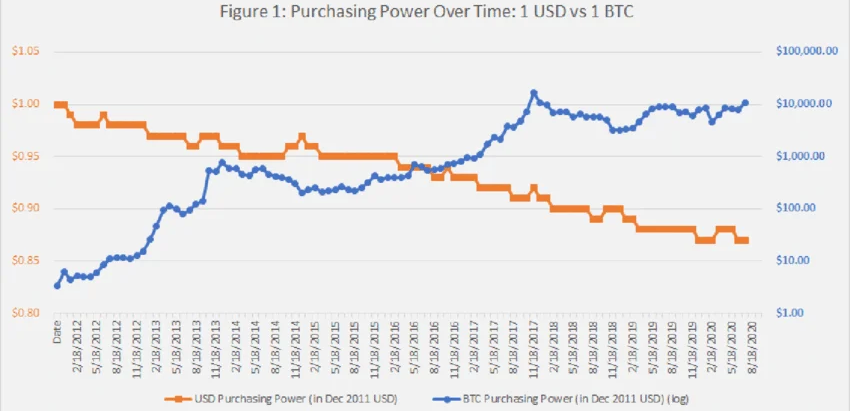
Under these conditions, Bitcoin faces a structural disadvantage:
- It competes with high-yield traditional assets
- It lacks immediate macro catalysts
- It remains sensitive to global capital flows
8. What to Watch Next: Signals of Market Recovery
The next phase of the market depends on whether control shifts back from external factors to internal dynamics.
Three key indicators to monitor:
1. ETF Flows
Sustained inflows would signal renewed institutional confidence.
2. Coinbase Premium
A return to positive territory would indicate strong U.S. spot demand.
3. Quality of Volume
Recovery must be driven by:
- Spot buying
- Not leveraged speculation
Without these signals, rallies risk becoming:
short-lived relief bounces rather than trend reversals.
9. The Misconception of “Peak Fear = Bottom”
A common assumption in crypto markets is:
Extreme fear marks the bottom.
However, this cycle challenges that narrative.
Because fear is externally driven:
- It can reappear repeatedly
- It is not resolved by price stabilization alone
Thus:
multiple retests of the bottom are possible.
10. Conclusion: A Market Waiting for Trust, Not Price
The Bitcoin market is currently in a rare state where:
- Supply-side exhaustion is forming
- But macro uncertainty prevents recovery
This creates an unstable equilibrium:
- Technically oversold
- Structurally fragile
The key takeaway is:
The next breakout will not be driven by price—it will be driven by the restoration of trust.
Until then, the market remains in a “bottom validation phase”, where:
- Every rally is tested
- Every narrative is fragile
- Every recovery is uncertain
