

Key Takeaways :
- Prediction markets now assign a 34% probability that Bitcoin will fall below $85,000 by the end of January, reflecting growing macro and geopolitical uncertainty.
- Bitcoin derivatives activity has fallen more than 43%, while the long/short ratio has dropped below 1, signaling short-term bearish positioning.
- Technical indicators suggest downside risk remains dominant, with $87,500 and $85,000 acting as critical support levels.
- Expectations that the Federal Reserve will pause rate hikes (95% probability) are not translating into immediate bullish momentum for crypto.
- For investors and builders, this phase highlights the importance of capital efficiency, risk management, and real-world blockchain use cases, not just price speculation.
1. Market Context: Bitcoin Slips Below $90,000 Amid Policy Uncertainty
As of January 22, Bitcoin has been trading below the psychologically important $90,000 level, reflecting a noticeable deterioration in short-term market sentiment. The pullback comes despite expectations that the U.S. Federal Reserve will hold interest rates steady at its January 28 Federal Open Market Committee (FOMC) meeting.
Ordinarily, a pause in rate hikes would be interpreted as supportive for risk assets, including cryptocurrencies. However, the current environment is shaped by a more complex mix of factors: delayed inflation data releases, geopolitical tensions highlighted during the World Economic Forum in Davos, and declining leverage across crypto derivatives markets.
According to data from the U.S. Bureau of Economic Analysis, core Personal Consumption Expenditures (PCE) inflation rose 2.8% year-over-year and 0.2% month-over-month, in line with expectations despite disruptions caused by an extended U.S. government shutdown. Former Kansas City Fed President Esther George noted that inflation appears stagnant while consumer spending remains resilient, making policy direction difficult to interpret.
This ambiguity has translated into hesitation across speculative markets, including Bitcoin.
2. Federal Reserve Expectations: A Pause That Fails to Ignite Risk Appetite
Real-time data from CME’s FedWatch tool suggests a 95% probability that the Federal Reserve will keep rates unchanged in the 3.50%–3.75% range at the upcoming meeting. Only 5% of analysts expect a rate cut to 3.25%–3.50%.
While this confirms that monetary tightening is likely on hold, it does not yet signal a full pivot toward easing. For crypto markets, this distinction matters. Bitcoin has historically benefited most not from pauses, but from clear transitions toward liquidity expansion.
As a result, traders appear reluctant to rebuild leveraged long positions, preferring capital preservation over directional bets.
3. Prediction Markets Signal Growing Downside Risk
One of the clearest signals of shifting sentiment comes from prediction markets. On Polymarket, more than $52 million has been wagered on Bitcoin’s price outcome for January.
The probability that Bitcoin will trade below $85,000 by month-end has surged from 15% to 34% within a week. Over $4.5 million is already positioned on this bearish outcome alone.
Prediction markets often reflect collective expectations more efficiently than traditional surveys, especially during periods of uncertainty. The sharp repricing suggests that traders are actively hedging against downside scenarios rather than positioning for immediate upside.
This behavior aligns closely with what is happening in derivatives markets.
4. Derivatives Data: Leverage Is Being Taken Off the Table
Data from Coinglass shows that Bitcoin futures trading volume has dropped 43.11% to approximately $59.22 billion, while open interest has declined slightly to $60.12 billion.
This combination—falling volume and declining open interest—indicates that traders are closing positions rather than rotating capital into new leverage. It is a classic sign of defensive positioning.
Furthermore, the 24-hour long/short ratio has fallen to 0.9685, meaning that short positions now slightly outweigh longs. While not extreme, this imbalance confirms that intraday traders are leaning bearish.
In practical terms, the market is signaling that participants expect volatility with downside bias, rather than a sharp rebound.
[Bitcoin Derivatives Volume and Open Interest Decline]
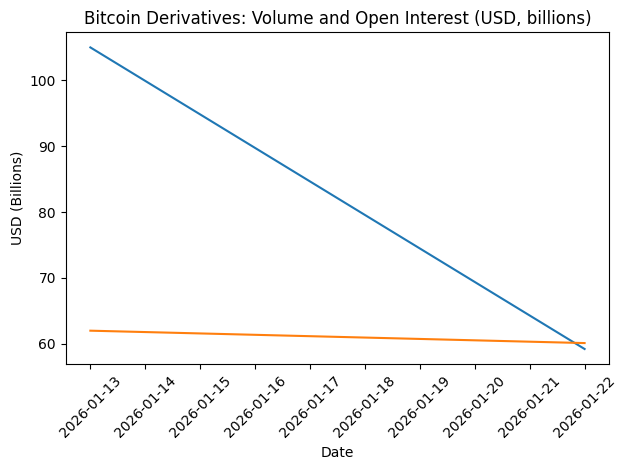
(Image description: A dual-axis chart showing Bitcoin futures trading volume declining by over 40% alongside a modest reduction in open interest, highlighting deleveraging behavior.)
5. Technical Analysis: Rising Wedge Breakdown and Key Support Levels
From a technical perspective, Bitcoin remains vulnerable. The price has failed to reclaim the $92,000–$92,500 resistance zone, reinforcing the bearish structure on the daily chart.
Bitcoin has been trading within a rising wedge pattern, which historically resolves to the downside when bullish momentum weakens. Breakout probability indicators currently assign roughly 60% likelihood to a downside move, compared to only 27% for upside continuation.
Bollinger Bands based on the 20-day simple moving average show Bitcoin trading below the mid-band near $92,300, with the lower band around $87,500 acting as immediate support. Sustained closes below the mid-band typically confirm seller dominance.
Momentum indicators reinforce this view. The Relative Strength Index (RSI-14) remains near 43, well below the neutral 50 level, suggesting ongoing distribution rather than accumulation.
[Bitcoin Daily Chart with Rising Wedge and Support Levels]
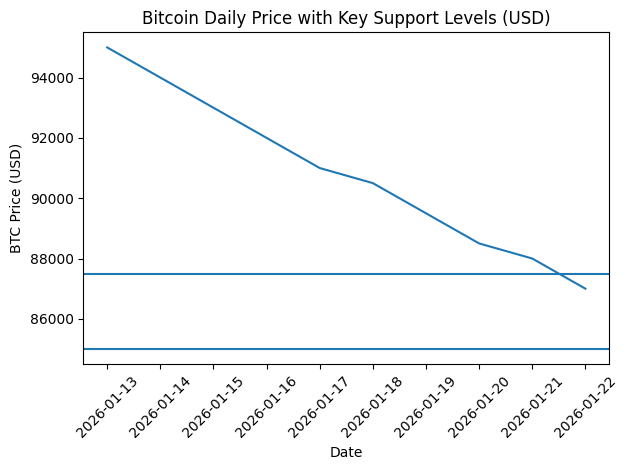
(Image description: A daily Bitcoin price chart highlighting the rising wedge structure, RSI below 50, and key support zones at $87,500 and $85,000.)
6. The $85,000 Level: Psychological and Structural Importance
If selling pressure accelerates and Bitcoin decisively breaks below $87,500, attention will quickly shift to $85,000, a level already heavily priced into prediction markets.
A daily close below $85,000 would expose Bitcoin to a deeper pullback toward the $80,000–$82,000 demand zone, where prior accumulation occurred. This zone is likely to attract long-term buyers, but short-term volatility could be severe.
Conversely, a strong recovery above $92,500 on high volume would invalidate the bearish setup and reopen upside targets at $97,000 and eventually $100,000. Until that happens, downside risks dominate.
7. Implications for Investors and Builders
For readers seeking new crypto assets, yield opportunities, or practical blockchain applications, this market phase offers important lessons:
- Speculation-driven leverage is shrinking, favoring projects with real cash flows or utility.
- Treasury management, hedging, and capital efficiency are becoming competitive advantages.
- Infrastructure, payments, stablecoins, and compliance-oriented blockchain solutions are likely to outperform purely narrative-driven tokens.
Rather than signaling the end of Bitcoin’s broader cycle, this consolidation reflects a market recalibrating expectations in a higher-rate, geopolitically complex world.
Conclusion: Caution, Not Capitulation
Bitcoin’s struggle below $90,000 and the rising probability of a dip below $85,000 reflect caution rather than panic. Prediction markets, derivatives data, and technical indicators all point to a market that is de-risking while waiting for clearer macro signals.
For long-term participants, this environment rewards discipline over excitement. Whether Bitcoin ultimately breaks lower or stages a recovery, the current phase underscores a maturing market—one where risk management, fundamentals, and real-world adoption matter more than ever.
